2025-09-16
Visited : 2150
Researchers at ICN2 have co-led a study showing that adding salt to regular ice considerably boosts its ability to produce electricity when bent. The discovery could pave the way for new electronic devices or for generating power in extreme environments such as polar regions.
For centuries, humans have used water to generate energy, through water mills, hydroelectric power plants, and other examples. In contrast, ice has rarely been considered a source of power since, unlike piezoelectric materials, it cannot generate an electric charge when compressed. However, a team of researchers from ICN2, Xi’an Jiaotong University, and Stony Brook University has recently discovered that, despite not being piezoelectric, ice can generate electricity when unevenly deformed, thanks to a phenomenon known as flexoelectricity.
Building on this first discovery, the researchers have now achieved a new breakthrough: adding salt to ice significantly enhances its ability to generate electricity, opening up a wide range of potential technological applications.
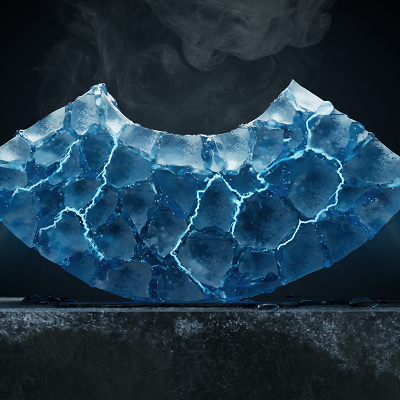
The study, published in Nature Materials, was led by Dr Xin Wen and supervised by ICREA Prof. Gustau Catalán, head of the ICN2 Oxide Nanophysics Group, and Prof. Shengping Shen from Xi’an Jiaotong University in Xi’an, China. Moreover, given the significance of this finding, the journal has featured an ilustration of this work as the cover for their last issue. Moreover, given the significance of this finding, the journal has featured an illustration of this work as the cover of its latest issue.
How does salt boost ice's electricity?
In the previously mentioned work, it was observed that pure ice generates electric charge when deformed. These levels are relatively low and insufficient to be used in electronic devices. However, the results of this second study showed that by adding common salt (NaCl) at a concentration of 25%, ice exhibits a flexoelectric coefficient 1,000 times higher than that of pure ice. In other words, its ability to generate electric charge is increased by a factor of 1,000, bringing it to the level of some piezoelectric materials currently used in electronics.
This phenomenon is explained by the flow of salty water along grain boundaries within the ice. When the material is bent, the water molecules and salt ions trapped between the ice crystals move from the compressed regions to the stretched regions. This movement generates an electric current, contributing to an enhanced flexoelectric response of the ice.
Based on this principle, the researchers developed prototype devices that can convert ice bending into usable energy.
Great potential for the development of sensors and other devices
The results suggest that this phenomenon could be exploited for the development of low-cost sensors and energy-harvesting devices that could be manufactured directly in extremely cold environments, such as the polar regions. However, the study also highlights certain challenges that still need to be addressed: salty ice loses efficiency after many cycles of use, and its power output remains lower than that of the most advanced commercial piezoelectric materials.
Nevertheless, its advantages — including abundance, sustainability and low cost — make it a highly promising candidate for developing clean technologies. Furthermore, this phenomenon could improve our understanding of natural processes in icy environments, such as on glaciers, and of the presence of electrical activity on icy moons in our Solar System, such as Europa and Enceladus.
Read the original article on ICN2.