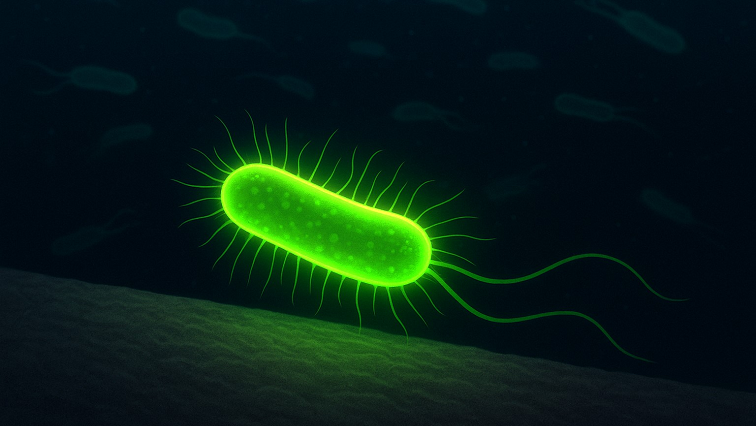
In natural environments, bacteria rarely live as free-swimming cells but attached to surfaces as biofilms in medical devices, mobile phones or human tissue. The bacterial behaviour, how they attach and grow, group together or excrete compounds that glue the biofilm, is influenced by their mechanical interaction with the surface. Understanding bacteria-surface interactions is essential for tackling biofilm formation, developing antibacterial materials, and advancing biosensing technologies. Yet, the underlying biophysical mechanisms remain largely unexplored. How bacteria “feel” and respond to surfaces can have a profound effect on bacterial physiology.
Researchers led by Dr. Cristina Flors, leader of the Advanced Fluorescence Nanoscopy group at IMDEA Nanociencia, have now developed a novel approach to visualize and quantify the mechanical stress experienced by bacterial membranes upon contact with surfaces. Using fluorescence lifetime imaging microscopy (FLIM) and a mechanosensitive fluorescent probe known as Flipper-TR, the team can measure subtle variations in membrane tension in live bacteria interacting with different materials. This innovative method provides a direct window into the physical forces at play at the bacterial interface.
The probe Flipper-TR® is a commercially available fluorescent reporter that specifically targets the membrane of cells, and whose lifetime reports on membrane tension changes. The probe is composed by two molecules, dithienothiophene moieties that become planarised under compression within the bacterial membrane and twist out of planarity when tension is released, resulting in changes in fluorescence lifetime. Flipper-TR has mostly been used in mammalian cells and currently few reports include bacteria due to experimental difficulties. Now, the team at IMDEA Nanociencia shows that this probe is suitable for bacterial model systems. Moreover, they show that it is sensitive enough to discriminate bacterial contact with surfaces with different adhesive and topological properties.
The study demonstrates that Flipper-TR successfully stains both Gram-positive and Gram-negative bacteria and can sensitively distinguish how their membranes respond to diverse surfaces and nanostructures. Differences in fluorescence lifetime reveal distinct adhesion mechanisms and even detecting membrane stretching when bacteria are placed on nanostructured, mechano-bactericidal substrates. These findings open the way to understanding how mechanical cues influence bacterial physiology and offer design principles for creating bio-interactive materials that either discourage or promote bacterial adhesion, with potential applications in healthcare, biotechnology, and materials science.
Read the original article on IMDEA Nanociencia.