To capture a crisp image of a hummingbird in flight, which can flap its wings up to 200 times per second, a photographer needs a camera with an extremely fast shutter speed. But what if your target is smaller than a single chromosome and can travel at velocities approaching lightspeed? Conventional cameras, no matter how advanced, are limited by the nature of light. You would need a special device and an innovative method to film such a tiny, speedy subject.
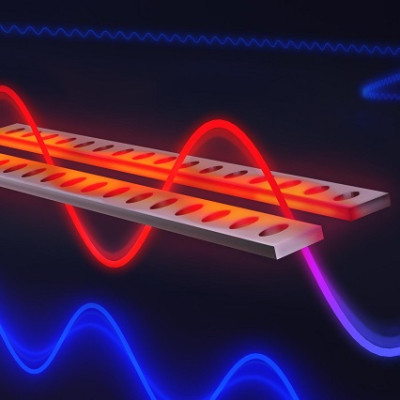
In a study published in Nature Communications, UChicago chemists designed just such an ultrafast “camera.” They used it to capture polaritons - quasiparticles made of both light and matter - moving through a special crystal that can steer their direction. The researchers observed polaritons traveling across long distances, zipping across a flake of the crystal providing the matter part of the quasiparticle without losing energy or fading out as quickly as expected.
“Normally, light interacts with matter in a way that doesn’t care about orientation. It’s all the same in any direction. But what happens when that’s no longer true?” asked Sarah King, assistant professor of chemistry and co-author on the study. “Directly observing polaritons moving in one direction on the nanoscale can help us understand how we can control how light and matter interact.”
Opening new possibilities
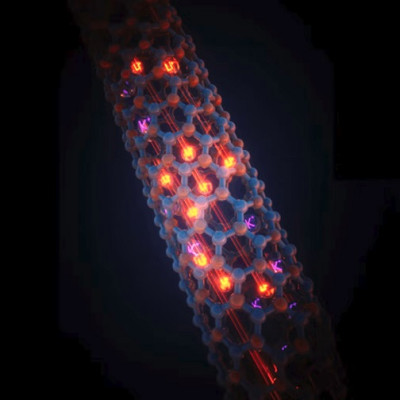
One challenge to developing advanced, light-based technologies is the ability to control microscopic beams of light. Pure light is wild. ]t moves in all directions, spreads out, and fades. But when light fuses with matter as a polariton, it can be more easily manipulated. For the study, the researchers used hybrids made from photons and a layered crystalline material called molybdenum oxydichloride (MoOCl2, informally pronounced moo-kul).
Polaritons are like little cars that can be steered in a particular direction, and the crystal has special properties that make it even more useful for controlling light. It behaves differently depending on which direction you go. It acts like a conductive metal in one direction and an insulator in another direction.
Imagine roads with curbs and medians. Driving straight down the road is easy, but driving crossways over the curbs would slow you down significantly. Simply rotating the crystal could tune the quasiparticle’s motion and properties, speed, size, distance, direction, and even grip. Materials with these natural guardrails eliminate the need for engineers to build walls or tunnels to direct the hybrid particles.
“This work could enable technologies that rely on guiding light at extremely small scales, such as advanced optical circuits and high-resolution imaging tools,” said Atreyie Ghosh, a postdoctoral scholar in King’s group and co–first author. “By allowing light to travel farther with less loss while staying tightly confined, it opens new possibilities for more efficient and precise control of light.”
The “camera”
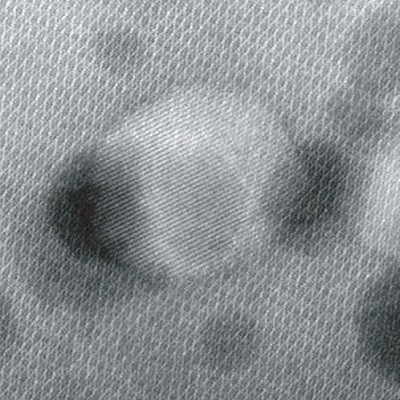
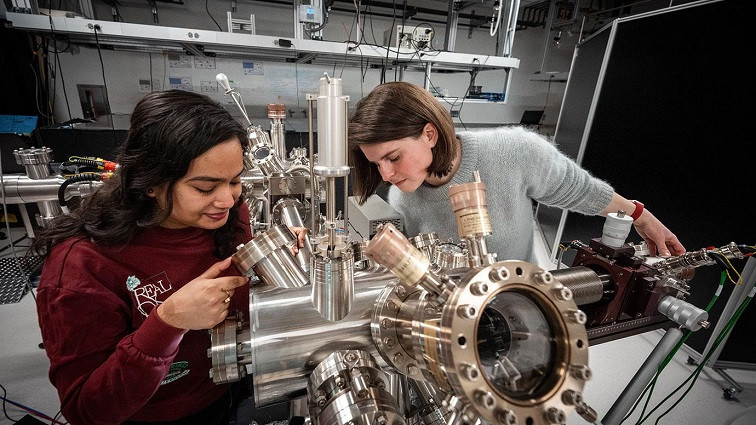
King’s team used a technique called time-resolved photoemission electron microscopy, which combines a laser’s ease of use with an electron microscope’s ability to capture extremely small subjects. “We know how to control photons. We can control their time, temporal profile, energy, and polarization,” said King. But optical microscopes can’t clearly image anything smaller than half the wavelength of visible light. That is a miniscule distance, yet a light-matter quasiparticle is still a fraction of that size. “On the other hand, it’s very difficult to control an electron’s time, energy, or polarization,” she continued, “but the diffraction limit of the electron is much smaller. So we’re taking the best of both worlds to image these types of dynamics in space and time.”
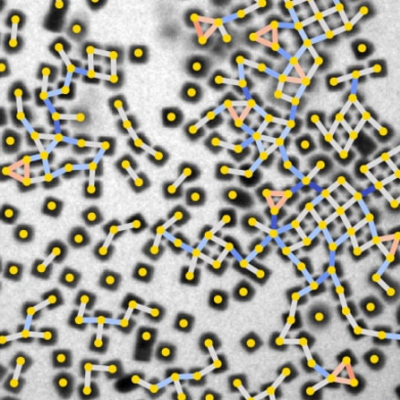
The set-up works by shooting a laser at the crystal, which produces polaritons and sends them racing down the “street.” The team then shoots another laser at the crystal in a way that does not create hybrids but still ejects electrons. Some of those electrons combine energy with the quasiparticles, and they “light up,” which the microscope can capture in a snapshot. The team ran the race over and over, waiting longer between starting and taking a snapshot, capturing images at different checkpoints along the quasiparticles’ path. Together, the snapshots form a “molecular movie,” said King. Through this movie, they saw the hybrid particles travel three times as far as had previously been measured in this crystal.
“It’s astonishing to observe such long propagation lengths in real time,” said Calvin Raab, a graduate student in the King group and co–first author. “We can watch the polariton travel across the MoOCl2 flakes and reflect off the edges of the material. It’s not often you can actually see quasiparticles bouncing around inside a 2D material in real space.”
Material matters
The results are exciting because MoOCl2 is an air-stable material that can be easily peeled apart into high-quality 2D flakes using simple methods, and all measurements are performed at room temperature, explained Ghosh. “The demonstration of long polariton propagation lengths under such practical conditions positions MoOCl2 as a highly promising platform for next-generation optoelectronic devices.”
MoOCl2 is also one of the first materials with direction-dependent rules built into the crystalline structure that can form quasiparticles using visible light, which is useful because “that’s the world that we live in,” said King. “A lot of our technologies have been developed for visible frequencies.”
The work raises several fundamental questions about the crystal: just how reactive are its atoms to light? Can researchers modify its properties? Can they twist and stack layers to achieve different quantum behaviors? Can they further refine and control its electromagnetic properties?
There are many directions the team might pursue in its investigation into this material. Their ultimate goal is to find new ways to control light, said King, and “to interrogate, for example, some of the beautiful work that’s happening here at the University in quantum information science.”
Read the original article on University of Chicago (UChicago).