
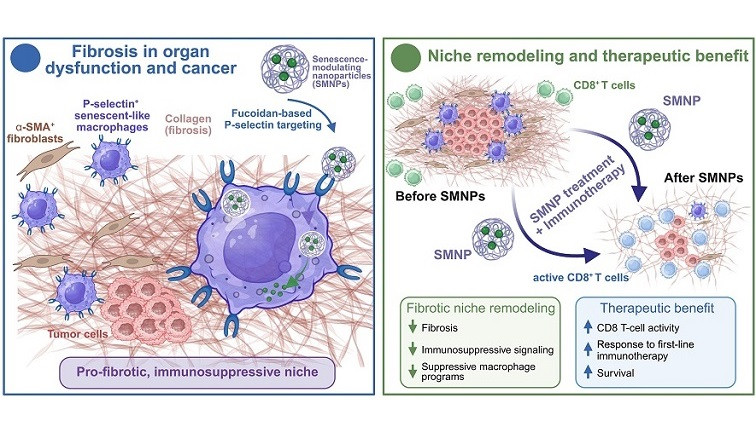
Many liver and lung cancers arise in tissue that's already been scarred by chronic disease, such as hepatitis, cirrhosis or long-term lung damage. That scarring creates an environment that suppresses nearby immune cells, so by the time a tumor takes hold, it's often already shielded from the immune system and immunotherapy.
Now, scientists at Memorial Sloan Kettering Cancer Center (MSK) have developed a new approach to breaking down this barrier. They engineered nanoparticles—tiny particles about 1,000 times smaller than the width of a human hair—that can be loaded with drugs and directed at specific cells in the body.
By selectively eliminating a small population of immune cells found to drive fibrosis, the approach could make immunotherapy work for more patients with minimal toxicity to healthy cells.
The laboratory findings, published in Science, could pave the way for new approaches against immunotherapy-resistant tumors, as well as other fibrotic and inflammatory diseases.
"Immunotherapy can elicit amazing therapy responses—but right now it doesn't work for the vast majority of patients," says Scott Lowe, Ph.D., a co-corresponding author of the study. "So anything we can do to make it work better and for more people is worth pursuing."
Read the original article on Memorial Sloan Kettering Cancer Center (MSK).
