
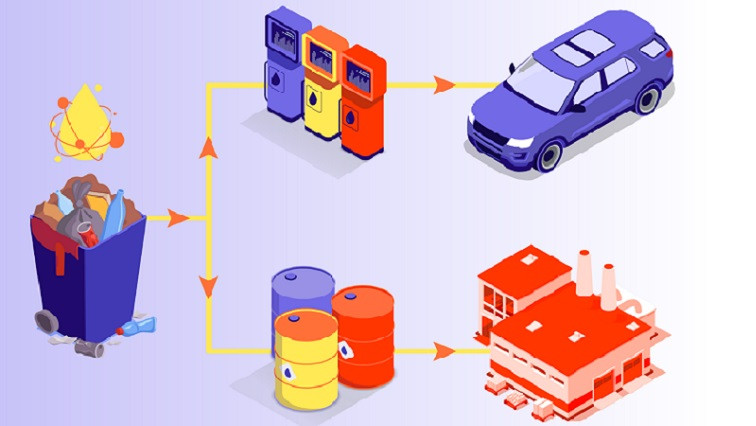
Researchers at the Department of Energy’s Oak Ridge National Laboratory developed a method to convert a commonly discarded hydrocarbon polymer into gasoline- and diesel-like fuels. The team has applied for a patent for the discovery, which treats polyethylene — the stuff of white cutting boards and shopping bags — with aluminum chloride-containing molten salts that serve as both solvent and catalyst. The results were published in the Journal of the American Chemical Society.
The scientists closely monitored the chemical reaction that turns the polymer into petrol to learn the secrets of its success. Soft X-ray spectroscopy and nuclear magnetic resonance showed that charged aluminum atoms each bind to three other atoms to create strongly acidic catalytic sites that break long polymer chains into shorter ones. Isotopic labeling and neutron scattering revealed how simpler polymer chains form gasoline-like fuels and more complex chains form diesel-like fuels.
If scaled beyond the laboratory, the process could strengthen U.S. energy security and industrial competitiveness.
“We developed an efficient and selective polyethylene-to-gasoline conversion,” said Liqi Qiu, a postdoctoral researcher at the University of Tennessee, Knoxville, who performed most of the study’s experiments in the ORNL laboratory of Sheng Dai, of ORNL and UTK. Dai, an ORNL Corporate Fellow and section head for separations and polymer chemistry, is a co-corresponding author of the paper.
The experiments produced a gasoline yield of about 60 percent under mild conditions.
“We converted polymer waste to value-added fuels by using commercially available inorganic salts as the reaction media to provide the catalytic sites,” said Zhenzhen Yang, an ORNL staff scientist who was also a co-corresponding author of the paper. “Unlike traditional techniques for converting polymer to fuel, the new process did not require noble-metal catalysts, organic solvents or external hydrogen. This is the first time molten salts were used as media to produce high-value-added chemicals from waste without any catalytic initiator or solvent and at temperature below 200 degrees Celsius.”
That temperature is comparable to a conventional kitchen oven. Previously, converting polyethylene to gasoline required temperatures of 450 to 500 degrees Celsius through pyrolysis, a heat-driven process that breaks long polymer chains into smaller hydrocarbons.
Read the original article on Oak Ridge National Laborator.
