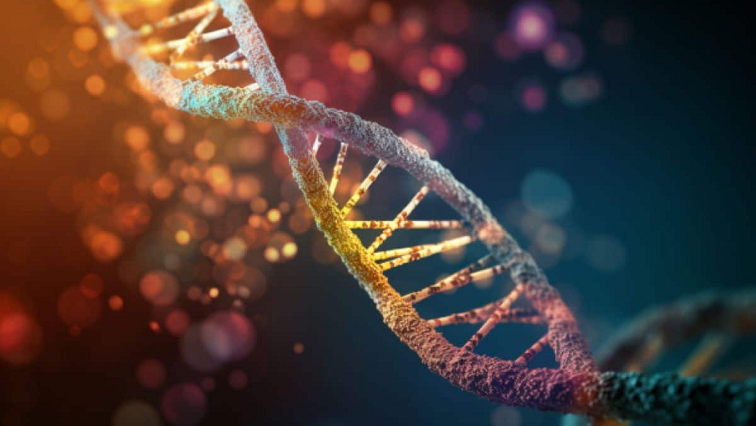
In his doctoral thesis research, Doctoral Researcher Johannes Parikka fabricated fishnet-type two-dimensional (2D) DNA origami lattices on silicon.
"DNA origami are nanoscale structures composed of single-stranded DNA. They can interact with each other, forming larger lattice structures," specifies Doctoral Researcher Johannes Parikka from the University of Jyväskylä.
Earlier, similar lattices have been made only on mica, which, as a fragile mineral, is not compatible with any subsequent microfabrication methods, such as etching. DNA origami lattices on silicon open the possibility to utilize DNA-assisted lithography, which further enables the fabrication of a new type of material.
"The largest single crystal lattice assembled on silicon was 5.6 µm2 in area, which means around 560 individual DNA origami. For this particular design and silicon substrate, it is the largest result ever achieved," says Parikka.
Versatile DNA origami
The research utilized the self-assembly of DNA origami structures on silicon, where they can form larger 2D lattices. DNA origami and the treated silicon substrate are both negatively charged. Divalent cations, such as Mg2+, can therefore attach DNA origami to the surface. The interaction strength between the DNA origami and the surface can be tuned with a monovalent cation, such as Na+, that is, by table salt (NaCl).
The Na+ ions of added table salt replace some of the attaching Mg2+ ions, which increases the DNA origami mobility on the surface, enabling the lattice assembly, specifies Parikka.
During the research, it was determined how deposition conditions, such as temperature and salt concentrations, affect the lattice formation. Structures were mostly imaged using atomic force microscopy (AFM).
"During the research, it was also noticed that by tuning the conditions, mainly sample solution salt concentrations, DNA origami lattices could be rolled into tubular structures in solution. In addition, the same DNA origami, with slight modifications, could be used to form controlled nanoparticle lattices," says Parikka.
Towards metamaterial fabrication
The results presented in this thesis are important for DNA origami lattice fabrication on silicon and thus also for photonics, since it enables metallization of the structures by DNA-assisted lithography. Metallic lattices, compared to individual DNA origami, enhance the optical response better and enable the fabrication of a metamaterial.
Metamaterials have a certain property, such as a negative refractive index, which cannot be found in materials found in nature, explains Parikka.
Read the original article on University of Jyväskylä.