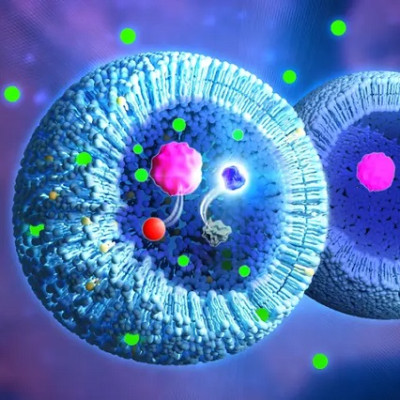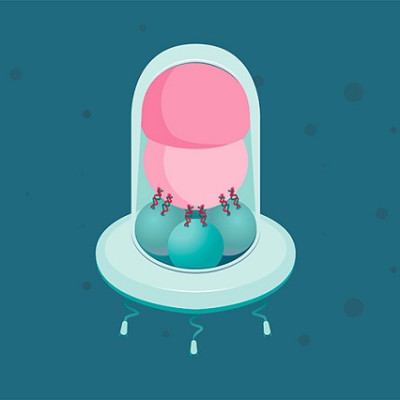
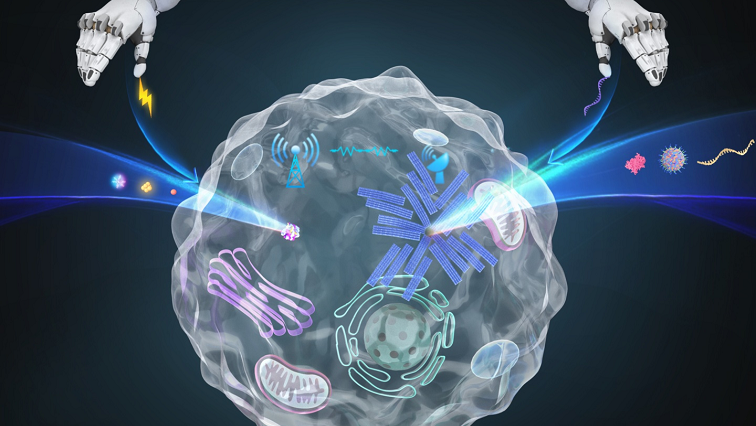
The research team calls the artificial, programmable platform a “double-necked synthetic cell microreactor”. “We functionally couple two DNA-based nanopores using membrane dynamics. The activation of a nanopore can trigger the formation of a second type of pore. This allows us to control molecular transport and biochemical reactions within the artificial compartment,” says Prof. Laura Na Liu, Head of the 2nd Physics Institute at the University of Stuttgart.
Applying natural principles of collective organization to synthetic systems
Biological complexity emerges from interactions between many coupled components rather than from isolated functions. In living matter, collective behavior arises through continuous communication, feedback, and dynamic regulation across multiple spatial and temporal scales.
“The double-necked synthetic cell microreactor illustrates how principles of collective organization can begin to be transferred into synthetic systems,” says Prof. Thomas Speck, Head of the Institute for Theoretical Physics IV at the University of Stuttgart.
Platform opens up opportunities for new biotechnologies
By coupling membrane dynamics, molecular transport, and programmable DNA nanostructures into an interacting network, the Stuttgart researchers introduce a bottom-up strategy for constructing synthetic modules with coordinated collective behavior.
The platform also serves as a controllable micro-scale reaction chamber for chemical reactions. Dynamic regulation of membrane permeability allows different molecular building blocks and reactants to be delivered in a controlled sequence into confined reaction spaces. Using this principle, the researchers orchestrated biochemical processes spanning enzyme cascade reactions for pathway-like transformations, actin polymerization and bundling to mimic cytoskeletal organization, and cell-free Spinach RNA transcription for controlled gene expression, as well as the confined synthesis of three-dimensional DNA crystals.
“Dynamically regulated reaction environments could open new possibilities for programmable biochemical synthesis and artificial entities capable of organizing complex multistep processes autonomously,” says Prof. Stephan Nussberger, who heads the Biophysics Division at the Institute for Biomaterials and Biomolecular Systems at the University of Stuttgart.
DNA nanotechnology as the enabling platform
The study is based on DNA nanotechnology, a research field that uses DNA not only as genetic material, but also as a programmable construction material for nanoscale architectures and devices. Over the past years, Laura Na Liu’s research group has pioneered multiple approaches for engineering dynamic DNA-based architectures on cell membranes.
“The next frontier is no longer simply constructing structures, but programming how synthetic components interact, communicate, and collectively organize functionality,” says Laura Na Liu. “The double-necked synthetic cell microreactor is a step towards this."
The study was conducted in collaboration with researchers from the University of Michigan and Arizona State University, and has been published in the journal Nature Chemistry.
Read the original article on University of Stuttgart.