Next‑generation electronics are increasingly expected to operate directly on the human body - integrated with skin, clothing, or flexible substrates - rather than remaining confined to conventional rigid devices. This shift has driven intense research into soft, multifunctional materials that can combine mechanical flexibility, durability, and high sensing performance.
Researchers at Shahid Beheshti University, in collaboration with scientists from Kharazmi University, the Technical University of Denmark, and Zhengzhou University, have developed a conductive nanocomposite hydrogel capable of detecting subtle human body movements with high sensitivity. The material is designed for applications in wearable sensors, health‑monitoring systems, and wireless human–machine interfaces. The study has been published in the journal Chemical Engineering Journal.
Hydrogels have emerged as promising candidates because of their soft, water‑rich structures that closely resemble biological tissues. These materials can retain large amounts of water and exhibit excellent flexibility, making them attractive for biomedical engineering, tissue engineering, biosensors, and flexible electronics. However, many conventional hydrogels suffer from limitations such as weak mechanical strength, limited electrical conductivity, low durability, and poor self‑healing capability.
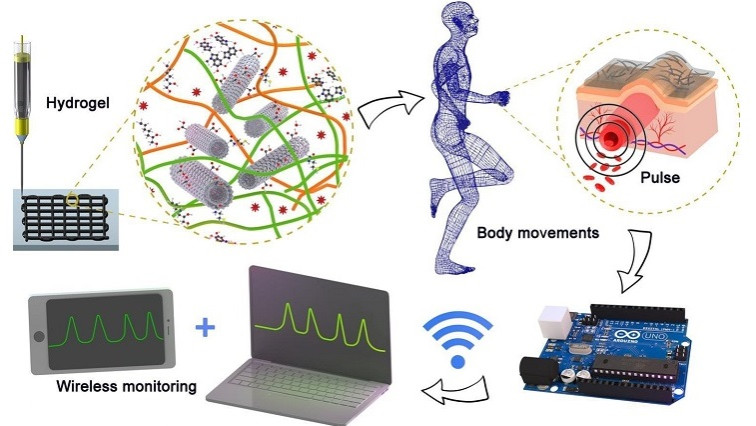
To address these challenges, the research team designed a bioinspired conductive hydrogel incorporating functionalized multi‑walled carbon nanotubes (MWCNTs), natural polymers, and a dual cross‑linking network. The nanoscale component of the system relies on thiol‑functionalized MWCNTs, which form a conductive and mechanically robust network within the hydrogel matrix. These nanotubes significantly enhance electrical conductivity while maintaining flexibility.
The hydrogel was synthesized using a UV‑activated "thiol–ene" click reaction, a chemical process known for its efficiency and controllability. Alongside the carbon nanotubes, the researchers incorporated natural polymers such as oxidized guar gum and hydroxyethyl cellulose to improve biocompatibility and structural flexibility.
The resulting material features a dual network structure composed of both chemical and physical bonds. This architecture plays a key role in improving the hydrogel’s mechanical strength and functional stability while preserving its high flexibility. Mechanical testing showed that the hydrogel achieved a strength of approximately 261 kPa and could recover about 94% of its original structure after deformation. The material also demonstrated effective self‑healing performance, an essential feature for wearable devices that are continuously subjected to bending, stretching, and mechanical stress.
One of the most notable properties of the developed hydrogel is its high sensitivity to body motion. The reported gauge factor of approximately 10.97 enables the sensor to detect a wide range of movements, from subtle vibrations to larger joint bending. The hydrogel also exhibited strong anti‑fatigue behavior, maintaining stable performance under 100% strain over 1,000 cycles. In addition, the system showed a rapid response time of about 120 milliseconds, enabling near real‑time monitoring of physical motion.
Another advantage of this technology is its relatively simple and cost‑effective fabrication process, which can be carried out at room temperature. The material is also compatible with 3D printing techniques, opening possibilities for scalable production and customized wearable devices.
According to the researchers, the developed hydrogel could support a wide range of applications, including wearable sensors for athletes and patients, health‑monitoring systems for the elderly, motion control in human–machine interfaces, and the development of electronic skin technologies.