
InP-based photonic integration is recognized as a reliable and comprehensive active-passive platform, though it has limitations in terms of yield and substrate size. Monolithic silicon photonics, on the other hand, boast excellent passive performance, temperature-intensive modulators, and compatibility with complementary metal oxide semiconductor (CMOS) fabrication. Yet, the lack of a light source has so far hindered the development of this technology.
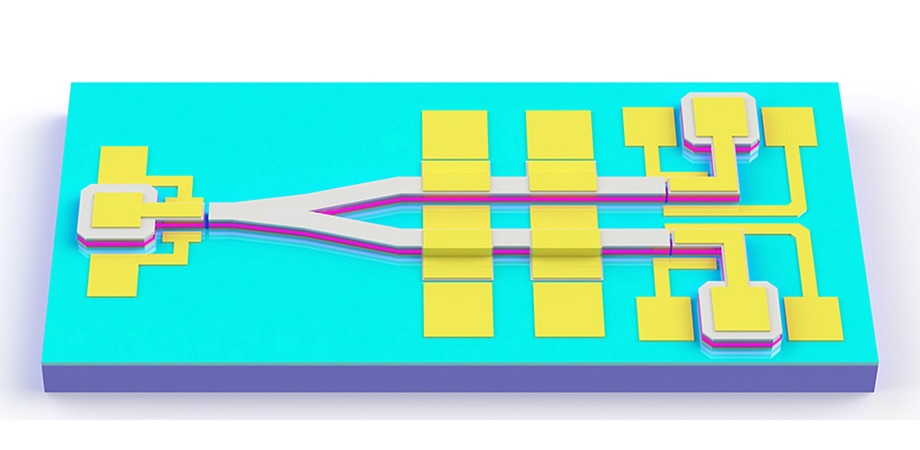
The researchers designed their circuit chip based on the GaN-on-silicon platform and using III-nitride epitaxial layers grown through metal organic chemical vapor deposition. The monolithic, top-down approach builds III-nitride transmitters, modulators, waveguides, beamsplitters, receivers, and monitors on a conventional GaN-on-silicon wafer and does not involve regrowth or postgrowth doping.

By employing direct and indirect modulations within a single light path, the researchers simultaneously transmitted two types of data or encrypted one modulation signal’s data transmission with another modulation.
The researchers’ results further validated the data transmission and processing using UV light with a peak emission wavelength of 386 nm, the researchers said. In addition, “The adoption of multifunction MQW completely overcomes the compatibility problem of different optical active devices and considerably reduces fabrication complexity,” they said.
According to research team leader and senior corresponding author Yongjin Wang of the Peter Grünberg Research Center at Nanjing University of Posts and Telecommunications, further advancements in III-nitride etching accuracy added to the proposed integration scheme hold high potential for next-generation photonic integration. Applications in the sensing field, where high integration density is not a critical requirement, Wang said, are especially promising.
The research was published in Advanced Photonics Nexus (www.doi.org/10.1117/1.APN.2.4.046003).
