
| Date | 1st, Jul 2023 |
|---|
Home > Press > Research breakthrough could be significant for quantum computing future: Irish-based scientists confirm crucial characteristic of new superconductor material
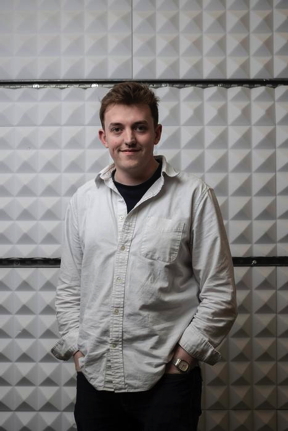 Joe Carroll, a PhD researcher working with Prof. of Quantum Physics S�amus Davis at the Macroscopic Quantum Matter Group laboratory in University College Cork, lead author on a paper have discovered a spatially modulating superconducting state in a new and unusual superconductor Uranium Ditelluride (UTe2).
CREDIT
Clare Keogh/UCC
Joe Carroll, a PhD researcher working with Prof. of Quantum Physics S�amus Davis at the Macroscopic Quantum Matter Group laboratory in University College Cork, lead author on a paper have discovered a spatially modulating superconducting state in a new and unusual superconductor Uranium Ditelluride (UTe2).
CREDIT
Clare Keogh/UCC
Abstract: Scientists using one of the world�s most powerful quantum microscopes have made a discovery that could have significant consequences for the future of computing.
Cork, Ireland | Posted on June 30th, 2023
Researchers at the Macroscopic Quantum Matter Group laboratory in University College Cork (UCC) have discovered a spatially modulating superconducting state in a new and unusual superconductor Uranium Ditelluride (UTe2). This new superconductor may provide a solution to one of quantum computing�s greatest challenges.
Their finding has been published in the prestigious journal Nature.
Lead author Joe Carroll, a PhD researcher working with UCC Prof. of Quantum Physics S�amus Davis, explains the subject of the paper.
�Superconductors are amazing materials which have many strange and unusual properties. Most famously they allow electricity to flow with zero resistance. That is, if you pass a current through them they don�t start to heat up, in fact, they don�t dissipate any energy despite carrying a huge current. They can do this because instead of individual electrons moving through the metal we have pairs of electrons which bind together. These pairs of electrons together form macroscopic quantum mechanical fluid.�
�What our team found was that some of the electron pairs form a new crystal structure embedded in this background fluid. These types of states were first discovered by our group in 2016 and are now called Electron Pair-Density Waves. These Pair Density Waves are a new form of superconducting matter the properties of which we are still discovering.�
�What is particularly exciting for us and the wider community is that UTe2 appears to be a new type of superconductor. Physicists have been searching for a material like it for nearly 40 years. The pairs of electrons appear to have intrinsic angular momentum. If this is true, then what we have detected is the first Pair-Density Wave composed of these exotic pairs of electrons.�
When asked about the practical implications of this work Mr. Carroll explained;
�There are indications that UTe2 is a special type of superconductor that could have huge consequences for quantum computing.�
�Typical, classical, computers use bits to store and manipulate information. Quantum computers rely on quantum bits or qubits to do the same. The problem facing existing quantum computers is that each qubit must be in a superposition with two different energies - just as Schr�dinger�s cat could be called both �dead� and �alive�. This quantum state is very easily destroyed by collapsing into the lowest energy state � �dead� - thereby cutting off any useful computation.
�This places huge limits on the application of quantum computers. However, since its discovery five years ago there has been a huge amount of research on UTe2 with evidence pointing to it being a superconductor which may be used as a basis for topological quantum computing. In such materials there is no limit on the lifetime of the qubit during computation opening up many new ways for more stable and useful quantum computers. In fact, Microsoft have already invested billions of dollars into topological quantum computing so this is a well-established theoretical science already.� he said.
�What the community has been searching for is a relevant topological superconductor; UTe2 appears to be that.�
�What we�ve discovered then provides another piece to the puzzle of UTe2. To make applications using materials like this we must understand their fundamental superconducting properties. All of modern science moves step by step. We are delighted to have contributed to the understanding of a material which could bring us closer to much more practical quantum computers.�
Congratulating the research team at the Macroscopic Quantum Matter Group Laboratory in University College Cork, Professor John F. Cryan, Vice President Research and Innovation said:
�This important discovery will have significant consequences for the future of quantum computing. In the coming weeks, the University will launch UCC Futures - Future Quantum and Photonics and research led by Professor Seamus Davis and the Macroscopic Quantum Matter Group, with the use of one of the world's most powerful microscopes, will play a crucial role in this exciting initiative.�
####
For more information, please click here
Contacts:Eoin HahessyUniversity College Cork
Cell: 00353860468950
Copyright © University College Cork
If you have a comment, please Contact us.
Issuers of news releases, not 7th Wave, Inc. or Nanotechnology Now, are solely responsible for the accuracy of the content.
Bookmark:


News and information
 The present and future of computing get a boost from new research July 21st, 2023
Billions of nanoplastics released when microwaving baby food containers: Exposure to plastic particles kills up to 75% of cultured kidney cells July 21st, 2023
Imaging
Nanobiotechnology: How Nanomaterials Can Solve Biological and Medical Problems April 14th, 2023
Quantum Physics
Superconductivity
Researchers at Purdue discover superconductive images are actually 3D and disorder-driven fractals May 12th, 2023
Possible Futures
Two types of ultrafast mode-locking operations generation from an Er-doped fiber laser based on germanene nanosheets July 21st, 2023
Detection of bacteria and viruses with fluorescent nanotubes July 21st, 2023
A non-covalent bonding experience: Scientists discover new structures for unique hybrid materials by altering their chemical bonds July 21st, 2023
Chip Technology
The present and future of computing get a boost from new research July 21st, 2023
Electron collider on a chip June 30th, 2023
Discovering features of band topology in amorphous thin films June 30th, 2023
Quantum Computing
Electron collider on a chip June 30th, 2023
Quantum materials: Electron spin measured for the first time June 9th, 2023
Discoveries
Billions of nanoplastics released when microwaving baby food containers: Exposure to plastic particles kills up to 75% of cultured kidney cells July 21st, 2023
Understanding the diverse industrial applications of materials science: Materials Science A Field of Diverse Industrial Applications July 21st, 2023
A non-covalent bonding experience: Scientists discover new structures for unique hybrid materials by altering their chemical bonds July 21st, 2023
Announcements
Billions of nanoplastics released when microwaving baby food containers: Exposure to plastic particles kills up to 75% of cultured kidney cells July 21st, 2023
Understanding the diverse industrial applications of materials science: Materials Science A Field of Diverse Industrial Applications July 21st, 2023
A non-covalent bonding experience: Scientists discover new structures for unique hybrid materials by altering their chemical bonds July 21st, 2023
Interviews/Book Reviews/Essays/Reports/Podcasts/Journals/White papers/Posters
The present and future of computing get a boost from new research July 21st, 2023
Billions of nanoplastics released when microwaving baby food containers: Exposure to plastic particles kills up to 75% of cultured kidney cells July 21st, 2023
Understanding the diverse industrial applications of materials science: Materials Science A Field of Diverse Industrial Applications July 21st, 2023
Tools
New single-photon Raman lidar can monitor for underwater oil leaks: System could be used aboard underwater vehicles for many applications June 30th, 2023
Understanding the mechanism of non-uniform formation of diamond film on tools: Paving the way to a dry process with less environmental impact March 24th, 2023
Novel microscope developed to design better high-performance batteries: Innovation gives researchers inside view of how batteries work February 10th, 2023
