
An efficient simulator for quantum systems is one of the original goals of quantum computing. Synthetic dimensions in photonics present a powerful approach for simulation that is free from the constraints of geometric dimensionality.
The UR simulator could provide scientists with a better understanding of complex natural phenomena that cannot be simulated on classical, high-performance computing systems. Specifically, the system could make quantum simulation feasible for exploring physical systems in a synthetic space that mimics the physical world.
The researchers created a quantum-correlated synthetic crystal using a chip-scale, dynamically modulated microresonator and a coherently controlled, broadband quantum frequency comb. The time-frequency entanglement of the comb modes extended the dimensionality of the synthetic space, forming a large synthetic lattice with electrically controlled tunability.
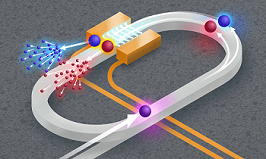

The researchers used the evolution of quantum correlations between entangled photons to perform a series of simulations with the quantum simulator. They demonstrated Bloch oscillations and multilevel Rabi oscillations, in addition to quantum random walks, in the time and frequency correlation space.
Researcher Usman Javid said that the systems the group is currently simulating are well understood. Still, he said, the proof-of-principle experiment demonstrates the power of the approach for scaling up to more complex simulations and computation tasks.
The research was published in Nature Photonics (www.doi.org/10.1038/s41566-023-01236-7).
