
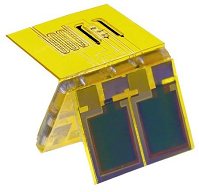
The wearable device itself is assembled in an origami-like fashion, with individual layers dedicated to different processes. The FPSCs provide ample power under outdoor and indoor illumination conditions, enabling the sensors to periodically monitor sweat rate and continuously monitor numerous biomarkers.
The first of four principal and interacting components comprising the researchers’ device serves to distribute the electricity harvested by the solar cell. The second component applies the process of iontophoresis — the inducement of sweating — to enable the wearer of the device to sweat without exercise or exposure to high heat. The third component enables the device to perform electrochemical measurements of various biomarkers found in sweat. The fourth component manages data processing and wireless communication, allowing the sensor to interface with a cellphone app to display monitoring results.
Earlier iterations of the wearable sensor were energized by lithium-ion batteries and silicon solar cells, though neither option proved satisfactory. The lithium batteries were bulky, and had to be recharged with an external source of electricity. The silicon cells were rigid, inefficient, and reliant on strong lighting conditions.
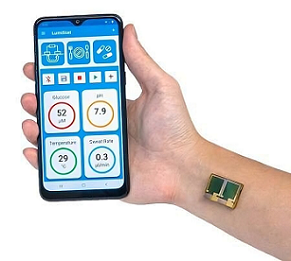

Gao said that the type of FPSC used for the sweat sensor is particularly well-suited to indoor lighting because its spectral response pairs well with the emission spectrum for lighting that is commonly used indoors.
The Caltech researchers showed that the wearable sweat sensor can continuously collect and monitor multimodal physical and chemical data including data on glucose, pH, sodium ion, sweat rate, and skin temperature, across indoor and outdoor physical activities for a period of over 12 hours. In the study, iontophoresis was performed every three hours to ensure that enough sweat was available to continuously monitor the biomarkers under observation.
Sweat is naturally less invasive to collect than blood, and as the technology for solar-powered sweat sensors develops, these sensors will be able to measure far more than current health trackers, the researchers said. Future sweat sensors could be used for diabetes management, to detect heart disease and gout, and/or to determine an individual’s baseline for substances such as cortisol, hormones, or the metabolites of various nutrients and medicines.
The research was published in Nature Electronics (www.doi.org/10.1038/s41928-023-00996-y).
