
The UCSB QD platform enables devices to be fabricated with a bandwidth that is comparable to the best QD mode-locked lasers reported to date, the researchers said. Both the AM and the FM pulse widths generated in the UCSB devices meet the state-of-art for QD mode-locked lasers.
Despite optical frequency combs’ widespread utility in remote sensing, spectroscopy, and optical communications applications, the optical pulses delivered by amplitude-modulated frequency combs are not favorable to dense wavelength-division multiplexing (DWDM) systems. These systems use many micro-ring modulators, and the high, instantaneous power of the optical pulses creates strong thermal nonlinearities.
On the other hand, according to the UCSB researchers, the formation of a broadband optical frequency comb relies on careful engineering of the group velocity dispersion (GVD) of the waveguide.
This is a challenge for platforms where the GVD is determined by the material. As a result, the system size, weight, power consumption, and cost (SWaP-C) of optical frequency combs must be improved to increase the likelihood for their use in industry.
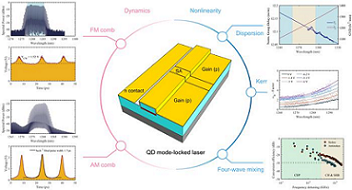
The researchers used a colliding-pulse structure to give the QD mode-locked laser a fast repetition rate of 60 GHz. This allows the QD laser to provide support for DWDM systems and reduces channel crosstalk in data transmission. The design of the laser cavity enables a 3-dB optical bandwidth as high as 2.2 THz in the telecom O-band. The broadband FM comb is generated from a 1.35-mm-long and 2.6-μm-wide laser cavity, with a high wall-plug efficiency of over 12%.
In addition to the group velocity dispersion (GVD) of the waveguide, the generation of FM combs relies on the nonlinear properties of the laser’s active region, including spatial hole burning, Kerr nonlinearities, and four-wave mixing. The QD mode-locked laser exhibits a high four-wave mixing efficiency of −5 dB, which enables it to generate FM combs efficiently.

The researchers said that the developed technique is CMOS compatible.
The research was published in Light: Science & Applications (www.doi.org/10.1038/s41377-023-01225-z).
