
Carbon nanotubes can be noncovalently modified to create sensors that change their fluorescence when interacting with biomolecules. However, noncovalent chemistry hinders the sensors’ ability to recognize molecules consistently and perform reliable signal transduction.
In earlier studies, the RUB team had shown how the fluorescence of nanotubes can be manipulated to detect vital biomolecules. The next step, involving researchers from IMS and ETH Zurich as well as RUB, was to customize the carbon sensors so they could be used with different target molecules in a straightforward manner.
To build the modular sensors, the researchers linked DNA bases to the nanotubes to create a guanine quantum defect in the crystal structure of the nanotube. The guanine quantum defect caused the fluorescence of the nanotubes to change at the quantum level.
The defect also acted as a molecular handle, which enabled the researchers to introduce a detection unit into the sensor, that can be adapted to a target molecule for the purpose of identifying a specific viral or bacterial protein. The interaction between the detection unit and a bacterial or viral molecule affects the fluorescence of the nanotubes, causing their brightness to increase or decrease.

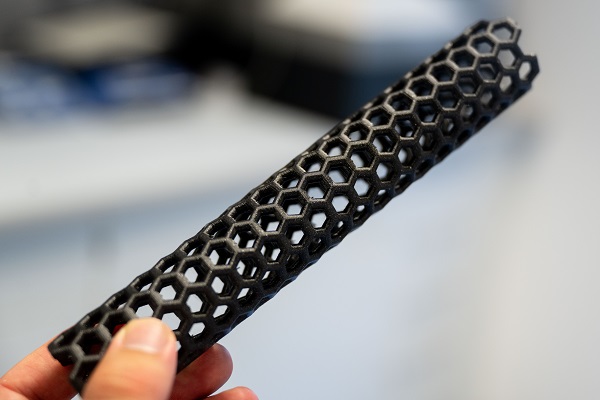
“Through the attachment of the detection unit to the DNA anchors, the assembly of such a sensor resembles a system of building blocks — except that the individual parts are 100,000 times smaller than a human hair,” said Sebastian Kruss, professor of physical chemistry at RUB. The NIR fluorescent biosensors are built from tubular carbon nanosensors with a diameter of less than 1 nm.
To demonstrate the potential of the biosensor, the researchers designed sensors for the SARS CoV-2 spike protein and used aptamers to bind to the protein. “Aptamers are folded DNA or RNA strands. Due to their structure, they can selectively bind to proteins,” researcher Justus Metternich said. “In the next step, one could transfer the concept to antibodies or other detection units.”
The fluorescent sensors indicated the presence of the SARS-CoV-2 protein with a high degree of reliability. The selectivity of sensors with guanine quantum defects was higher than the selectivity of sensors without the defects.
The team’s approach to developing the sensors could provide a generic blueprint for the development of NIR fluorescent biosensors with improved stability.
The research was published in Journal of the American Chemistry Society (www.pubs.acs.org/doi/10.1021/jacs.3c03336).
