NEW YORK, Nov. 13, 2023 — Researchers from the City University of New York (CUNY) Graduate Center and the California Institute of Technology (CalTech) have shrunk a mode-locked laser (MLL) to the size of an optical chip with an integrated nanophotonic platform. The results show promise for developing ultrafast nanophotonic systems for a wide range of applications.
MLLs can produce coherent ultrashort pulses of light at extremely fast speeds on the order of picoseconds and femtoseconds. These devices have enabled numerous technologies in photonics, including extreme nonlinear optics, two-photon microscopy, and optical computing.
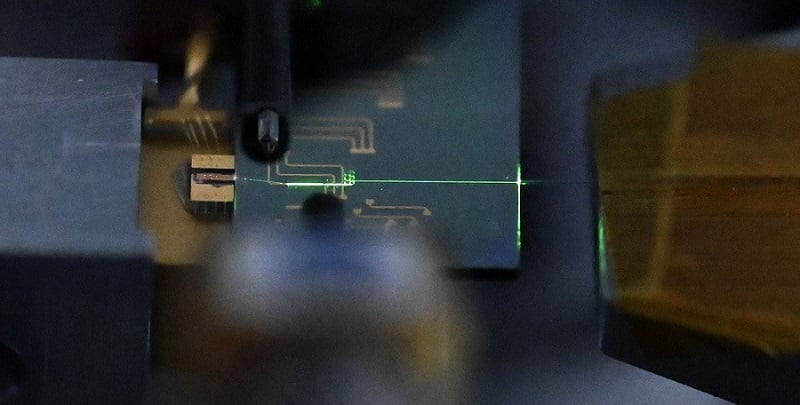
The researchers created a mode-locked laser that generates ultrashort ~4.8-ps optical pulses at around 1065 nm with a peak power of ~0.5 W. Courtesy of Alireza Marandi.
However, most MLLs are expensive and power-demanding, and they require bulky discrete optical components and equipment. As a result, the use of ultrafast photonic systems has generally been limited to table-top laboratory experiments. What’s more, so-called integrated MLLs meant to drive nanophotonic platforms suffer from critical limitations like low peak power and a lack of controllability.
“Our goal is to revolutionize the field of ultrafast photonics by transforming large lab-based systems into chip-sized ones that can be mass produced and field deployed,” said Qiushi Guo, a physics professor at CUNY Graduate Center. “Not only do we want to make things smaller, but we also want to ensure that these ultrafast chip-sized lasers deliver satisfactory performances.”
Through hybrid integration of a semiconductor optical amplifier chip with a novel thin-film lithium niobate nanophotonic circuit, the researchers created an integrated MLL the size of an optical chip. According to the authors, the MLL generates ultrashort ~4.8-ps optical pulses at around 1065 nm with a peak power of ~0.5 W — the highest output pulse energy and peak power of any integrated MLLs in nanophotonic platforms.

“We are not just interested in making mode-locked lasers more compact,” said Alireza Marandi, an assistant professor of electrical engineering and applied physics at CalTech. “We are excited about making a well-performing mode-locked laser on a nanophotonic chip and combining it with other components. That is when we can build a complete ultrafast photonic system in an integrated circuit.”

Alireza Marandi, assistant professor of electrical engineering and applied physics at CalTech. Courtesy of California Institute of Technology.
Beyond the compact size, the demonstrated mode-locked laser exhibits properties that are beyond the reach of conventional MLLs. For example, by adjusting the pump current of the laser, Guo was able to precisely tune the repetition frequencies of out pulses in a very wide range of 200 MHz. By employing the strong reconfigurability of the demonstrated laser, the research team hopes to enable chip-scale, frequency-stabilized comb sources, which are vital for precision sensing.
“This achievement paves the way for eventually using cellphones to diagnose eye diseases or analyzing food and environments for things like E. coli and dangerous viruses,” Guo said. “It could also enable futuristic chip-scale atomic clocks, which allows navigation when GPS is compromised or unavailable.”
The researchers plan to continue improving this technology so it can operate at even shorter timescales and higher peak powers, with a goal of 50 fs, which would be a hundredfold improvement over the current device, which generates pulses 4.8 ps in length.
The research was published in Science (www.doi.org/10.1126/science.adj5438).

