
Science

Explosives chemist David Chavez pours an example of melt-castable explosive into a copper mold at Los Alamos National Laboratory’s Technical Area 9
LANL
1/3
The explosive bis-oxadiazole with formula
LANL
2/3
Explosives chemist David Chavez pours an example of melt-castable explosive into a copper mold at Los Alamos National Laboratory’s Technical Area 9
LANL
3/3
Molecule of bis-oxadiazole (top) and in a crystal matrix when solidified
LANL
It looks as if the days of the venerable explosive trinitrotoluene (TNT) are numbered as researchers at the Los Alamos National Laboratory (LANL) and the US Army Research Laboratory in Aberdeen, Maryland develop a new explosive that has the power of TNT, yet is safer and more environmentally friendly.
Invented by the German chemist Julius Wilbrand in 1863, TNT was originally created as a textile dye, but in 1891 Carl Häussermann discovered its explosive properties. Today, it's one of the best known and most widely used explosives for both military and civilian applications. This because TNT is not only a powerful explosive, it can also be melted and poured into molds.
But the key selling factor for TNT is that it's very safe to handle. In fact, Britain's 1875 Explosives Act didn't even class TNT as an explosive in terms of storage and handling. This is because TNT is very hard to detonate, requiring a detonator and a pre-explosive charge called a gain to set it off with a strong enough shock wave. By itself, you can hit TNT with a hammer, saw it in half, or burn it in a campfire – though we definitely wouldn't recommend such experiments.
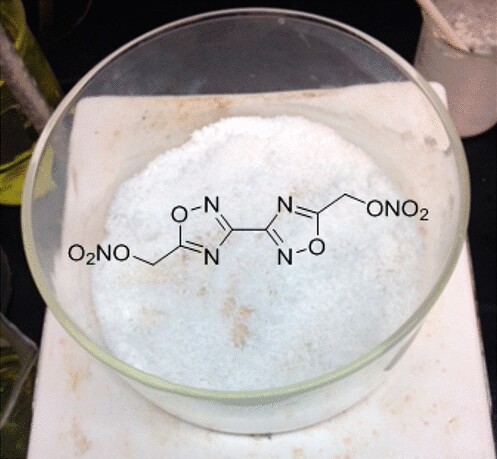
LANL
Unfortunately, TNT is also highly toxic, with prolonged exposure affecting the blood, liver, and spleen. It's also a possible human carcinogen and is a very dangerous soil and water pollutant. Not surprisingly, finding an safer, yet as effective, substitute that melts like TNT has its attractions.
The new explosive being developed under explosives chemist David Chavez is a nitrogen-containing compound called bis-oxadiazole – or more technically, bis(1,2,4-oxadiazole)bis(methylene)dinitrate. This 24-atom molecule is packed with nitrogen and when exploded has a yield 1.5 times greater than that of TNT. It has a comparable melting point, and is as insensitive as TNT. However, it is much more environmentally friendly with a less toxic profile.
The tricky bit was finding a way to not only make bis-oxadiazole, but in sufficient quantities with the desired efficiency. The first attempts at synthesis had a yield of only 4 percent, but the team has now managed to boost this to 44 percent. They are now working to scale this up to producing the explosive by the kilogram before subjecting it to a wide range of explosive and toxicology tests.
The research was published in Organic Process Research & Development.
Source: LANL

