
Posted: Jun 26, 2018
(Nanowerk News) Need to kill tumors? Just add heat.
That’s the promise of heated magnetic nanoparticles, a futuristic-sounding technology that could one day be used to fry and eradicate cancer cells without harming healthy tissue elsewhere in the body.
New research led by the University at Buffalo advances this concept, with scientists developing nanoparticles that can zap tumors with significant amounts of heat under a low magnetic field. The study was published in the journal Small ("Maximizing Specific Loss Power for Magnetic Hyperthermia by Hard–Soft Mixed Ferrites"), and was selected as a future cover article.
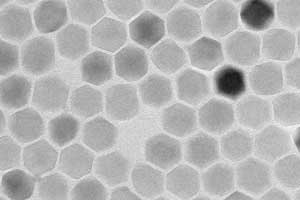 A transmission electron microscope image of zinc ferrite nanoparticles with an average diameter of 22 nanometers. This type of nanoparticle possesses high heating performance at very low magnetic fields suitable for clinical use, researchers say. (Image: Xiang Yu)
“The main accomplishment of our work is the greatly enhanced heating performance of nanoparticles under low-field conditions suitable for clinical applications. The best heating power we obtained is close to the theoretical limit, greatly surpassing some of the best-performing particles that other research teams have produced,” says Hao Zeng, PhD, professor of physics in the UB College of Arts and Sciences, who led the project.
He explains that the therapy has a number of potential benefits over other treatment routes. It’s minimally invasive, and is not expected to generate the type of severe side effects often associated with chemotherapy and radiation, he says.
“The treatment will only heat up the region where nanoparticles are without affecting healthy tissues that are further away, so we anticipate few side effects,” Zeng says. “In addition, the magnetic field that’s used to excite the particles can penetrate deep into the body from an instrument that does not require any contact or insertion of probes. As such, the therapy can reach parts of the body that are not easily accessible to surgery.”
The study was a collaboration between UB; Capital Normal University in Beijing, China; the Chinese PLA General Hospital in Beijing; and the University of Nebraska Omaha. Shuli He, PhD, a visiting scholar at UB from Capital Normal University, was first author.
A transmission electron microscope image of zinc ferrite nanoparticles with an average diameter of 22 nanometers. This type of nanoparticle possesses high heating performance at very low magnetic fields suitable for clinical use, researchers say. (Image: Xiang Yu)
“The main accomplishment of our work is the greatly enhanced heating performance of nanoparticles under low-field conditions suitable for clinical applications. The best heating power we obtained is close to the theoretical limit, greatly surpassing some of the best-performing particles that other research teams have produced,” says Hao Zeng, PhD, professor of physics in the UB College of Arts and Sciences, who led the project.
He explains that the therapy has a number of potential benefits over other treatment routes. It’s minimally invasive, and is not expected to generate the type of severe side effects often associated with chemotherapy and radiation, he says.
“The treatment will only heat up the region where nanoparticles are without affecting healthy tissues that are further away, so we anticipate few side effects,” Zeng says. “In addition, the magnetic field that’s used to excite the particles can penetrate deep into the body from an instrument that does not require any contact or insertion of probes. As such, the therapy can reach parts of the body that are not easily accessible to surgery.”
The study was a collaboration between UB; Capital Normal University in Beijing, China; the Chinese PLA General Hospital in Beijing; and the University of Nebraska Omaha. Shuli He, PhD, a visiting scholar at UB from Capital Normal University, was first author.
A transmission electron microscope image of zinc ferrite nanoparticles with an average diameter of 22 nanometers. This type of nanoparticle possesses high heating performance at very low magnetic fields suitable for clinical use, researchers say. (Image: Xiang Yu)
“The main accomplishment of our work is the greatly enhanced heating performance of nanoparticles under low-field conditions suitable for clinical applications. The best heating power we obtained is close to the theoretical limit, greatly surpassing some of the best-performing particles that other research teams have produced,” says Hao Zeng, PhD, professor of physics in the UB College of Arts and Sciences, who led the project.
He explains that the therapy has a number of potential benefits over other treatment routes. It’s minimally invasive, and is not expected to generate the type of severe side effects often associated with chemotherapy and radiation, he says.
“The treatment will only heat up the region where nanoparticles are without affecting healthy tissues that are further away, so we anticipate few side effects,” Zeng says. “In addition, the magnetic field that’s used to excite the particles can penetrate deep into the body from an instrument that does not require any contact or insertion of probes. As such, the therapy can reach parts of the body that are not easily accessible to surgery.”
The study was a collaboration between UB; Capital Normal University in Beijing, China; the Chinese PLA General Hospital in Beijing; and the University of Nebraska Omaha. Shuli He, PhD, a visiting scholar at UB from Capital Normal University, was first author.
