
Jun 28, 2018
(Nanowerk News) It is crucial that we prevent the Earth from warming by more than two degrees Celsius compared with the pre-industrial era. This is a key aim of the 2015 Paris Climate Agreement. To achieve this goal, greenhouse gas emissions have to be drastically reduced. And for this to happen, we need a global energy revolution, with fossil fuels such as oil, gas and coal being largely replaced by renewable energy sources.
So far, so obvious. However, it is well known that difficulties are being experienced in reaching these climate goals, and Dr Michael Zürch is certain that this is not just due a lack of political will.
“It would definitely be possible to accelerate the energy transition if, for example, we had better solar technology,” says Zürch, a physicist who obtained his PhD at Friedrich Schiller University in Jena and has been doing research at the renowned University of California at Berkeley since 2015. He points out that the silicon-based solar modules currently in use have an efficiency of at most 20 per cent.
In other words: with current modules, more than three-quarters of the solar energy cannot be used. “We need alternatives to silicon that enable a more efficient conversion of solar energy into electricity,” adds Zürch.
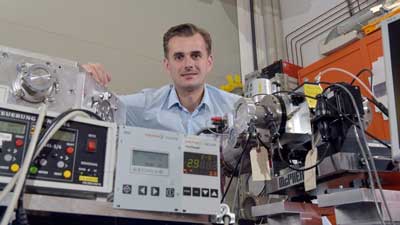 Dr Michael Zürch from the Institute of Optics and Quantum Electronics at the University of Jena investigates semiconductor materials to replace silicon in solar modules. (Photo: Jan-Peter Kasper/FSU)
Over the next four years, Zürch will be focusing intensively on these alternatives. With colleagues at the Chair of Quantum Electronics of the University of Jena, as well as French and US partners, he is launching his ‘Quest for Energy’ research project. The German Academic Exchange Service is funding the project until 2022 with around one million euros, as part of the German-French research initiative ‘Make our planet great again’.
Dr Michael Zürch from the Institute of Optics and Quantum Electronics at the University of Jena investigates semiconductor materials to replace silicon in solar modules. (Photo: Jan-Peter Kasper/FSU)
Over the next four years, Zürch will be focusing intensively on these alternatives. With colleagues at the Chair of Quantum Electronics of the University of Jena, as well as French and US partners, he is launching his ‘Quest for Energy’ research project. The German Academic Exchange Service is funding the project until 2022 with around one million euros, as part of the German-French research initiative ‘Make our planet great again’.
Dr Michael Zürch from the Institute of Optics and Quantum Electronics at the University of Jena investigates semiconductor materials to replace silicon in solar modules. (Photo: Jan-Peter Kasper/FSU)
Over the next four years, Zürch will be focusing intensively on these alternatives. With colleagues at the Chair of Quantum Electronics of the University of Jena, as well as French and US partners, he is launching his ‘Quest for Energy’ research project. The German Academic Exchange Service is funding the project until 2022 with around one million euros, as part of the German-French research initiative ‘Make our planet great again’.
