
Oct 22, 2018
(Nanowerk News) Using ferroelectricity instead of magnetism in computer memory saves energy. If ferroelectric bits were nanosized, this would also save space. But conventional wisdom dictates that ferroelectric properties disappear when the bits are made smaller.
Reports that hafnium oxide can be used to make a nanoscale ferroelectric have not yet convinced the field. University of Groningen (UG) physicists have now gathered evidence that could persuade the skeptics. It was published in Nature Materials ("A rhombohedral ferroelectric phase in epitaxially strained Hf0.5Zr0.5O2 thin films").
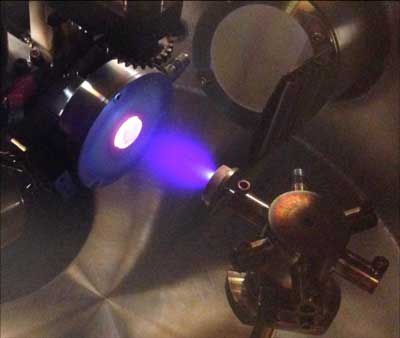 Inside view of the vacuum chamber in which the process of 'pulsed laser deposition' takes place, used to create the hafnium oxide crystals in this study. On the left the glowing substrate on which the film is growing with atomic control; in the center the blue plasma of ions that is created by shooting a laser on a target with the right chemical composition (target visible on the right side of the figure). (Image: Henk Bonder, University of Groningen)
Ferroelectric materials have a spontaneous dipole moment which can point up or down. This means that they can be used to store information, just like magnetic bits on a hard disk. The advantage of ferroelectric bits is that they can be written at a low voltage and power. Magnetic bits require large currents to create a magnetic field for switching, and thus more power. The disadvantage of ferroelectrics is that the aligned dipoles are only stable in fairly large groups, so if you make the crystals smaller, the dipole moment eventually disappears.
Inside view of the vacuum chamber in which the process of 'pulsed laser deposition' takes place, used to create the hafnium oxide crystals in this study. On the left the glowing substrate on which the film is growing with atomic control; in the center the blue plasma of ions that is created by shooting a laser on a target with the right chemical composition (target visible on the right side of the figure). (Image: Henk Bonder, University of Groningen)
Ferroelectric materials have a spontaneous dipole moment which can point up or down. This means that they can be used to store information, just like magnetic bits on a hard disk. The advantage of ferroelectric bits is that they can be written at a low voltage and power. Magnetic bits require large currents to create a magnetic field for switching, and thus more power. The disadvantage of ferroelectrics is that the aligned dipoles are only stable in fairly large groups, so if you make the crystals smaller, the dipole moment eventually disappears.
Inside view of the vacuum chamber in which the process of 'pulsed laser deposition' takes place, used to create the hafnium oxide crystals in this study. On the left the glowing substrate on which the film is growing with atomic control; in the center the blue plasma of ions that is created by shooting a laser on a target with the right chemical composition (target visible on the right side of the figure). (Image: Henk Bonder, University of Groningen)
Ferroelectric materials have a spontaneous dipole moment which can point up or down. This means that they can be used to store information, just like magnetic bits on a hard disk. The advantage of ferroelectric bits is that they can be written at a low voltage and power. Magnetic bits require large currents to create a magnetic field for switching, and thus more power. The disadvantage of ferroelectrics is that the aligned dipoles are only stable in fairly large groups, so if you make the crystals smaller, the dipole moment eventually disappears.
