
Oct 31, 2018
(Nanowerk News) Researchers can design the perfect molecule to edit a gene, treat cancer or guide the development of a stem cell, but none of that will matter in the end if they can't get their molecules into the human cells they want to manipulate. The solution to that problem, described in a study published in Science Advances ("Universal intracellular biomolecule delivery with precise dosage control"), could be miniscule nanostraws, tiny glass-like protrusions which poke equally tiny holes in cell walls to deliver their cargo.
A team led by Nicholas Melosh, an associate professor of materials science and engineering, first began testing nanostraws about five years ago using relatively tough cell lines derived from cancers, mouse cells and other sources. Now, Melosh and colleagues have shown the technique works in human cells as well, a result that could speed up medical and biological research and could one day improve gene therapy for diseases of the eyes, immune system or cancers.
"What you're seeing is a huge push for gene therapy and cancer immunotherapy," said Melosh, who is also a member of Stanford Bio-X, Stanford ChEM-H and the Wu Tsai Neurosciences Institute, but existing techniques are not up the challenge of delivering materials to all the relevant human cell types, especially immune cells. "They're really tough compared to almost all other cells that we've handled," he said.
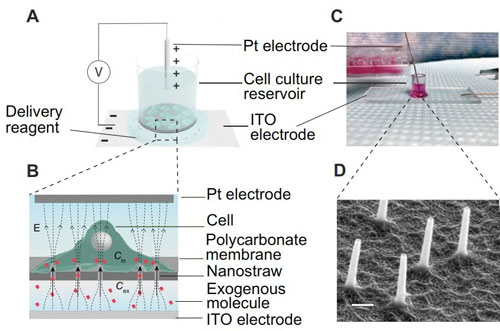 Design and operation of the nanostraw-electroporation system (NES). (A) Cells are cultured on the NS membrane in a well plate geometry. (B) The delivery reagent is placed under the bottom of the reservoir. An electric field is applied between the platinum and ITO electrode to deliver exogenous molecules into cells. (C) Schematic of NES delivery mechanism. The molecules beneath the NS membrane are electrophoretically injected into cells of interest through the NS. The delivered concentration (Cin) is in quadratic relationship with voltage intensity that is applied to the cells (V) and is proportional to the concentration of exogenous molecules (Cex) and the delivery duration. (D) SEM image of the NS protruding from the membrane. Scale bar, 300 nm. (© NPG) (click on image to enlarge)
 Design and operation of the nanostraw-electroporation system (NES). (A) Cells are cultured on the NS membrane in a well plate geometry. (B) The delivery reagent is placed under the bottom of the reservoir. An electric field is applied between the platinum and ITO electrode to deliver exogenous molecules into cells. (C) Schematic of NES delivery mechanism. The molecules beneath the NS membrane are electrophoretically injected into cells of interest through the NS. The delivered concentration (Cin) is in quadratic relationship with voltage intensity that is applied to the cells (V) and is proportional to the concentration of exogenous molecules (Cex) and the delivery duration. (D) SEM image of the NS protruding from the membrane. Scale bar, 300 nm. (© NPG) (click on image to enlarge)
