
Nov 08, 2018
(Nanowerk News) Each year, there are some 13.3 million new cases of acute kidney injury (AKI), a serious affliction. Formerly known as acute renal failure, the ailment produces a rapid buildup of nitrogenous wastes and decreases urine output, usually within hours or days of disease onset. Severe complications often ensue.
AKI is responsible for 1.7 million deaths annually. Protecting healthy kidneys from harm and treating those already injured remains a significant challenge for modern medicine.
In new research appearing in the journal Nature Biomedical Engineering ("DNA origami nanostructures can exhibit preferential renal uptake and alleviate acute kidney injury"), Hao Yan and his colleagues at the University of Wisconsin-Madison and in China describe a new method for treating and preventing AKI. Their technique involves the use of tiny, self-assembling forms measuring just billionths of a meter in diameter.
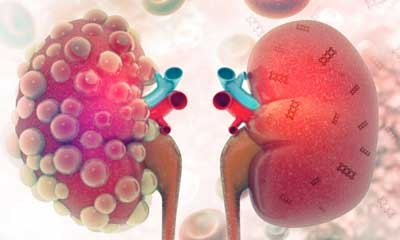 The illustration shows a diseased kidney on the left and a healthy kidney on the right, after rectangular DNA nanostructures migrated and accumulated in the kidney, acting to alleviate damage due to oxidative stress. (Graphic by Shireen Dooling)
Yan directs the Biodesign Center for Molecular Design and Biomimetics and is the Martin D. Glick Distinguished Professor in the School of Molecular Sciences at ASU.
The triangular, tubular and rectangular shapes are designed and built using a method known as DNA origami. Here, the base pairing properties of DNA's four nucleotides are used to engineer and fabricate DNA origami nanostructures (DONs), which self-assemble and preferentially accumulate in kidneys.
"The interdisciplinary collaboration between nanomedicine and the in-vivo imaging team led by professor Weibo Cai at the University of Wisconsin-Madison and the DNA nanotechnology team has led to a novel application--applying DNA origami nanostructures to treat acute kidney injury," Yan says. "This represents a new horizon for DNA nanotechnology research."
Experiments described in the new study--conducted in mice as well as human embryonic kidney cells--suggest that DONs act as a rapid and active kidney protectant and may also alleviate symptoms of AKI. The distribution of DONs was examined with positron emission tomography (PET). Results showed that the rectangular nanostructures were particularly successful, protecting the kidneys from harm as effectively as the leading drug therapy and alleviating a leading source of AKI known as oxidative stress.
The study is the first to explore the distribution of DNA nanostructures in a living system by means of quantitative imaging with PET and paves the way for a host of new therapeutic approaches for the treatment of AKI as well as other renal diseases.
"This is an excellent example of team science, with multidisciplinary and multinational collaboration," Cai said. "The four research groups are located in different countries, but they communicate regularly and have synergistic expertise. The three equally-contributing first authors (Dawei Jiang, Zhilei Ge, Hyung-Jun Im) also have very different backgrounds, one in radiolabeling and imaging, one in DNA nanostructures, and the other in clinical nuclear medicine. Together, they drove the project forward."
The illustration shows a diseased kidney on the left and a healthy kidney on the right, after rectangular DNA nanostructures migrated and accumulated in the kidney, acting to alleviate damage due to oxidative stress. (Graphic by Shireen Dooling)
Yan directs the Biodesign Center for Molecular Design and Biomimetics and is the Martin D. Glick Distinguished Professor in the School of Molecular Sciences at ASU.
The triangular, tubular and rectangular shapes are designed and built using a method known as DNA origami. Here, the base pairing properties of DNA's four nucleotides are used to engineer and fabricate DNA origami nanostructures (DONs), which self-assemble and preferentially accumulate in kidneys.
"The interdisciplinary collaboration between nanomedicine and the in-vivo imaging team led by professor Weibo Cai at the University of Wisconsin-Madison and the DNA nanotechnology team has led to a novel application--applying DNA origami nanostructures to treat acute kidney injury," Yan says. "This represents a new horizon for DNA nanotechnology research."
Experiments described in the new study--conducted in mice as well as human embryonic kidney cells--suggest that DONs act as a rapid and active kidney protectant and may also alleviate symptoms of AKI. The distribution of DONs was examined with positron emission tomography (PET). Results showed that the rectangular nanostructures were particularly successful, protecting the kidneys from harm as effectively as the leading drug therapy and alleviating a leading source of AKI known as oxidative stress.
The study is the first to explore the distribution of DNA nanostructures in a living system by means of quantitative imaging with PET and paves the way for a host of new therapeutic approaches for the treatment of AKI as well as other renal diseases.
"This is an excellent example of team science, with multidisciplinary and multinational collaboration," Cai said. "The four research groups are located in different countries, but they communicate regularly and have synergistic expertise. The three equally-contributing first authors (Dawei Jiang, Zhilei Ge, Hyung-Jun Im) also have very different backgrounds, one in radiolabeling and imaging, one in DNA nanostructures, and the other in clinical nuclear medicine. Together, they drove the project forward."
The illustration shows a diseased kidney on the left and a healthy kidney on the right, after rectangular DNA nanostructures migrated and accumulated in the kidney, acting to alleviate damage due to oxidative stress. (Graphic by Shireen Dooling)
Yan directs the Biodesign Center for Molecular Design and Biomimetics and is the Martin D. Glick Distinguished Professor in the School of Molecular Sciences at ASU.
The triangular, tubular and rectangular shapes are designed and built using a method known as DNA origami. Here, the base pairing properties of DNA's four nucleotides are used to engineer and fabricate DNA origami nanostructures (DONs), which self-assemble and preferentially accumulate in kidneys.
"The interdisciplinary collaboration between nanomedicine and the in-vivo imaging team led by professor Weibo Cai at the University of Wisconsin-Madison and the DNA nanotechnology team has led to a novel application--applying DNA origami nanostructures to treat acute kidney injury," Yan says. "This represents a new horizon for DNA nanotechnology research."
Experiments described in the new study--conducted in mice as well as human embryonic kidney cells--suggest that DONs act as a rapid and active kidney protectant and may also alleviate symptoms of AKI. The distribution of DONs was examined with positron emission tomography (PET). Results showed that the rectangular nanostructures were particularly successful, protecting the kidneys from harm as effectively as the leading drug therapy and alleviating a leading source of AKI known as oxidative stress.
The study is the first to explore the distribution of DNA nanostructures in a living system by means of quantitative imaging with PET and paves the way for a host of new therapeutic approaches for the treatment of AKI as well as other renal diseases.
"This is an excellent example of team science, with multidisciplinary and multinational collaboration," Cai said. "The four research groups are located in different countries, but they communicate regularly and have synergistic expertise. The three equally-contributing first authors (Dawei Jiang, Zhilei Ge, Hyung-Jun Im) also have very different backgrounds, one in radiolabeling and imaging, one in DNA nanostructures, and the other in clinical nuclear medicine. Together, they drove the project forward."
