
Nov 26, 2018
(Nanowerk News) Being able to control electronic systems using light waves instead of voltage signals is the dream of physicists all over the world. The advantage is that electromagnetic light waves oscillate at petaherz frequency. This means that computers in the future could operate at speeds a million times faster than those of today.
Scientists at Friedrich-Alexander-Universität Erlangen-Nürnberg (FAU) have now come one step closer to achieving this goal as they have succeeded in using ultra-short laser impulses to precisely control electrons in graphene
(Physical Review Letters, "Coherent Electron Trajectory Control in Graphene").
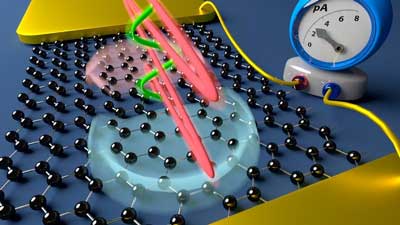 The driving laser field (red) 'shakes' electrons in graphene at ultrashort time scales, shown as violet and blue waves. A second laser pulse (green) can control this wave and thus determine the direction of the electron wave. (Image: Christian Heide)
Current control in electronics that is one million times faster than in today's systems is a dream for many. Ultimately, current control is one of the most important components as it is responsible for data and signal transmission. Controlling the flow of electrons using light waves instead of voltage signals, as is now the case, could make this dream a reality. However, up to now, it has been difficult to control the flow of electrons in metals as metals reflect light waves and the electrons inside them cannot be influenced by these light waves.
Physicists at FAU have therefore turned to graphene, a semi-metal that comprises only one single layer of carbon and is so thin that enough light can penetrate to enable electrons to be set in motion. In an earlier study, physicists at the Chair for Laser Physics had already succeeded in generating an electric signal at a time scale of only one femtosecond by using a very short laser pulse. This is equivalent to one millionth of one billionth of a second. In these extreme time scales, electrons reveal their quantum nature as they behave like a wave. The wave of electrons glides through the material as it is driven by the light field (the laser pulse).
The driving laser field (red) 'shakes' electrons in graphene at ultrashort time scales, shown as violet and blue waves. A second laser pulse (green) can control this wave and thus determine the direction of the electron wave. (Image: Christian Heide)
Current control in electronics that is one million times faster than in today's systems is a dream for many. Ultimately, current control is one of the most important components as it is responsible for data and signal transmission. Controlling the flow of electrons using light waves instead of voltage signals, as is now the case, could make this dream a reality. However, up to now, it has been difficult to control the flow of electrons in metals as metals reflect light waves and the electrons inside them cannot be influenced by these light waves.
Physicists at FAU have therefore turned to graphene, a semi-metal that comprises only one single layer of carbon and is so thin that enough light can penetrate to enable electrons to be set in motion. In an earlier study, physicists at the Chair for Laser Physics had already succeeded in generating an electric signal at a time scale of only one femtosecond by using a very short laser pulse. This is equivalent to one millionth of one billionth of a second. In these extreme time scales, electrons reveal their quantum nature as they behave like a wave. The wave of electrons glides through the material as it is driven by the light field (the laser pulse).
The driving laser field (red) 'shakes' electrons in graphene at ultrashort time scales, shown as violet and blue waves. A second laser pulse (green) can control this wave and thus determine the direction of the electron wave. (Image: Christian Heide)
Current control in electronics that is one million times faster than in today's systems is a dream for many. Ultimately, current control is one of the most important components as it is responsible for data and signal transmission. Controlling the flow of electrons using light waves instead of voltage signals, as is now the case, could make this dream a reality. However, up to now, it has been difficult to control the flow of electrons in metals as metals reflect light waves and the electrons inside them cannot be influenced by these light waves.
Physicists at FAU have therefore turned to graphene, a semi-metal that comprises only one single layer of carbon and is so thin that enough light can penetrate to enable electrons to be set in motion. In an earlier study, physicists at the Chair for Laser Physics had already succeeded in generating an electric signal at a time scale of only one femtosecond by using a very short laser pulse. This is equivalent to one millionth of one billionth of a second. In these extreme time scales, electrons reveal their quantum nature as they behave like a wave. The wave of electrons glides through the material as it is driven by the light field (the laser pulse).
