
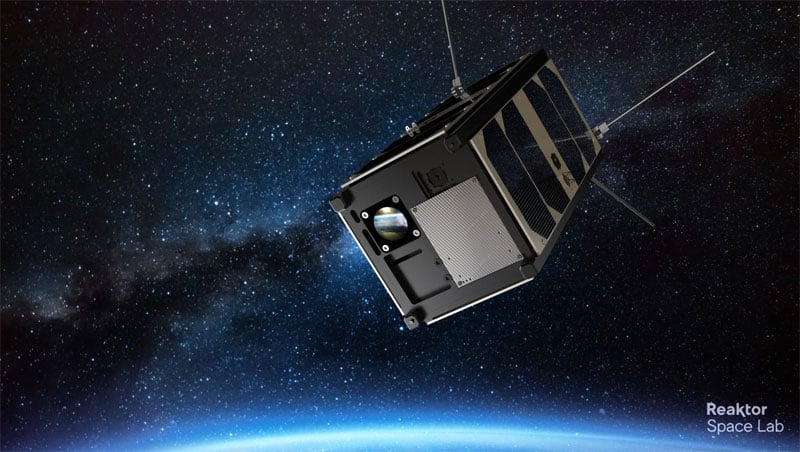
 3D render of the Reaktor Hello World satellite hosting the miniature IR hyperspectral imager for satellites. The satellite is only 10 cm wide and 20 cm long. Courtesy of VTT and Reaktor Space Lab.
The IR hyperspectral imager on board the Reaktor Hello World nanosatellite is a small, lightweight, 2D-snapshot tunable spectral imager operating in the shortwave-IR spectra (900-1400 nm). According to the VTT team, it is the world’s smallest IR hyperspectral camera and the first such device for nanosatellites.
3D render of the Reaktor Hello World satellite hosting the miniature IR hyperspectral imager for satellites. The satellite is only 10 cm wide and 20 cm long. Courtesy of VTT and Reaktor Space Lab.
The IR hyperspectral imager on board the Reaktor Hello World nanosatellite is a small, lightweight, 2D-snapshot tunable spectral imager operating in the shortwave-IR spectra (900-1400 nm). According to the VTT team, it is the world’s smallest IR hyperspectral camera and the first such device for nanosatellites.
The IR wavelength region shown by the hyperspectral imager contains data that can be used to recognize ground targets such as fields, forests, mines, or built infrastructure, and to analyze their features based on unique spectral fingerprints. These features could be related to the presence of chemicals such as fertilizers, biomass content, or rock species, for example. The hyperspectral imager can also monitor vegetation health and the composition of greenhouse gases.
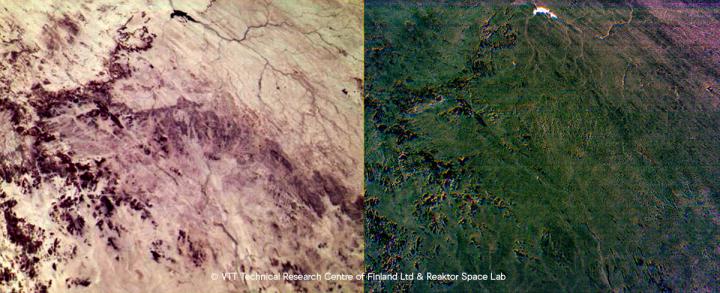 False color images of desert highland in southern Sahara. The image on the left depicts the changes of the soil type across the image while the image on the right displays changes in soil moisture. The water reservoir in the upper part of the image is very well highlighted in this image, when compared to the dark rocks. Courtesy of VTT and Reaktor Space Lab.
“This particular type of imaging data makes it possible to monitor the status of carbon sink resources,” said research team leader Anna Rissanen. “It also enables optimization of food production and reducing environmental load caused by agriculture, providing a way to sense water irrigation needs and optimize the use of fertilizers in fields.”
False color images of desert highland in southern Sahara. The image on the left depicts the changes of the soil type across the image while the image on the right displays changes in soil moisture. The water reservoir in the upper part of the image is very well highlighted in this image, when compared to the dark rocks. Courtesy of VTT and Reaktor Space Lab.
“This particular type of imaging data makes it possible to monitor the status of carbon sink resources,” said research team leader Anna Rissanen. “It also enables optimization of food production and reducing environmental load caused by agriculture, providing a way to sense water irrigation needs and optimize the use of fertilizers in fields.” 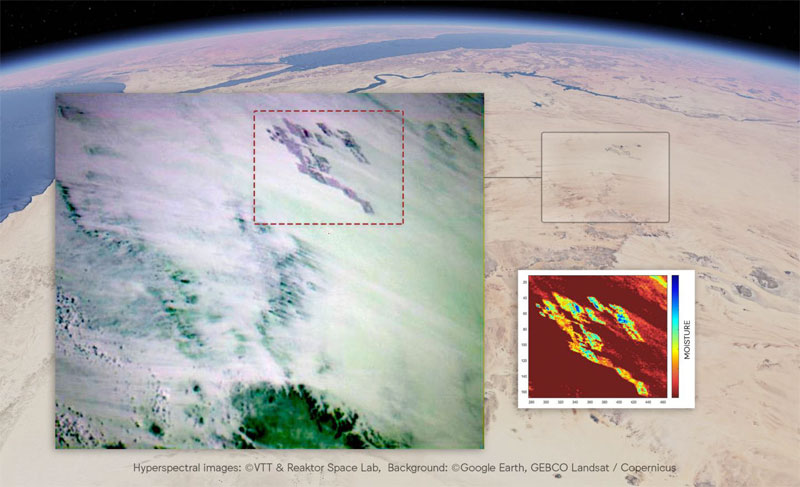 First land images from Reaktor Hello World overlaying image data from Google Earth. This image was taken above the Sahara, near the borders of Libya, Egypt, and Sudan. The fields in the upper right-hand corner of the image are part of an irrigation experiment. The reddish close-up image measures the spectral signature of water, which enables visualizing the changing moisture content in the ground. The image reveals differences of water content in the fields: The blue-green parts indicate better irrigation, whereas the yellow-orange parts signify drier conditions. Courtesy of Bergqvist Paula/VTT and Reaktor Space Lab.
Until now, hyperspectral imaging — the simultaneous collection of the optical spectrum at each point in an image — has been feasible only with large, expensive satellites. The larger satellites, in addition to their cost, came with significant restrictions — a single satellite could provide new data only when passing over a specific location and could produce new imagery only at intervals of several days.
In groups, nanosatellites can form cost-efficient constellations. “This new technology will allow us to react to global environmental changes in near real time,” said Tuomas Tikka, CEO of Reaktor Space Lab.
First land images from Reaktor Hello World overlaying image data from Google Earth. This image was taken above the Sahara, near the borders of Libya, Egypt, and Sudan. The fields in the upper right-hand corner of the image are part of an irrigation experiment. The reddish close-up image measures the spectral signature of water, which enables visualizing the changing moisture content in the ground. The image reveals differences of water content in the fields: The blue-green parts indicate better irrigation, whereas the yellow-orange parts signify drier conditions. Courtesy of Bergqvist Paula/VTT and Reaktor Space Lab.
Until now, hyperspectral imaging — the simultaneous collection of the optical spectrum at each point in an image — has been feasible only with large, expensive satellites. The larger satellites, in addition to their cost, came with significant restrictions — a single satellite could provide new data only when passing over a specific location and could produce new imagery only at intervals of several days.
In groups, nanosatellites can form cost-efficient constellations. “This new technology will allow us to react to global environmental changes in near real time,” said Tuomas Tikka, CEO of Reaktor Space Lab.
The team believes that its hyperspectral imaging technology could offer additional solutions for space exploration in the future.
