
Feb 28, 2019
(Nanowerk News) MIT researchers have developed a new genetic tool that could make it easier to engineer plants that can survive drought or resist fungal infections. Their technique, which uses nanoparticles to deliver genes into the chloroplasts of plant cells, works with many different plant species, including spinach and other vegetables.
This new strategy could help plant biologists to overcome the difficulties involved in genetically modifying plants, which is now a complex, time-consuming process that has to be customized to the specific plant species that is being altered.
“This is a universal mechanism that works across plant species,” says Michael Strano, the Carbon P. Dubbs Professor of Chemical Engineering at MIT, about the new method.
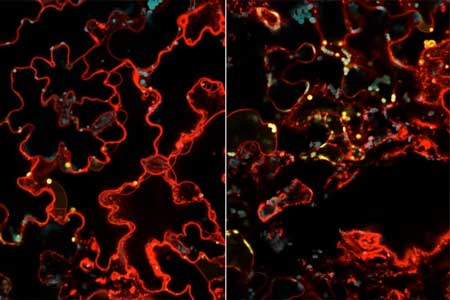 MIT engineers have developed a way to deliver genes to the chloroplasts of plant cells. In these images, mesophyll cells (right) and epidermal cells (left) in an arugula leaf have been engineered to express a yellow fluorescent protein in their chloroplasts. Cell walls are stained red and chloroplasts are stained blue. (Image: Tedrick Thomas Salim Lew and Seon-Yeong Kwak)
Strano and Nam-Hai Chua, the deputy chair of the Temasek Life Sciences Laboratory at the National University of Singapore and a professor emeritus at Rockefeller University, are the senior authors of the study, which appears in Nature Nanotechnology ("Chloroplast-selective gene delivery and expression in planta using chitosan-complexed single-walled carbon nanotube carriers").
“This is an important first step toward chloroplast transformation,” Chua says. “This technique can be used for rapid screening of candidate genes for chloroplast expression in a wide variety of crop plants.”
This study is the first to emerge from the recently launched Singapore-MIT Alliance for Research and Technology (SMART) program in Disruptive and Sustainable Technologies for Agricultural Precision (DiSTAP), which is headed by Strano and Chua. The lead authors of the study are former MIT postdoc Seon-Yeong Kwak, who is now the scientific director of the DiSTAP program, and MIT graduate student Tedrick Thomas Salim Lew. The research team included scientists from Yield10 Bioscience.
MIT engineers have developed a way to deliver genes to the chloroplasts of plant cells. In these images, mesophyll cells (right) and epidermal cells (left) in an arugula leaf have been engineered to express a yellow fluorescent protein in their chloroplasts. Cell walls are stained red and chloroplasts are stained blue. (Image: Tedrick Thomas Salim Lew and Seon-Yeong Kwak)
Strano and Nam-Hai Chua, the deputy chair of the Temasek Life Sciences Laboratory at the National University of Singapore and a professor emeritus at Rockefeller University, are the senior authors of the study, which appears in Nature Nanotechnology ("Chloroplast-selective gene delivery and expression in planta using chitosan-complexed single-walled carbon nanotube carriers").
“This is an important first step toward chloroplast transformation,” Chua says. “This technique can be used for rapid screening of candidate genes for chloroplast expression in a wide variety of crop plants.”
This study is the first to emerge from the recently launched Singapore-MIT Alliance for Research and Technology (SMART) program in Disruptive and Sustainable Technologies for Agricultural Precision (DiSTAP), which is headed by Strano and Chua. The lead authors of the study are former MIT postdoc Seon-Yeong Kwak, who is now the scientific director of the DiSTAP program, and MIT graduate student Tedrick Thomas Salim Lew. The research team included scientists from Yield10 Bioscience.
MIT engineers have developed a way to deliver genes to the chloroplasts of plant cells. In these images, mesophyll cells (right) and epidermal cells (left) in an arugula leaf have been engineered to express a yellow fluorescent protein in their chloroplasts. Cell walls are stained red and chloroplasts are stained blue. (Image: Tedrick Thomas Salim Lew and Seon-Yeong Kwak)
Strano and Nam-Hai Chua, the deputy chair of the Temasek Life Sciences Laboratory at the National University of Singapore and a professor emeritus at Rockefeller University, are the senior authors of the study, which appears in Nature Nanotechnology ("Chloroplast-selective gene delivery and expression in planta using chitosan-complexed single-walled carbon nanotube carriers").
“This is an important first step toward chloroplast transformation,” Chua says. “This technique can be used for rapid screening of candidate genes for chloroplast expression in a wide variety of crop plants.”
This study is the first to emerge from the recently launched Singapore-MIT Alliance for Research and Technology (SMART) program in Disruptive and Sustainable Technologies for Agricultural Precision (DiSTAP), which is headed by Strano and Chua. The lead authors of the study are former MIT postdoc Seon-Yeong Kwak, who is now the scientific director of the DiSTAP program, and MIT graduate student Tedrick Thomas Salim Lew. The research team included scientists from Yield10 Bioscience.
