
Mar 12, 2019
(Nanowerk News) In the field of physics, everything that has mass and takes up space is matter. Active matter consists of many self-propelled entities uniting to create large-scale structures and movements, such as a group of molecules interacting to enable muscle contraction, or a flock of birds synchronizing in flight to form complex patterns.
Active matter has become a major subject of research over the past several years, promising to revolutionize everything from medicine to robotics. Physicists theorize that by converting the internal energy of active matter into motion, they can ultimately harness active matter to create materials that behave like living organisms, and maybe even self-replicating nanomachines.
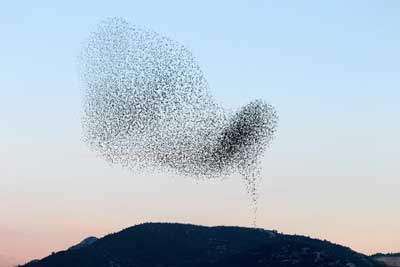 The collective behavior of a flock of birds synchronizing in flight to form patterns is an example of active matter.
John Gibbs, assistant professor of physics at Northern Arizona University, was recently awarded a $502,000 grant from the National Science Foundation (NSF) to build on research he’s been conducting in the field of active matter. The award will support a five-year project during which Gibbs and his team will develop a unique system of microscale self-propelled particles (SPPs) that will enable them to control the movement and interaction of colloidal SPPs (moving microparticles suspended in a liquid) in unprecedented ways.
Gibbs’ system will combine several innovative properties, including controllable particle speed, made possible by modulating the intensity of an external activating light source; a new fuel-free method of microscale motion; and tunable long-range interactions between the particles.
“Our main innovation is employing repulsive magnetic dipole-dipole interactions so that our active colloidal particles do not come into direct contact, which overcomes the limitation of the particles jamming or ‘freezing.’ More importantly, through targeted engineering, we can exploit this same repulsive force so that the particles show highly correlated velocity directions; in other words, the particles automatically align their motion in the same direction, mimicking systems encountered in nature,” said Gibbs.
The collective behavior of a flock of birds synchronizing in flight to form patterns is an example of active matter.
John Gibbs, assistant professor of physics at Northern Arizona University, was recently awarded a $502,000 grant from the National Science Foundation (NSF) to build on research he’s been conducting in the field of active matter. The award will support a five-year project during which Gibbs and his team will develop a unique system of microscale self-propelled particles (SPPs) that will enable them to control the movement and interaction of colloidal SPPs (moving microparticles suspended in a liquid) in unprecedented ways.
Gibbs’ system will combine several innovative properties, including controllable particle speed, made possible by modulating the intensity of an external activating light source; a new fuel-free method of microscale motion; and tunable long-range interactions between the particles.
“Our main innovation is employing repulsive magnetic dipole-dipole interactions so that our active colloidal particles do not come into direct contact, which overcomes the limitation of the particles jamming or ‘freezing.’ More importantly, through targeted engineering, we can exploit this same repulsive force so that the particles show highly correlated velocity directions; in other words, the particles automatically align their motion in the same direction, mimicking systems encountered in nature,” said Gibbs.
The collective behavior of a flock of birds synchronizing in flight to form patterns is an example of active matter.
John Gibbs, assistant professor of physics at Northern Arizona University, was recently awarded a $502,000 grant from the National Science Foundation (NSF) to build on research he’s been conducting in the field of active matter. The award will support a five-year project during which Gibbs and his team will develop a unique system of microscale self-propelled particles (SPPs) that will enable them to control the movement and interaction of colloidal SPPs (moving microparticles suspended in a liquid) in unprecedented ways.
Gibbs’ system will combine several innovative properties, including controllable particle speed, made possible by modulating the intensity of an external activating light source; a new fuel-free method of microscale motion; and tunable long-range interactions between the particles.
“Our main innovation is employing repulsive magnetic dipole-dipole interactions so that our active colloidal particles do not come into direct contact, which overcomes the limitation of the particles jamming or ‘freezing.’ More importantly, through targeted engineering, we can exploit this same repulsive force so that the particles show highly correlated velocity directions; in other words, the particles automatically align their motion in the same direction, mimicking systems encountered in nature,” said Gibbs.
