
Mar 08, 2019
(Nanowerk News) Combining an atomically thin graphene and a boron nitride layer at a slightly rotated angle changes their electrical properties. Physicists at the University of Basel have now shown for the first time the combination with a third layer can result in new material properties also in a three-layer sandwich of carbon and boron nitride.
This significantly increases the number of potential synthetic materials, report the researchers in the scientific journal Nano Letters ("New Generation of Moiré Superlattices in Doubly Aligned hBN/Graphene/hBN Heterostructures").
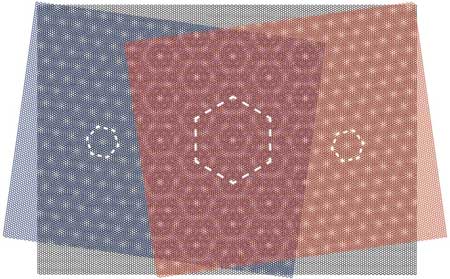 A graphene layer (black) of hexagonally arranged carbon atoms is placed between two layers of boron nitride atoms, which are also arranged hexagonally with a slightly different size. The overlap creates honeycomb patterns in various sizes. (Image: Swiss Nanoscience Institute, University of Basel)
Last year, researchers in the US caused a big stir when they showed that rotating two stacked graphene layers by a “magical” angle of 1.1 degrees turns graphene superconducting – a striking example of how the combination of atomically thin materials can produce completely new electrical properties.
A graphene layer (black) of hexagonally arranged carbon atoms is placed between two layers of boron nitride atoms, which are also arranged hexagonally with a slightly different size. The overlap creates honeycomb patterns in various sizes. (Image: Swiss Nanoscience Institute, University of Basel)
Last year, researchers in the US caused a big stir when they showed that rotating two stacked graphene layers by a “magical” angle of 1.1 degrees turns graphene superconducting – a striking example of how the combination of atomically thin materials can produce completely new electrical properties.
A graphene layer (black) of hexagonally arranged carbon atoms is placed between two layers of boron nitride atoms, which are also arranged hexagonally with a slightly different size. The overlap creates honeycomb patterns in various sizes. (Image: Swiss Nanoscience Institute, University of Basel)
Last year, researchers in the US caused a big stir when they showed that rotating two stacked graphene layers by a “magical” angle of 1.1 degrees turns graphene superconducting – a striking example of how the combination of atomically thin materials can produce completely new electrical properties.
