
| Date | 26th, Apr 2019 |
|---|
Home > Press > Coal could yield treatment for traumatic injuries: Rice, Texas A&M, UTHealth scientists discover coal-derived �dots� are effective antioxidant
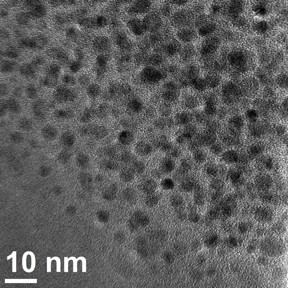 Coal-derived graphene quantum dots as seen under an electron microscope. Rice University scientists have modified the dots to serve as antioxidants. (Credit: Tour Group/Rice University)
Abstract: Graphene quantum dots drawn from common coal may be the basis for an effective antioxidant for people who suffer traumatic brain injuries, strokes or heart attacks.
Houston, TX | Posted on April 25th, 2019
Their ability to quench oxidative stress after such injuries is the subject of a study by scientists at Rice University, the Texas A&M Health Science Center and the McGovern Medical School at The University of Texas Health Science Center at Houston (UTHealth).
Quantum dots are semiconducting materials small enough to exhibit quantum mechanical properties that only appear at the nanoscale.
Rice chemist James Tour, A&M neurologist Thomas Kent and UTHealth biochemist Ah-Lim Tsai and their teams found the biocompatible dots, when modified with a common polymer, are effective mimics of the body's own superoxide dismutase, one of many natural enzymes that keep oxidative stress in check.
But because natural antioxidants can be overwhelmed by the rapid production of reactive oxygen species (ROS) that race to heal an injury, the team has been working for years to see if a quick injection of reactive nanomaterials can limit the collateral damage these free radicals can cause to healthy cells.
An earlier study by the trio showed that hydrophilic clusters modified with polyethylene glycol (PEG) to improve their solubility and biological stability are effective at quenching oxidative stress, as a single nanoparticle had the ability to neutralize thousands of ROS molecules.
"Replacing our earlier nanoparticles with coal-derived quantum dots makes it much simpler and less expensive to produce these potentially therapeutic materials," Tour said. "It opens the door to more readily accessible therapies."
Tests on cell lines showed a mix of PEG and graphene quantum dots from common coal is just as effective at halting damage from superoxide and hydrogen peroxides as the earlier materials, but the dots themselves are more disclike than the ribbonlike clusters.
The results appear in the American Chemical Society journal ACS Applied Materials & Interfaces.
The Tour lab first extracted quantum dots from coal in 2013 and reported on their potential for medical imaging, sensing, electronic and photovoltaic applications. A subsequent study showed how they can be engineered for specific semiconducting properties.
In the new study, the researchers evaluated the dots' electrochemical, chemical and biological activity. The Rice lab chemically extracted quantum dots from inexpensive bituminous and anthracite coal, modified them with the polymer and tested their abilities on live cells from rodents.
The results showed that quantum dot doses in various concentrations were highly effective at protecting cells from oxidation, even if the doses were delayed by 15 minutes after the researchers added damaging hydrogen peroxide to the cell culture dishes.
The disclike, 3-5-nanometer bituminous quantum dots are smaller than the 10-20-nanometer anthracite dots. The researchers found the level of protection was dose-dependent for both types of particles, but that the larger anthracite-derived dots protected more cells at lower concentrations.
"Although they both work in cells, in vivo, the smaller ones are more effective," Tour said. "The larger ones likely have trouble accessing the brain as well."
Rice graduate students Lizanne Nilewski and Kimberly Mendoza, also an intern at Baylor College of Medicine, and postdoctoral researcher Almaz Jalilov are lead authors of the paper. Co-authors are UTHealth research scientist Vladimir Berka and hematology instructor Gang Wu; Rice graduate students William Sikkema, Andrew Metzger, Ruquan Ye, Rui Zhang, Duy Xuan Luong, Tuo Wang and Emily McHugh; Paul Derry, an assistant professor at Texas A&M, and Rice alumnus Errol Lo�c Samuel, group leader of biophysical chemistry at Baylor.
Tour is the T.T. and W.F. Chao Chair in Chemistry as well as a professor of computer science and of materials science and nanoengineering at Rice. Kent is the Robert A. Welch Chair Professor in the Institute of Biosciences and Technology at Texas A&M-Houston Campus and an adjunct professor at Houston Methodist Hospital. Tsai is a professor of hematology at UTHealth.
The Alliance for NanoHealth, the National Institutes of Health, the Dunn Foundation, the National Defense Science Engineering Graduate Fellowship and the Welch Foundation supported the research.
####
About Rice UniversityLocated on a 300-acre forested campus in Houston, Rice University is consistently ranked among the nation�s top 20 universities by U.S. News & World Report. Rice has highly respected schools of Architecture, Business, Continuing Studies, Engineering, Humanities, Music, Natural Sciences and Social Sciences and is home to the Baker Institute for Public Policy. With 3,962 undergraduates and 3,027 graduate students, Rice�s undergraduate student-to-faculty ratio is just under 6-to-1. Its residential college system builds close-knit communities and lifelong friendships, just one reason why Rice is ranked No. 1 for lots of race/class interaction and No. 2 for quality of life by the Princeton Review. Rice is also rated as a best value among private universities by Kiplinger�s Personal Finance.
Follow Rice News and Media Relations via Twitter @RiceUNews.
For more information, please click here
Contacts:David Ruth713-348-6327
Mike Williams713-348-6728
Copyright © Rice University
If you have a comment, please Contact us.
Issuers of news releases, not 7th Wave, Inc. or Nanotechnology Now, are solely responsible for the accuracy of the content.
Bookmark:


 Coal yields graphene quantum dots:
Rice fine-tunes quantum dots from coal:
Wiess School of Natural Sciences:
Chemistry
Nanoscale chemically ordered-disordered domains in Fe3Pt alloys and their three-dimensional interface and lattice strain May 27th, 2022
News and information
Two opposing approaches could give lithium-sulfur batteries a leg up over lithium-ion July 1st, 2022
Efficiently processing high-quality periodic nanostructures with ultrafast laser July 1st, 2022
Photonic synapses with low power consumption and high sensitivity are expected to integrate sensing-memory-preprocessing capabilities July 1st, 2022
Graphene/ Graphite
OCSiAl expands its graphene nanotube production capacities to Europe June 17th, 2022
Bumps could smooth quantum investigations: Rice University models show unique properties of 2D materials stressed by contoured substrates June 10th, 2022
Nanotubes: a promising solution for advanced rubber cables with 60% less conductive filler June 1st, 2022
Govt.-Legislation/Regulation/Funding/Policy
Solving the solar energy storage problem with rechargeable batteries that can convert and store energy at once June 24th, 2022
Boron nitride nanotube fibers get real: Rice lab creates first heat-tolerant, stable fibers from wet-spinning process June 24th, 2022
UBCO researchers change the game when it comes to activity tracking: Flexible, highly sensitive motion device created by extrusion printing June 17th, 2022
University of Illinois Chicago joins Brookhaven Lab's Quantum Center June 10th, 2022
Possible Futures
Sieving carbons: Ideal anodes for high-energy sodium-ion batteries July 1st, 2022
An artificial intelligence probe help see tumor malignancy July 1st, 2022
Photon-controlled diode: an optoelectronic device with a new signal processing behavior July 1st, 2022
Nanomedicine
An artificial intelligence probe help see tumor malignancy July 1st, 2022
New technology helps reveal inner workings of human genome June 24th, 2022
Discoveries
Sieving carbons: Ideal anodes for high-energy sodium-ion batteries July 1st, 2022
Efficiently processing high-quality periodic nanostructures with ultrafast laser July 1st, 2022
Photonic synapses with low power consumption and high sensitivity are expected to integrate sensing-memory-preprocessing capabilities July 1st, 2022
Materials/Metamaterials
New protocol for assessing the safety of nanomaterials July 1st, 2022
Nanotubes: a promising solution for advanced rubber cables with 60% less conductive filler June 1st, 2022
New route to build materials out of tiny particles May 27th, 2022
A one-stop shop for quantum sensing materials May 27th, 2022
Announcements
Two opposing approaches could give lithium-sulfur batteries a leg up over lithium-ion July 1st, 2022
Efficiently processing high-quality periodic nanostructures with ultrafast laser July 1st, 2022
Photonic synapses with low power consumption and high sensitivity are expected to integrate sensing-memory-preprocessing capabilities July 1st, 2022
Interviews/Book Reviews/Essays/Reports/Podcasts/Journals/White papers/Posters
Sieving carbons: Ideal anodes for high-energy sodium-ion batteries July 1st, 2022
An artificial intelligence probe help see tumor malignancy July 1st, 2022
Photon-controlled diode: an optoelectronic device with a new signal processing behavior July 1st, 2022
Military
Boron nitride nanotube fibers get real: Rice lab creates first heat-tolerant, stable fibers from wet-spinning process June 24th, 2022
Bumps could smooth quantum investigations: Rice University models show unique properties of 2D materials stressed by contoured substrates June 10th, 2022
Nanostructured fibers can impersonate human muscles June 3rd, 2022
Lightening up the nanoscale long-wavelength optoelectronics May 13th, 2022
Grants/Sponsored Research/Awards/Scholarships/Gifts/Contests/Honors/Records
Solving the solar energy storage problem with rechargeable batteries that can convert and store energy at once June 24th, 2022
Boron nitride nanotube fibers get real: Rice lab creates first heat-tolerant, stable fibers from wet-spinning process June 24th, 2022
Quantum Dots/Rods
New substance classes for nanomaterials: Nano spheres and diamond slivers made of silicon and germanium: Potential applications as nano semiconductor materials September 10th, 2021
�Missing jigsaw piece�: engineers make critical advance in quantum computer design August 20th, 2021
Nanobiotechnology
New technology helps reveal inner workings of human genome June 24th, 2022
Research partnerships
New technology helps reveal inner workings of human genome June 24th, 2022
Boron nitride nanotube fibers get real: Rice lab creates first heat-tolerant, stable fibers from wet-spinning process June 24th, 2022
