
| Date | 4th, May 2019 |
|---|
Home > Press > No ink needed for these graphene artworks: Artist employs Rice University lab's laser-induced graphene as medium for ultramodern art
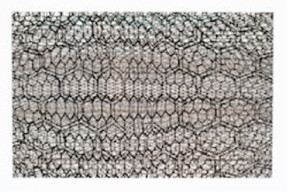 The "ink" in "Where Do I Stand?" by artist Joseph Cohen is actually laser-induced graphene (LIG). The design shows Cohen's impression of what LIG looks like at the microscopic level. The work was produced in the Rice University lab where the technique of creating LIG was invented. (Credit: Jeff Fitlow/Rice University)
Abstract: When you read about electrifying art, "electrifying" isn't usually a verb. But an artist working with a Rice University lab is in fact making artwork that can deliver a jolt.
Houston, TX | Posted on May 3rd, 2019
The Rice lab of chemist James Tour introduced laser-induced graphene (LIG) to the world in 2014, and now the researchers are making art with the technique, which involves converting carbon in a common polymer or other material into microscopic flakes of graphene.
LIG is metallic and conducts electricity. The interconnected flakes are effectively a wire that could empower electronic artworks.
The paper in the American Chemical Society journal ACS Applied Nano Materials � simply titled "Graphene Art" � lays out how the lab and Houston artist and co-author Joseph Cohen generated LIG portraits and prints, including a graphene-inspired landscape called "Where Do I Stand?"
While the work isn't electrified, Cohen said it lays the groundwork for future possibilities.
"That's what I would like to do," he said. "Not make it kitsch or play off the novelty, but to have it have some true functionality that allows greater awareness about the material and opens up the experience."
Cohen created the design in an illustration program and sent it directly to the industrial engraving laser Tour's lab uses to create LIG on a variety of materials. The laser burned the artist's fine lines into the substrate, in this case archive-quality paper treated with fire retardant.
The piece, which was part of Cohen's exhibit at Rice's BioScience Research Collaborative last year, peers into the depths of what a viewer shrunken to nanoscale might see when facing a field of LIG, with overlapping hexagons � the basic lattice of atom-thick graphene � disappearing into the distance.
"You�re looking at this image of a 3D foam matrix of laser-induced graphene and it's actually made of LIG," he said. "I didn't base it on anything; I was just thinking about what it would look like. When I shared it with Jim, he said, 'Wow, that's what it would look like if you could really blow this up.'"
Cohen said his art is about media specificity.
"In terms of the artistic application, you're not looking at a representation of something, as traditionally we would in the history of art," he said. "Each piece is 100% original. That's the key."
He developed an interest in nanomaterials as media for his art when he began work with Rice alumnus Daniel Heller, a bioengineer at Memorial Sloan Kettering Cancer Center in New York who established an artist-in-residency position in his lab.
After two years of creating with carbon nanotube-infused paint, Cohen attended an Electrochemical Society conference and met Tour, who in turn introduced him to Rice chemists Bruce Weisman and Paul Cherukuri, who further inspired his investigation of nanotechnology.
The rest is art history.
It would be incorrect to think of the process as "printing," Tour said. Instead of adding a substance to the treated paper, substance is burned away as the laser turns the surface into foamlike flakes of interconnected graphene.
The art itself can be much more than eye candy, given LIG's potential for electronic applications like sensors or as triboelectric generators that turn mechanical actions into current.
"You could put LIG on your back and have it flash LEDs with every step you take," Tour said.
The fact that graphene is a conductor -- unlike paint, ink or graphite from a pencil -- makes it particularly appealing to Cohen, who expects to take advantage of that capability in future works.
"It's art with a capital A that is trying to do the most that it can with advancements in science and technology," he said. "If we look back historically, from the Renaissance to today, the highest forms of art push the limits of human understanding."
Rice graduate student Yieu Chyan is lead author of the paper. Co-authors are undergraduate Winston Wang and graduate student Chenhao Zhang. Tour is the T.T. and W.F. Chao Chair in Chemistry as well as a professor of computer science and of materials science and nanoengineering at Rice.
####
About Rice UniversityLocated on a 300-acre forested campus in Houston, Rice University is consistently ranked among the nation�s top 20 universities by U.S. News & World Report. Rice has highly respected schools of Architecture, Business, Continuing Studies, Engineering, Humanities, Music, Natural Sciences and Social Sciences and is home to the Baker Institute for Public Policy. With 3,962 undergraduates and 3,027 graduate students, Rice�s undergraduate student-to-faculty ratio is just under 6-to-1. Its residential college system builds close-knit communities and lifelong friendships, just one reason why Rice is ranked No. 1 for lots of race/class interaction and No. 2 for quality of life by the Princeton Review. Rice is also rated as a best value among private universities by Kiplinger�s Personal Finance.
Follow Rice News and Media Relations via Twitter @RiceUNews.
For more information, please click here
Contacts:David Ruth713-348-6327
Mike Williams713-348-6728
Copyright © Rice University
If you have a comment, please Contact us.
Issuers of news releases, not 7th Wave, Inc. or Nanotechnology Now, are solely responsible for the accuracy of the content.
Bookmark:


 Defects are perfect in laser-induced graphene:
Wiess School of Natural Sciences:
News and information
Two opposing approaches could give lithium-sulfur batteries a leg up over lithium-ion July 1st, 2022
Efficiently processing high-quality periodic nanostructures with ultrafast laser July 1st, 2022
Photonic synapses with low power consumption and high sensitivity are expected to integrate sensing-memory-preprocessing capabilities July 1st, 2022
Graphene/ Graphite
OCSiAl expands its graphene nanotube production capacities to Europe June 17th, 2022
Bumps could smooth quantum investigations: Rice University models show unique properties of 2D materials stressed by contoured substrates June 10th, 2022
Nanotubes: a promising solution for advanced rubber cables with 60% less conductive filler June 1st, 2022
Dynamic metasurfaces and metadevices empowered by graphene May 6th, 2022
Possible Futures
Sieving carbons: Ideal anodes for high-energy sodium-ion batteries July 1st, 2022
An artificial intelligence probe help see tumor malignancy July 1st, 2022
Photon-controlled diode: an optoelectronic device with a new signal processing behavior July 1st, 2022
Announcements
Two opposing approaches could give lithium-sulfur batteries a leg up over lithium-ion July 1st, 2022
Efficiently processing high-quality periodic nanostructures with ultrafast laser July 1st, 2022
Photonic synapses with low power consumption and high sensitivity are expected to integrate sensing-memory-preprocessing capabilities July 1st, 2022
Interviews/Book Reviews/Essays/Reports/Podcasts/Journals/White papers/Posters
Sieving carbons: Ideal anodes for high-energy sodium-ion batteries July 1st, 2022
An artificial intelligence probe help see tumor malignancy July 1st, 2022
Photon-controlled diode: an optoelectronic device with a new signal processing behavior July 1st, 2022
Human Interest/Art
Scientists prepare for the world�s smallest race: Nanocar Race II March 18th, 2022
Graphene nanotubes revolutionize touch screen use for prosthetic hands August 3rd, 2021
JEOL Announces 2020 Microscopy Image Grand Prize Winners January 7th, 2021
'Quantum Rhapsodies' performance explores quantum physics, its role in our universe April 5th, 2019
Printing/Lithography/Inkjet/Inks/Bio-printing/Dyes
On-Chip Photodetection: Two-dimensional material heterojunctions hetero-integration May 13th, 2022
