
| Date | 4th, May 2019 |
|---|
Home > Press > Sculpting Super-Fast Light Pulses: NIST Nanopillars Shape Light Precisely for Practical Applications
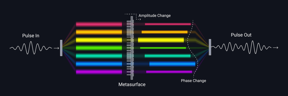 Schematic shows a novel technique to reshape the properties of an ultrafast light pulse. An incoming pulse of light (left) is dispersed into its various constituent frequencies, or colors, and directed into a metasurface composed of millions of tiny silicon pillars and an integrated polarizer. The nanopillars are specifically designed to simultaneously and independently shape such properties of each frequency component as its amplitude, phase or polarization. The transmitted beam is then recombined to achieve a new shape-modified pulse (right).
Credit: S. Kelley/NIST
Schematic shows a novel technique to reshape the properties of an ultrafast light pulse. An incoming pulse of light (left) is dispersed into its various constituent frequencies, or colors, and directed into a metasurface composed of millions of tiny silicon pillars and an integrated polarizer. The nanopillars are specifically designed to simultaneously and independently shape such properties of each frequency component as its amplitude, phase or polarization. The transmitted beam is then recombined to achieve a new shape-modified pulse (right).
Credit: S. Kelley/NIST
Abstract: Imagine being able to shape a pulse of light in any conceivable manner�compressing it, stretching it, splitting it in two, changing its intensity or altering the direction of its electric field.
Gaithersburg, MD | Posted on May 3rd, 2019
Controlling the properties of ultrafast light pulses is essential for sending information through high-speed optical circuits and in probing atoms and molecules that vibrate thousands of trillions of times a second. But the standard method of pulse shaping�using devices known as spatial light modulators�is costly, bulky and lacks the fine control scientists increasingly need. In addition, these devices are typically based on liquid crystals that can be damaged by the very same pulses of high intensity laser light they were designed to shape.
Now researchers at the National Institute of Standards and Technology (NIST) and the University of Maryland�s NanoCenter in College Park have developed a novel and compact method of sculpting light. They first deposited a layer of ultrathin silicon on glass, just a few hundred nanometers (billionths of a meter) thick, and then covered an array of millions of tiny squares of the silicon with a protective material. By etching away the silicon surrounding each square, the team created millions of tiny pillars, which played a key role in the light sculpting technique.
The flat, ultrathin device is an example of a metasurface, which is used to change the properties of a light wave traveling through it. By carefully designing the shape, size, density and distribution of the nanopillars, multiple properties of each light pulse can now be tailored simultaneously and independently with nanoscale precision. These properties include the amplitude, phase and polarization of the wave.
A light wave, a set of oscillating electric and magnetic fields oriented at right angles to each other, has peaks and troughs similar to an ocean wave. If you�re standing in the ocean, the frequency of the wave is how often the peaks or troughs travel past you, the amplitude is the height of the waves (trough to peak), and the phase is where you are relative to the peaks and troughs.
�We figured out how to independently and simultaneously manipulate the phase and amplitude of each frequency component of an ultrafast laser pulse,� said Amit Agrawal, of NIST and the NanoCenter. �To achieve this, we used carefully designed sets of silicon nanopillars, one for each constituent color in the pulse, and an integrated polarizer fabricated on the back of the device.�
When a light wave travels through a set of the silicon nanopillars, the wave slows down compared with its speed in air and its phase is delayed�the moment when the wave reaches its next peak is slightly later than the time at which the wave would have reached its next peak in air. The size of the nanopillars determines the amount by which the phase changes, whereas the orientation of the nanopillars changes the light wave�s polarization. When a device known as a polarizer is attached to the back of the silicon, the change in polarization can be translated to a corresponding change in amplitude.
Altering the phase, amplitude or polarization of a light wave in a highly controlled manner can be used to encode information. The rapid, finely tuned changes can also be used to study and change the outcome of chemical or biological processes. For instance, alterations in an incoming light pulse could increase or decrease the product of a chemical reaction. In these ways, the nanopillar method promises to open new vistas in the study of ultrafast phenomenon and high-speed communication.
Agrawal, along with Henri Lezec of NIST and their collaborators, describe the findings online today in the journal Science.
�We wanted to extend the impact of metasurfaces beyond their typical application�changing the shape of an optical wavefront spatially�and use them instead to change how the light pulse varies in time,� said Lezec.
A typical ultrafast laser light pulse lasts for only a few femtoseconds, or one thousandth of a trillionth of a second, too short for any device to shape the light at one particular instant. Instead, Agrawal, Lezec and their colleagues devised a strategy to shape the individual frequency components or colors that make up the pulse by first separating the light into those components with an optical device called a diffraction grating.
Each color has a different intensity or amplitude�similar to the way a musical overtone is composed of many individual notes that have different volumes. When directed into the nanopillar-etched silicon surface, different frequency components struck different sets of nanopillars. Each set of nanopillars was tailored to alter the phase, intensity or electric field orientation (polarization) of components in a particular way. A second diffraction grating then recombined all the components to create the newly shaped pulse.
The researchers designed their nanopillar system to work with ultrafast light pulses (10 femtoseconds or less, equivalent to one hundredth of a trillionth of a second) composed of a broad range of frequency components that span wavelengths from 700 nanometers (visible red light) to 900 nanometers (near-infrared). By simultaneously and independently altering the amplitude and phase of these frequency components, the scientists demonstrated that their method could compress, split and distort pulses in a controllable manner.
Further refinements in the device will give scientists additional control over the time evolution of light pulses and may enable researchers to shape in exquisite detail individual lines in a frequency comb, a precise tool for measuring the frequencies of light used in such devices as atomic clocks and for identifying planets around distant stars.
####
For more information, please click here
Contacts:MEDIA CONTACTJennifer Huergo
(301) 975-6343
TECHNICAL CONTACTAmit Agrawal
(301) 975-4633
Copyright © National Institute of Standards and Technology (NIST)
If you have a comment, please Contact us.
Issuers of news releases, not 7th Wave, Inc. or Nanotechnology Now, are solely responsible for the accuracy of the content.
Bookmark:


News and information
 Two opposing approaches could give lithium-sulfur batteries a leg up over lithium-ion July 1st, 2022
Efficiently processing high-quality periodic nanostructures with ultrafast laser July 1st, 2022
Photonic synapses with low power consumption and high sensitivity are expected to integrate sensing-memory-preprocessing capabilities July 1st, 2022
Laboratories
University of Illinois Chicago joins Brookhaven Lab's Quantum Center June 10th, 2022
A one-stop shop for quantum sensing materials May 27th, 2022
Govt.-Legislation/Regulation/Funding/Policy
Solving the solar energy storage problem with rechargeable batteries that can convert and store energy at once June 24th, 2022
Boron nitride nanotube fibers get real: Rice lab creates first heat-tolerant, stable fibers from wet-spinning process June 24th, 2022
UBCO researchers change the game when it comes to activity tracking: Flexible, highly sensitive motion device created by extrusion printing June 17th, 2022
University of Illinois Chicago joins Brookhaven Lab's Quantum Center June 10th, 2022
Possible Futures
Sieving carbons: Ideal anodes for high-energy sodium-ion batteries July 1st, 2022
An artificial intelligence probe help see tumor malignancy July 1st, 2022
Photon-controlled diode: an optoelectronic device with a new signal processing behavior July 1st, 2022
Discoveries
Sieving carbons: Ideal anodes for high-energy sodium-ion batteries July 1st, 2022
Efficiently processing high-quality periodic nanostructures with ultrafast laser July 1st, 2022
Photonic synapses with low power consumption and high sensitivity are expected to integrate sensing-memory-preprocessing capabilities July 1st, 2022
Announcements
Two opposing approaches could give lithium-sulfur batteries a leg up over lithium-ion July 1st, 2022
Efficiently processing high-quality periodic nanostructures with ultrafast laser July 1st, 2022
Photonic synapses with low power consumption and high sensitivity are expected to integrate sensing-memory-preprocessing capabilities July 1st, 2022
Interviews/Book Reviews/Essays/Reports/Podcasts/Journals/White papers/Posters
Sieving carbons: Ideal anodes for high-energy sodium-ion batteries July 1st, 2022
An artificial intelligence probe help see tumor malignancy July 1st, 2022
Photon-controlled diode: an optoelectronic device with a new signal processing behavior July 1st, 2022
Tools
New technology helps reveal inner workings of human genome June 24th, 2022
Snapshot measurement of single nanostructure�s circular dichroism March 25th, 2022
Eyebrow-raising: Researchers reveal why nanowires stick to each other February 11th, 2022
JEOL Introduces New Scanning Electron Microscope with �Simple SEM� Automation and Live Elemental and 3D Analysis January 14th, 2022
Aerospace/Space
Boron nitride nanotube fibers get real: Rice lab creates first heat-tolerant, stable fibers from wet-spinning process June 24th, 2022
University of Strathclyde and National University of Singapore to co-ordinate satellite quantum communications May 13th, 2022
Lightening up the nanoscale long-wavelength optoelectronics May 13th, 2022
Photonics/Optics/Lasers
Photon-controlled diode: an optoelectronic device with a new signal processing behavior July 1st, 2022
Efficiently processing high-quality periodic nanostructures with ultrafast laser July 1st, 2022
Photonic synapses with low power consumption and high sensitivity are expected to integrate sensing-memory-preprocessing capabilities July 1st, 2022
Research partnerships
New technology helps reveal inner workings of human genome June 24th, 2022
Boron nitride nanotube fibers get real: Rice lab creates first heat-tolerant, stable fibers from wet-spinning process June 24th, 2022
