
| Date | 3rd, Aug 2019 |
|---|
Home > Press > Nanoscribe expands its worldwide presence: Specialist for 3D nano and micro fabrication opens US subsidiary for service and sales
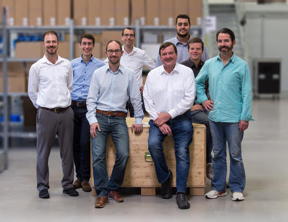
Abstract: Nanoscribe GmbH is further expanding its sales and service activities on the American continent. The new subsidiary opens its location in the Boston area (USA) on 1 August 2019. The German manufacturer of 3D printers for microfabrication sees this step as an important element of its internationalization strategy.
Eggenstein-Leopoldshafen, Germany | Posted on July 31st, 2019
Today, many top American universities already rely on Nanoscribe's 3D microfabrication technology, such as Harvard University and Boston University in Massachusetts, Stanford University and the California Institute of Technology in California. In addition to the steady expansion of relations with the science and research market, the company now also intends to push ahead with market penetration in the industrial environment, starting with the first pioneering customers. CEO Martin Hermatschweiler sees the US as a strong sales market with growth potential. "From Boston, we can now react even more flexibly to our customers' wishes and offer them the best possible support," says Hermatschweiler, who will lead the US subsidiary as General Manager.
Following the establishment of a subsidiary in China in 2018, the German high-tech company Nanoscribe is continuing its internationalization strategy with the opening of its US subsidiary. Numerous product prizes such as the Prism Award and most recently the Innovation Award of the LASER World of Photonics 2019 as well as various company awards underline the success story of the company founded in 2007 from the Karlsruhe Institute of Technology (KIT). With more than 70 employees, the world market and technology leader in the field of 3D microfabrication intends to increasingly focus on solutions for industrial manufacturing in the future.
In order to match this, Nanoscribe has recently added with Quantum X a completely new developed maskless lithography system to its portfolio. Quantum X is the first thoroughbred industrial device to benefit from patent-pending Two-Photon Grayscale Lithography (2GL) and has been specially designed for the production of challenging microoptical components. The 2GL additive manufacturing process combines the exceptional performance of grayscale lithography with the precision and flexibility of Nanoscribe's continuously evolving Two-Photon Polymerization (2PP). "With Quantum X, we provide users with a highly efficient and extremely precise manufacturing process that overcomes previous limitations in design freedom, precision, and throughput," explains Hermatschweiler.
This drastically shortens design iteration cycles for functional prototypes making the entire manufacturing process more time and cost-effective. Especially for the production of refractive and diffractive microoptical components, which are needed in the fields of augmented reality, sensor technology as well as for information and communication technology, these benefits are of particular interest. The additively produced microstructured surfaces are either used directly or integrated as masters into the process chain of a molding series production.
####
About Nanoscribe GmbHNanoscribe GmbH develops and provides 3D printers and maskless lithography systems for Microfabrication as well as photoresins and process solutions. Today�s market and technology leader for additive microfabrication was founded in 2007 as a spin-off of the Karlsruhe Institute of Technology (KIT, Germany) and has evolved to a medium-sized company with more than 70 employees and subsidiaries in China and the United States. Worldwide, more than 1,500 scientists at top universities and pioneer companies benefit from Nanoscribe�s groundbreaking technology and award-winning solutions for 3D microfabrication.
For more information, please click here
Contacts:Anke WernerMedia Contact+49 721 981 980 501
Copyright © Nanoscribe GmbH
If you have a comment, please Contact us.
Issuers of news releases, not 7th Wave, Inc. or Nanotechnology Now, are solely responsible for the accuracy of the content.
Bookmark:


News and information
 Two opposing approaches could give lithium-sulfur batteries a leg up over lithium-ion July 1st, 2022
Efficiently processing high-quality periodic nanostructures with ultrafast laser July 1st, 2022
Photonic synapses with low power consumption and high sensitivity are expected to integrate sensing-memory-preprocessing capabilities July 1st, 2022
New protocol for assessing the safety of nanomaterials July 1st, 2022
Nanofabrication
Efficiently processing high-quality periodic nanostructures with ultrafast laser July 1st, 2022
First integrated laser on lithium niobate chip: Research paves the way for high-powered telecommunication systems April 8th, 2022
Atom by atom: building precise smaller nanoparticles with templates March 4th, 2022
Review on the femtosecond laser precision micro/nano-engineering December 3rd, 2021
Openings/New facilities/Groundbreaking/Expansion
OCSiAl expands its graphene nanotube production capacities to Europe June 17th, 2022
Announcements
Two opposing approaches could give lithium-sulfur batteries a leg up over lithium-ion July 1st, 2022
Efficiently processing high-quality periodic nanostructures with ultrafast laser July 1st, 2022
Photonic synapses with low power consumption and high sensitivity are expected to integrate sensing-memory-preprocessing capabilities July 1st, 2022
Tools
New technology helps reveal inner workings of human genome June 24th, 2022
Snapshot measurement of single nanostructure�s circular dichroism March 25th, 2022
Eyebrow-raising: Researchers reveal why nanowires stick to each other February 11th, 2022
JEOL Introduces New Scanning Electron Microscope with �Simple SEM� Automation and Live Elemental and 3D Analysis January 14th, 2022
Alliances/Trade associations/Partnerships/Distributorships
University of Illinois Chicago joins Brookhaven Lab's Quantum Center June 10th, 2022
University of Strathclyde and National University of Singapore to co-ordinate satellite quantum communications May 13th, 2022
CEA and Startup C12 Join Forces to Develop Next-Generation Quantum Computers with Multi-Qubit Chips at Wafer Scale March 25th, 2022
