
| Date | 2nd, Aug 2019 |
|---|
Home > Press > Physicists make graphene discovery that could help develop superconductors: Rutgers-led research could reduce energy use, improve electronic devices
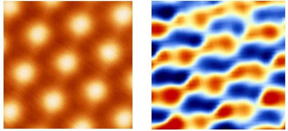 Left: This image, taken with a scanning tunneling microscope, shows a moir� pattern in "magic angle" twisted bilayer graphene. Right: Scanning tunneling charge spectroscopy, a technique invented by Professor Eva Andrei's group, reveals correlated electrons as shown by the alternating positive (blue) and negative (red) charge stripes that formed in the "magic angle" twisted bilayer graphene seen in the image at left.
Abstract: When two mesh screens are overlaid, beautiful patterns appear when one screen is offset. These "moir� patterns" have long intrigued artists, scientists and mathematicians and have found applications in printing, fashion and banknotes.
New Brunswick, NJ | Posted on August 1st, 2019
Now, a Rutgers-led team has paved the way to solving one of the most enduring mysteries in materials physics by discovering that in the presence of a moir� pattern in graphene, electrons organize themselves into stripes, like soldiers in formation.
Their findings, published in the journal Nature, could help in the search for quantum materials, such as superconductors, that would work at room temperature. Such materials would dramatically reduce energy consumption by making power transmission and electronic devices more efficient.
"Our findings provide an essential clue to the mystery connecting a form of graphene, called twisted bilayer graphene, to superconductors that could work at room temperature," said senior author Eva Y. Andrei, Board of Governors professor in Rutgers' Department of Physics and Astronomy in the School of Arts and Sciences at Rutgers University-New Brunswick.
Graphene - an atomically thin layer of the graphite used in pencils - is a mesh made of carbon atoms that looks like a honeycomb. It's a great conductor of electricity and much stronger than steel.
The Rutgers-led team studied twisted bilayer graphene, created by superimposing two layers of graphene and slightly misaligning them. This creates a "twist angle" that results in a moir� pattern which changes rapidly when the twist angle changes.
In 2010, Andrei's team discovered that in addition to being pretty, moir� patterns formed with twisted bilayer graphene have a dramatic effect on the electronic properties of the material. This is because the moir� pattern slows down the electrons that conduct electricity in graphene and zip past each other at great speeds.
At a twist angle of about 1.1 degrees - the so-called magic angle - these electrons come to an almost dead stop. The sluggish electrons start seeing each other and interact with their neighbors to move in lock-step. As a result, the material acquires amazing properties such as superconductivity or magnetism.
Using a technique invented by Andrei's group to study twisted bilayer graphene, the team discovered a state where the electrons organize themselves into stripes that are robust and difficult to break.
"Our team found a close resemblance between this feature and similar observations in high-temperature superconductors, providing new evidence of the deep link underlying these systems and opening the way to unraveling their enduring mystery," Andrei said.
###
The lead author is Rutgers post-doc Yuhang Jiang. Rutgers co-authors include post-doc Jinhai Mao, graduate student Xinyuan Lai and Professor Kristjan Haule. Scientists at the National Institute for Materials Science in Japan contributed to the study.
####
For more information, please click here
Contacts:Todd Bates
848-932-0550
Copyright © Rutgers University
If you have a comment, please Contact us.
Issuers of news releases, not 7th Wave, Inc. or Nanotechnology Now, are solely responsible for the accuracy of the content.
Bookmark:


News and information
 Two opposing approaches could give lithium-sulfur batteries a leg up over lithium-ion July 1st, 2022
Efficiently processing high-quality periodic nanostructures with ultrafast laser July 1st, 2022
Photonic synapses with low power consumption and high sensitivity are expected to integrate sensing-memory-preprocessing capabilities July 1st, 2022
2 Dimensional Materials
Controlled synthesis of crystal flakes paves path for advanced future electronics June 17th, 2022
Solving the puzzle of 2D disorder: An interdisciplinary team developed a new method to characterize disorder in 2D materials June 17th, 2022
UBCO researchers change the game when it comes to activity tracking: Flexible, highly sensitive motion device created by extrusion printing June 17th, 2022
Bumps could smooth quantum investigations: Rice University models show unique properties of 2D materials stressed by contoured substrates June 10th, 2022
Graphene/ Graphite
OCSiAl expands its graphene nanotube production capacities to Europe June 17th, 2022
Bumps could smooth quantum investigations: Rice University models show unique properties of 2D materials stressed by contoured substrates June 10th, 2022
Nanotubes: a promising solution for advanced rubber cables with 60% less conductive filler June 1st, 2022
Dynamic metasurfaces and metadevices empowered by graphene May 6th, 2022
Superconductivity
A new step in the search for room-temperature superconductors May 27th, 2022
Law enforcement/Anti-Counterfeiting/Security/Loss prevention
How randomly moving electrons can improve cyber security May 27th, 2022
Govt.-Legislation/Regulation/Funding/Policy
Solving the solar energy storage problem with rechargeable batteries that can convert and store energy at once June 24th, 2022
Boron nitride nanotube fibers get real: Rice lab creates first heat-tolerant, stable fibers from wet-spinning process June 24th, 2022
UBCO researchers change the game when it comes to activity tracking: Flexible, highly sensitive motion device created by extrusion printing June 17th, 2022
University of Illinois Chicago joins Brookhaven Lab's Quantum Center June 10th, 2022
Possible Futures
Sieving carbons: Ideal anodes for high-energy sodium-ion batteries July 1st, 2022
An artificial intelligence probe help see tumor malignancy July 1st, 2022
Photon-controlled diode: an optoelectronic device with a new signal processing behavior July 1st, 2022
Discoveries
Sieving carbons: Ideal anodes for high-energy sodium-ion batteries July 1st, 2022
Efficiently processing high-quality periodic nanostructures with ultrafast laser July 1st, 2022
Photonic synapses with low power consumption and high sensitivity are expected to integrate sensing-memory-preprocessing capabilities July 1st, 2022
Materials/Metamaterials
New protocol for assessing the safety of nanomaterials July 1st, 2022
Nanotubes: a promising solution for advanced rubber cables with 60% less conductive filler June 1st, 2022
New route to build materials out of tiny particles May 27th, 2022
A one-stop shop for quantum sensing materials May 27th, 2022
Announcements
Two opposing approaches could give lithium-sulfur batteries a leg up over lithium-ion July 1st, 2022
Efficiently processing high-quality periodic nanostructures with ultrafast laser July 1st, 2022
Photonic synapses with low power consumption and high sensitivity are expected to integrate sensing-memory-preprocessing capabilities July 1st, 2022
Interviews/Book Reviews/Essays/Reports/Podcasts/Journals/White papers/Posters
Sieving carbons: Ideal anodes for high-energy sodium-ion batteries July 1st, 2022
An artificial intelligence probe help see tumor malignancy July 1st, 2022
Photon-controlled diode: an optoelectronic device with a new signal processing behavior July 1st, 2022
Energy
Key in increasing efficiency of next-generation solar cell, found in �light absorption capacity�! July 1st, 2022
Solving the solar energy storage problem with rechargeable batteries that can convert and store energy at once June 24th, 2022
Organic water splitters get a boost June 10th, 2022
Research partnerships
New technology helps reveal inner workings of human genome June 24th, 2022
Boron nitride nanotube fibers get real: Rice lab creates first heat-tolerant, stable fibers from wet-spinning process June 24th, 2022
Printing/Lithography/Inkjet/Inks/Bio-printing/Dyes
On-Chip Photodetection: Two-dimensional material heterojunctions hetero-integration May 13th, 2022
