
| Date | 8th, Aug 2019 |
|---|
Home > Press > Cellulose nanofibers to improve the sensitivity of lateral flow tests
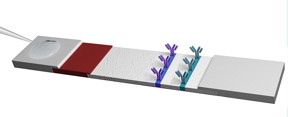
Abstract: Scientists from the ICN2 Nanobioelectronics and Biosensors Group led by ICREA Prof. Arben Merko�i have carried out a research to enhance the sensitivity of lateral flow tests. They have proposed to include cellulose nanofibers in the test area, which has produced an average increase of 36.6 % of the colorimetric signal on positive tests. The proposed modification can be easily applied to any kind of lateral flow strip, enabling its use in point-of-care applications.
Barcelona, Spain | Posted on August 7th, 2019
Lateral flow tests are used across a wide range of sectors including human health and pharma, environmental testing, animal health, food and feed testing, and plant and crop health. They are paper-based biosensors that fulfil all the demands of the World Health Organization for devices: the ASSURED criteria require them to be affordable, sensitive, selective, user-friendly, rapid and robust and derivable to the end-user. Paradoxically, sensitivity is not always assured.
Their way of working is simple: a fluid sample, with or without a specific analyte, is put in one end of the strip. Certain particles (transducers) prepared to attach to that analyte are dragged along by the fluid. A large amount of antibodies are placed in the test line to retain the analyte marked with the transducers. In case the analyte is present in the sample, the test line will be coloured because of the transducers. Otherwise, the particles will continue their journey to the end of the strip.
Researchers from the ICN2, in collaboration with University of Girona, have found a way to increase remarkably the sensitivity of the test with only a slight increase in time. The research has been led by ICREA Prof. Arben Merko�i, Group Leader of the ICN2 Nanobioelectronics and Biosensors Group, and counted with the participation of the ICN2 Advanced AFM Laboratory too, led by Dr Neus Domingo. The results have been published in Biosensors and Bioelectronics with Dr Daniel Quesada-Gonz�lez, now researcher at the spin-off Paperdropdx, as its first author.
One way to enhance the sensitivity of the strips has to do with their porosity. If pores are big enough, the transducers may go through them instead of stopping in the test line, decreasing sensitivity. On the other side, if pores are too small, sensitivity increases, but the sample will flow slower.
The new research proposes to decrease the pore size only on the test area by including cellulose nanofibers in that zone. They are biocompatible with antibodies, thus increasing the areas where they can be placed on the surface of the strip, where the colour of the transducer particles is best appreciated. Thanks to this modification, the researchers have observed an average increase of 36.6 % of the colorimetric signal, meaning that more transducer particles were retained in the test line. They have also demonstrated that this retention is only due to the interaction of the analytes with the antibodies, not because of any interactions of the transducers with cellulose nanofibers, which avoids false positives.
This strategy could be used to discriminate better between similar concentrations of a given analyte, which is useful especially on diagnostic applications. The higher level of sensitivity allows a quantitative analysis of the samples using a simple camera device like the ones integrated in smartphones. The proposed modification is cheap and can be easily applied, enabling its use in point-of-care applications.
####
For more information, please click here
Contacts:Francisco J. Pa�os
Copyright © ICN2
If you have a comment, please Contact us.
Issuers of news releases, not 7th Wave, Inc. or Nanotechnology Now, are solely responsible for the accuracy of the content.
Bookmark:


News and information
 Two opposing approaches could give lithium-sulfur batteries a leg up over lithium-ion July 1st, 2022
Efficiently processing high-quality periodic nanostructures with ultrafast laser July 1st, 2022
Photonic synapses with low power consumption and high sensitivity are expected to integrate sensing-memory-preprocessing capabilities July 1st, 2022
Possible Futures
Sieving carbons: Ideal anodes for high-energy sodium-ion batteries July 1st, 2022
An artificial intelligence probe help see tumor malignancy July 1st, 2022
Photon-controlled diode: an optoelectronic device with a new signal processing behavior July 1st, 2022
Nanomedicine
An artificial intelligence probe help see tumor malignancy July 1st, 2022
New technology helps reveal inner workings of human genome June 24th, 2022
Discoveries
Sieving carbons: Ideal anodes for high-energy sodium-ion batteries July 1st, 2022
Efficiently processing high-quality periodic nanostructures with ultrafast laser July 1st, 2022
Photonic synapses with low power consumption and high sensitivity are expected to integrate sensing-memory-preprocessing capabilities July 1st, 2022
Announcements
Two opposing approaches could give lithium-sulfur batteries a leg up over lithium-ion July 1st, 2022
Efficiently processing high-quality periodic nanostructures with ultrafast laser July 1st, 2022
Photonic synapses with low power consumption and high sensitivity are expected to integrate sensing-memory-preprocessing capabilities July 1st, 2022
Interviews/Book Reviews/Essays/Reports/Podcasts/Journals/White papers/Posters
Sieving carbons: Ideal anodes for high-energy sodium-ion batteries July 1st, 2022
An artificial intelligence probe help see tumor malignancy July 1st, 2022
Photon-controlled diode: an optoelectronic device with a new signal processing behavior July 1st, 2022
Tools
New technology helps reveal inner workings of human genome June 24th, 2022
Snapshot measurement of single nanostructure�s circular dichroism March 25th, 2022
Eyebrow-raising: Researchers reveal why nanowires stick to each other February 11th, 2022
JEOL Introduces New Scanning Electron Microscope with �Simple SEM� Automation and Live Elemental and 3D Analysis January 14th, 2022
Nanobiotechnology
New technology helps reveal inner workings of human genome June 24th, 2022
