
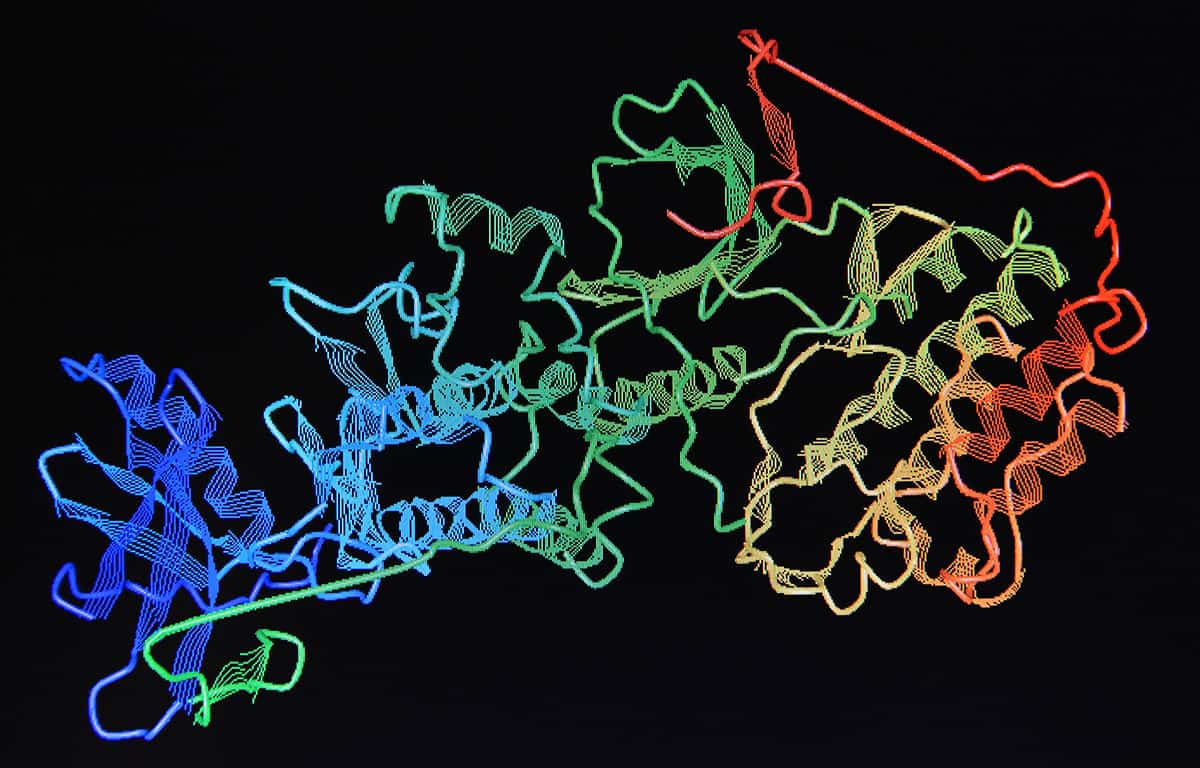
 Fast folding. A quantum approach solves the riddle at the heart of a range of biological processes. (Credit: iStock/sergunt)
The study of protein folding is fundamental in biophysics because it is important for understanding how proteins function in a wide range of biological processes and for investigating diseases like Alzheimer’s and Parkinson’s in which proteins misfold. Thanks to a new quantum approach, researchers in China have now found that proteins could fold much faster than previous calculations suggest.
Proteins consist of a long chain of molecules known as amino acids folded into a 3D shape. Researchers have been studying protein folding since the 1950s, and in 1956, two postdocs working at the Carlsberg Laboratory in Copenhagen, John Schellman and Bill Harrington, were the first to discover that protein folding reactions are very fast and often reversible. However, just over a decade later, physicist and molecular biologist Cyrus Levinthal pointed out that they may be extremely slow.
The Levinthal paradox
In his model, Levinthal assumed that a protein folds through a series of meta-stable intermediate states and that a myriad of different conformations are possible. He estimated that if a protein explored new conformations randomly at the rate at which a single molecular bond can rotate, the time it would take for it to explore all the possible conformations would amount to the age of the universe – even for a protein containing just 100 amino acid residues. Experiments show, however, that proteins can fold in less than a few seconds.
