
| Date | 13th, Aug 2019 |
|---|
Home > Press > Sharp meets flat in tunable 2D material: Rice's new atom-flat compounds show promise for optoelectronics, advanced computing
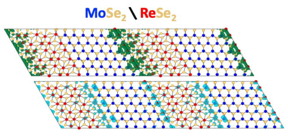 An illustration shows several arrangements of rhenium diselenide and molybdenum diselenide, which form a razor-sharp junction where they meet in a new transition metal dichalcogenide created at Rice University. The material is scalable and its band gap tunable for optoelectronics. (Credit: Ajayan Research Group/Rice University)
Abstract: A Rice University lab wants its products to look sharp, even at the nanoscale. Its latest creation is right on target.
Houston, TX | Posted on August 12th, 2019
The Rice lab of materials scientist Pulickel Ajayan has created unique two-dimensional flakes with two distinct personalities: molybdenum diselenide on one side of a sharp divide with rhenium diselenide on the other.
From all appearances, the two-toned material likes it that way, growing naturally � though under tight conditions � in a chemical vapor deposition furnace.
The material is a 2D transition metal dichalcogenide heterostructure, a crystal with more than one chemical component. That's not unusual in itself, but the sharp zigzag boundary between elements in the material reported in the American Chemical Society journal Nano Letters is unique.
Dichalcogenides are semiconductors that incorporate transition metals and chalcogens. They're a promising component for optoelectronic applications like solar cells, photodetectors and sensing devices. Lead author Amey Apte, a Rice graduate student, said they may also be suitable materials for quantum computing or neuromorphic computing, which emulates the structure of the human brain.
Apte said well-known, atomically flat molybdenum-tungsten dichalcogenide heterostructures can be more alloy-like, with diffuse boundaries between their crystal domains. However, the new material � technically, 2H MoSe2-1T' ReSe2 � has atomically sharp interfaces that gives it a smaller electronic band gap than other dichalcogenides.
"Instead of having one unique band gap based on the composition of an alloy, we can tune the band gap in this material in a very controllable way," Apte said. "The strong dissimilarity between two adjacent atomically thin domains opens up new avenues." He said the range of voltages likely spans from 1.5 to 2.5 electron volts.
Growing the materials reliably involved the creation of a phase diagram that laid out how each parameter � the balance of chemical gas precursor, the temperature and the time � affects the process. Rice graduate student and co-author Sandhya Susarla said the diagram serves as a road map for manufacturers.
"The biggest issue in these 2D materials has been that they're not very reproducible," she said. "They're very sensitive to a lot of parameters, because the process is kinetically controlled.
"But our process is scalable because it's thermodynamically controlled," Susarla said. "Manufacturers don't have a lot of parameters to look at. They just have to look at the phase diagram, control the composition and they will get the product every time."
The researchers think they can gain further control of the material's form by tailoring the substrate for epitaxial growth. Having the atoms fall into place in accordance with the surface's own atomic arrangement would allow for far more customization.
Co-authors of the paper are Rice graduate student Lucas Sassi; former postdoctoral researcher Jongwon Yoon, now a senior researcher at the Korea Basic Science Institute; Palash Bharadwaj, the Texas Instruments Assistant Professor of Electrical and Computer Engineering; alumnus Chandra Sekhar Tiwary, now an assistant professor at the Indian Institute of Technology, Kharagpur; and James Tour, the T.T. and W.F. Chao Chair in Chemistry, a professor of computer science and of materials science and nanoengineering; Aravind Krishnamoorthy, Rajiv Kalia, Aiichiro Nakano and Priya Vashishta of the University of Southern California and Jordan Hachtel and Juan Carlos Idrobo of Oak Ridge National Laboratory.
Ajayan is chair of Rice�s Department of Materials Science and NanoEngineering, the Benjamin M. and Mary Greenwood Anderson Professor in Engineering and a professor of chemistry.
The Department of Energy, Office of Science, Basic Energy Sciences and the Air Force Office of Scientific Research supported the research.
####
About Rice UniversityLocated on a 300-acre forested campus in Houston, Rice University is consistently ranked among the nation�s top 20 universities by U.S. News & World Report. Rice has highly respected schools of Architecture, Business, Continuing Studies, Engineering, Humanities, Music, Natural Sciences and Social Sciences and is home to the Baker Institute for Public Policy. With 3,962 undergraduates and 3,027 graduate students, Rice�s undergraduate student-to-faculty ratio is just under 6-to-1. Its residential college system builds close-knit communities and lifelong friendships, just one reason why Rice is ranked No. 1 for lots of race/class interaction and No. 4 for quality of life by the Princeton Review. Rice is also rated as a best value among private universities by Kiplinger�s Personal Finance.
Follow Rice News and Media Relations on Twitter @RiceUNews.
For more information, please click here
Contacts:Jeff Falk713-348-6775
Mike Williams713-348-6728
Copyright © Rice University
If you have a comment, please Contact us.
Issuers of news releases, not 7th Wave, Inc. or Nanotechnology Now, are solely responsible for the accuracy of the content.
Bookmark:


News and information
 Two opposing approaches could give lithium-sulfur batteries a leg up over lithium-ion July 1st, 2022
Efficiently processing high-quality periodic nanostructures with ultrafast laser July 1st, 2022
Photonic synapses with low power consumption and high sensitivity are expected to integrate sensing-memory-preprocessing capabilities July 1st, 2022
2 Dimensional Materials
Controlled synthesis of crystal flakes paves path for advanced future electronics June 17th, 2022
Solving the puzzle of 2D disorder: An interdisciplinary team developed a new method to characterize disorder in 2D materials June 17th, 2022
UBCO researchers change the game when it comes to activity tracking: Flexible, highly sensitive motion device created by extrusion printing June 17th, 2022
Bumps could smooth quantum investigations: Rice University models show unique properties of 2D materials stressed by contoured substrates June 10th, 2022
Laboratories
University of Illinois Chicago joins Brookhaven Lab's Quantum Center June 10th, 2022
Govt.-Legislation/Regulation/Funding/Policy
Solving the solar energy storage problem with rechargeable batteries that can convert and store energy at once June 24th, 2022
Boron nitride nanotube fibers get real: Rice lab creates first heat-tolerant, stable fibers from wet-spinning process June 24th, 2022
UBCO researchers change the game when it comes to activity tracking: Flexible, highly sensitive motion device created by extrusion printing June 17th, 2022
University of Illinois Chicago joins Brookhaven Lab's Quantum Center June 10th, 2022
Possible Futures
Sieving carbons: Ideal anodes for high-energy sodium-ion batteries July 1st, 2022
An artificial intelligence probe help see tumor malignancy July 1st, 2022
Photon-controlled diode: an optoelectronic device with a new signal processing behavior July 1st, 2022
Chip Technology
Photon-controlled diode: an optoelectronic device with a new signal processing behavior July 1st, 2022
Photonic synapses with low power consumption and high sensitivity are expected to integrate sensing-memory-preprocessing capabilities July 1st, 2022
Quantum Computing
University of Illinois Chicago joins Brookhaven Lab's Quantum Center June 10th, 2022
Bumps could smooth quantum investigations: Rice University models show unique properties of 2D materials stressed by contoured substrates June 10th, 2022
Discoveries
Sieving carbons: Ideal anodes for high-energy sodium-ion batteries July 1st, 2022
Efficiently processing high-quality periodic nanostructures with ultrafast laser July 1st, 2022
Photonic synapses with low power consumption and high sensitivity are expected to integrate sensing-memory-preprocessing capabilities July 1st, 2022
Announcements
Two opposing approaches could give lithium-sulfur batteries a leg up over lithium-ion July 1st, 2022
Efficiently processing high-quality periodic nanostructures with ultrafast laser July 1st, 2022
Photonic synapses with low power consumption and high sensitivity are expected to integrate sensing-memory-preprocessing capabilities July 1st, 2022
Interviews/Book Reviews/Essays/Reports/Podcasts/Journals/White papers/Posters
Sieving carbons: Ideal anodes for high-energy sodium-ion batteries July 1st, 2022
An artificial intelligence probe help see tumor malignancy July 1st, 2022
Photon-controlled diode: an optoelectronic device with a new signal processing behavior July 1st, 2022
Military
Boron nitride nanotube fibers get real: Rice lab creates first heat-tolerant, stable fibers from wet-spinning process June 24th, 2022
Bumps could smooth quantum investigations: Rice University models show unique properties of 2D materials stressed by contoured substrates June 10th, 2022
Nanostructured fibers can impersonate human muscles June 3rd, 2022
Lightening up the nanoscale long-wavelength optoelectronics May 13th, 2022
