
| Date | 15th, Aug 2019 |
|---|
Home > Press > Damaged hearts rewired with nanotube fibers: Texas Heart doctors confirm Rice-made, conductive carbon threads are electrical bridges
 (Credit: James Philpot/Texas Heart Institute)
The Texas Heart Institute (THI), founded by world-renowned cardiovascular surgeon Dr. Denton A. Cooley in 1962, is a nonprofit organization dedicated to reducing the devastating toll of cardiovascular disease through innovative and progressive programs in research, education and improved patient care. More information about THI (@Texas_Heart) is available at www.texasheart.org.
(Credit: James Philpot/Texas Heart Institute)
The Texas Heart Institute (THI), founded by world-renowned cardiovascular surgeon Dr. Denton A. Cooley in 1962, is a nonprofit organization dedicated to reducing the devastating toll of cardiovascular disease through innovative and progressive programs in research, education and improved patient care. More information about THI (@Texas_Heart) is available at www.texasheart.org.
Abstract: Thin, flexible fibers made of carbon nanotubes have now proven able to bridge damaged heart tissues and deliver the electrical signals needed to keep those hearts beating.
Houston, TX | Posted on August 14th, 2019
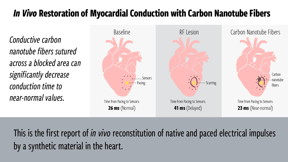
Scientists at Texas Heart Institute (THI) report they have used biocompatible fibers invented at Rice University in studies that showed sewing them directly into damaged tissue can restore electrical function to hearts.
"Instead of shocking and defibrillating, we are actually correcting diseased conduction of the largest major pumping chamber of the heart by creating a bridge to bypass and conduct over a scarred area of a damaged heart," said Dr. Mehdi Razavi, a cardiologist and director of Electrophysiology Clinical Research and Innovations at THI, who co-led the study with Rice chemical and biomolecular engineer Matteo Pasquali.
"Today there is no technology that treats the underlying cause of the No. 1 cause of sudden death, ventricular arrhythmias," Razavi said. "These arrhythmias are caused by the disorganized firing of impulses from the heart's lower chambers and are challenging to treat in patients after a heart attack or with scarred heart tissue due to such other conditions as congestive heart failure or dilated cardiomyopathy."
Results of the studies on preclinical models appear as an open-access Editor's Pick in the American Heart Association's Circulation: Arrhythmia and Electrophysiology. The association helped fund the research with a 2015 grant.
The research springs from the pioneering 2013 invention by Pasquali's lab of a method to make conductive fibers out of carbon nanotubes. The lab's first threadlike fibers were a quarter of the width of a human hair, but contained tens of millions of microscopic nanotubes. The fibers are also being studied for electrical interfaces with the brain, for use in cochlear implants, as flexible antennas and for automotive and aerospace applications.
The experiments showed the nontoxic, polymer-coated fibers, with their ends stripped to serve as electrodes, were effective in restoring function during monthlong tests in large preclinical models as well as rodents, whether the initial conduction was slowed, severed or blocked, according to the researchers. The fibers served their purpose with or without the presence of a pacemaker, they found.
In the rodents, they wrote, conduction disappeared when the fibers were removed.
"The reestablishment of cardiac conduction with carbon nanotube fibers has the potential to revolutionize therapy for cardiac electrical disturbances, one of the most common causes of death in the United States," said co-lead author Mark McCauley, who carried out many of the experiments as a postdoctoral fellow at THI. He is now an assistant professor of clinical medicine at the University of Illinois College of Medicine.
"Our experiments provided the first scientific support for using a synthetic material-based treatment rather than a drug to treat the leading cause of sudden death in the U.S. and many developing countries around the world," Razavi added.
Many questions remain before the procedure can move toward human testing, Pasquali said. The researchers must establish a way to sew the fibers in place using a minimally invasive catheter, and make sure the fibers are strong and flexible enough to serve a constantly beating heart over the long term. He said they must also determine how long and wide fibers should be, precisely how much electricity they need to carry and how they would perform in the growing hearts of young patients.
"Flexibility is important because the heart is continuously pulsating and moving, so anything that's attached to the heart's surface is going to be deformed and flexed," said Pasquali, who has appointments at Rice's Brown School of Engineering and Wiess School of Natural Sciences.
"Good interfacial contact is also critical to pick up and deliver the electrical signal," he said. "In the past, multiple materials had to be combined to attain both electrical conductivity and effective contacts. These fibers have both properties built in by design, which greatly simplifies device construction and lowers risks of long-term failure due to delamination of multiple layers or coatings."
Razavi noted that while there are many effective antiarrhythmic drugs available, they are often contraindicated in patients after a heart attack. "What is really needed therapeutically is to increase conduction," he said. �Carbon nanotube fibers have the conductive properties of metal but are flexible enough to allow us to navigate and deliver energy to a very specific area of a delicate, damaged heart."
Rice alumna Flavia Vitale, now an assistant professor of neurology and of physical medicine and rehabilitation at the University of Pennsylvania, and Stephen Yan, a graduate student at Rice, are co-lead authors of the paper.
Co-authors are Colin Young and Julia Coco of Rice; Brian Greet of THI and Baylor St. Luke's Medical Center; Marco Orecchioni and Lucia Delogu of the Citt� della Speranza Pediatric Research Institute, Padua, Italy; Abdelmotagaly Elgalad, Mathews John, Doris Taylor and Luiz Sampaio, all of THI; and Srikanth Perike of the University of Illinois at Chicago. Pasquali is the A.J. Hartsook Professor of Chemical and Biomolecular Engineering, a professor of materials science and nanoengineering and of chemistry.
The American Heart Association, the Welch Foundation, the Air Force Office of Scientific Research, the National Institutes of Health and Louis Magne supported the research.
####
About Rice UniversityLocated on a 300-acre forested campus in Houston, Rice University is consistently ranked among the nation�s top 20 universities by U.S. News & World Report. Rice has highly respected schools of Architecture, Business, Continuing Studies, Engineering, Humanities, Music, Natural Sciences and Social Sciences and is home to the Baker Institute for Public Policy. With 3,962 undergraduates and 3,027 graduate students, Rice�s undergraduate student-to-faculty ratio is just under 6-to-1. Its residential college system builds close-knit communities and lifelong friendships, just one reason why Rice is ranked No. 1 for lots of race/class interaction and No. 2 for quality of life by the Princeton Review. Rice is also rated as a best value among private universities by Kiplinger�s Personal Finance.
Follow Rice News and Media Relations via Twitter @RiceUNews.
For more information, please click here
Contacts:David Ruth713-348-6327
Mike Williams713-348-6728
AT TEXAS HEART INSTITUTE:Keri Sprung832-355-9240
Copyright © Rice University
If you have a comment, please Contact us.
Issuers of news releases, not 7th Wave, Inc. or Nanotechnology Now, are solely responsible for the accuracy of the content.
Bookmark:


 Nanotube fibers being tested as a way to restore electrical health to hearts:
Electrophysiology Clinical Research and Innovations:
News and information
Two opposing approaches could give lithium-sulfur batteries a leg up over lithium-ion July 1st, 2022
Efficiently processing high-quality periodic nanostructures with ultrafast laser July 1st, 2022
Photonic synapses with low power consumption and high sensitivity are expected to integrate sensing-memory-preprocessing capabilities July 1st, 2022
Govt.-Legislation/Regulation/Funding/Policy
Solving the solar energy storage problem with rechargeable batteries that can convert and store energy at once June 24th, 2022
Boron nitride nanotube fibers get real: Rice lab creates first heat-tolerant, stable fibers from wet-spinning process June 24th, 2022
UBCO researchers change the game when it comes to activity tracking: Flexible, highly sensitive motion device created by extrusion printing June 17th, 2022
University of Illinois Chicago joins Brookhaven Lab's Quantum Center June 10th, 2022
Possible Futures
Sieving carbons: Ideal anodes for high-energy sodium-ion batteries July 1st, 2022
An artificial intelligence probe help see tumor malignancy July 1st, 2022
Photon-controlled diode: an optoelectronic device with a new signal processing behavior July 1st, 2022
Nanotubes/Buckyballs/Fullerenes/Nanorods
Boron nitride nanotube fibers get real: Rice lab creates first heat-tolerant, stable fibers from wet-spinning process June 24th, 2022
Nanotubes: a promising solution for advanced rubber cables with 60% less conductive filler June 1st, 2022
Protective equipment with graphene nanotubes meets the strictest ESD safety standards March 25th, 2022
CEA and Startup C12 Join Forces to Develop Next-Generation Quantum Computers with Multi-Qubit Chips at Wafer Scale March 25th, 2022
Nanomedicine
An artificial intelligence probe help see tumor malignancy July 1st, 2022
New technology helps reveal inner workings of human genome June 24th, 2022
Discoveries
Sieving carbons: Ideal anodes for high-energy sodium-ion batteries July 1st, 2022
Efficiently processing high-quality periodic nanostructures with ultrafast laser July 1st, 2022
Photonic synapses with low power consumption and high sensitivity are expected to integrate sensing-memory-preprocessing capabilities July 1st, 2022
Announcements
Two opposing approaches could give lithium-sulfur batteries a leg up over lithium-ion July 1st, 2022
Efficiently processing high-quality periodic nanostructures with ultrafast laser July 1st, 2022
Photonic synapses with low power consumption and high sensitivity are expected to integrate sensing-memory-preprocessing capabilities July 1st, 2022
Interviews/Book Reviews/Essays/Reports/Podcasts/Journals/White papers/Posters
Sieving carbons: Ideal anodes for high-energy sodium-ion batteries July 1st, 2022
An artificial intelligence probe help see tumor malignancy July 1st, 2022
Photon-controlled diode: an optoelectronic device with a new signal processing behavior July 1st, 2022
Military
Boron nitride nanotube fibers get real: Rice lab creates first heat-tolerant, stable fibers from wet-spinning process June 24th, 2022
Bumps could smooth quantum investigations: Rice University models show unique properties of 2D materials stressed by contoured substrates June 10th, 2022
Nanostructured fibers can impersonate human muscles June 3rd, 2022
Lightening up the nanoscale long-wavelength optoelectronics May 13th, 2022
Grants/Sponsored Research/Awards/Scholarships/Gifts/Contests/Honors/Records
Solving the solar energy storage problem with rechargeable batteries that can convert and store energy at once June 24th, 2022
Boron nitride nanotube fibers get real: Rice lab creates first heat-tolerant, stable fibers from wet-spinning process June 24th, 2022
Nanobiotechnology
New technology helps reveal inner workings of human genome June 24th, 2022
Research partnerships
New technology helps reveal inner workings of human genome June 24th, 2022
Boron nitride nanotube fibers get real: Rice lab creates first heat-tolerant, stable fibers from wet-spinning process June 24th, 2022
