
| Date | 17th, Aug 2019 |
|---|
Home > Press > uSEE breakthrough unlocks the nanoscale world on standard biology lab equipment
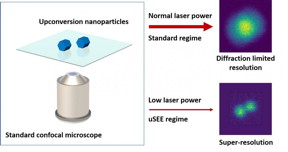 uSEE microscopy: Employing super-linear emitters (upconversion nanoparticles) in standard confocal microscopy can result in spontaneous 3D super-resolution imaging. Importantly for biology, and opposite to all other super-resolution techniques, the achieved sub-diffraction resolution is higher for lower excitation powers.
CREDIT
CNBP
uSEE microscopy: Employing super-linear emitters (upconversion nanoparticles) in standard confocal microscopy can result in spontaneous 3D super-resolution imaging. Importantly for biology, and opposite to all other super-resolution techniques, the achieved sub-diffraction resolution is higher for lower excitation powers.
CREDIT
CNBP
Abstract: The ability to observe how life works at a nanoscale level is a grand challenge of our time.
Sydney, Australia | Posted on August 16th, 2019
Standard optical microscopes can image cells and bacteria but not their nanoscale features which are blurred by a physical effect called diffraction.
Optical microscopes have evolved over the last two decades to overcome this diffraction limit; however, these so-called super-resolution techniques typically require expensive and elaborated instrumentation or imaging procedures.
Now, Australian researchers from the ARC Centre of Excellence for Nanoscale BioPhotonics (CNBP) report in Nature Communications a simple way to bypass diffraction limitations using standard optical imaging tools.
Lead authors Dr Denitza Denkova, and Dr Martin Ploschner from the CNBP node at Macquarie University say, "Working closely with biologists has inspired us to look for a solution that can transform super-resolution from a complex and expensive imaging method into an everyday bio-imaging technique."
Dr Ploschner explains how the technique works: "We have identified a particular type of fluorescent markers, so-called upconversion nanoparticles, that can enter into a regime in which light emitted from the particles grows abruptly �- in a super-linear fashion - when increasing the excitation light intensity. Our key discovery is that if this effect is exploited under the right imaging conditions, any standard scanning optical microscope can spontaneously image with super-resolution."
"While we have chosen to demonstrate this upconversion super-linear excitation-emission (uSEE) on one of the most commonly used types of optical microscopes - a confocal microscope - practically any type of scanning microscope or microscope involving variations in the illumination intensity can benefit from this spontaneous improvement of the resolution."
Dr Denitza Denkova says the uSEE approach improves the resolution beyond the diffraction limit simply by reducing the illumination intensity.
"Our approach works in the opposite direction to all other existing super-resolution methods; the lower the laser power, the better the resolution and the lower the risk of photo-damage to the bio-samples," she says.
"Best of all, super-resolution can be achieved without setup modifications and image processing. Thus, this method has the potential to enter any biological lab, at practically no extra cost."
"The value of our work is in realising the technique, for the first time, in a 3D biological setting, using biologically convenient particles. We suggest a modification of the composition of the nanoparticles and the imaging conditions, which triggers the spontaneous super-resolution to occur under a practically relevant microscopy configuration. We also develop a theoretical framework which allows end-users to adjust the particle composition and the imaging conditions and achieve super-resolution in their own laboratory setting."
"Our work enables microscopists to look in a new way with their existing tools."
CNBP node leader at Macquarie University, Professor James Piper AM, who is also an author on the paper, says the concept has been around for a while, but its practical realisation was elusive due to the need to combine the distinct research fields of biology, material science, optical engineering and physics.
"CNBP offered an ideal meeting platform for scientists with diverse expertise to join forces and take the idea from the drawing board to a practical imaging tool," Professor Piper says.
####
About Macquarie UniversityThe Centre for Nanoscale BioPhotonics (CNBP) is an Australian Research Council Centre of Excellence led by the University of Adelaide, with research focussed nodes also at Macquarie University, RMIT University, Griffith University and UNSW Sydney. A $40m initiative, the CNBP is focused on developing new light-based imaging and sensing tools, that can measure the inner workings of cells, inside the living body. http://cnbp.org.au/
For more information, please click here
Contacts:LJ Loch
61-488-038-555
Copyright © Macquarie University
If you have a comment, please Contact us.
Issuers of news releases, not 7th Wave, Inc. or Nanotechnology Now, are solely responsible for the accuracy of the content.
Bookmark:


Imaging
 An artificial intelligence probe help see tumor malignancy July 1st, 2022
News and information
Two opposing approaches could give lithium-sulfur batteries a leg up over lithium-ion July 1st, 2022
Efficiently processing high-quality periodic nanostructures with ultrafast laser July 1st, 2022
Photonic synapses with low power consumption and high sensitivity are expected to integrate sensing-memory-preprocessing capabilities July 1st, 2022
Govt.-Legislation/Regulation/Funding/Policy
Solving the solar energy storage problem with rechargeable batteries that can convert and store energy at once June 24th, 2022
Boron nitride nanotube fibers get real: Rice lab creates first heat-tolerant, stable fibers from wet-spinning process June 24th, 2022
UBCO researchers change the game when it comes to activity tracking: Flexible, highly sensitive motion device created by extrusion printing June 17th, 2022
University of Illinois Chicago joins Brookhaven Lab's Quantum Center June 10th, 2022
Possible Futures
Sieving carbons: Ideal anodes for high-energy sodium-ion batteries July 1st, 2022
An artificial intelligence probe help see tumor malignancy July 1st, 2022
Photon-controlled diode: an optoelectronic device with a new signal processing behavior July 1st, 2022
Nanomedicine
An artificial intelligence probe help see tumor malignancy July 1st, 2022
New technology helps reveal inner workings of human genome June 24th, 2022
Discoveries
Sieving carbons: Ideal anodes for high-energy sodium-ion batteries July 1st, 2022
Efficiently processing high-quality periodic nanostructures with ultrafast laser July 1st, 2022
Photonic synapses with low power consumption and high sensitivity are expected to integrate sensing-memory-preprocessing capabilities July 1st, 2022
Announcements
Two opposing approaches could give lithium-sulfur batteries a leg up over lithium-ion July 1st, 2022
Efficiently processing high-quality periodic nanostructures with ultrafast laser July 1st, 2022
Photonic synapses with low power consumption and high sensitivity are expected to integrate sensing-memory-preprocessing capabilities July 1st, 2022
Interviews/Book Reviews/Essays/Reports/Podcasts/Journals/White papers/Posters
Sieving carbons: Ideal anodes for high-energy sodium-ion batteries July 1st, 2022
An artificial intelligence probe help see tumor malignancy July 1st, 2022
Photon-controlled diode: an optoelectronic device with a new signal processing behavior July 1st, 2022
Tools
New technology helps reveal inner workings of human genome June 24th, 2022
Snapshot measurement of single nanostructure�s circular dichroism March 25th, 2022
Eyebrow-raising: Researchers reveal why nanowires stick to each other February 11th, 2022
JEOL Introduces New Scanning Electron Microscope with �Simple SEM� Automation and Live Elemental and 3D Analysis January 14th, 2022
Nanobiotechnology
New technology helps reveal inner workings of human genome June 24th, 2022
