
| Date | 22nd, Aug 2019 |
|---|
Home > Press > Cyborg heart could help scientists better understand the human organ
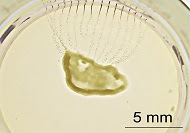 A miniature cyborg heart (shown here in a dish, being tested for electrical activity) could help researchers better understand how the human heart works.
Credit: Adapted from Nano Letters 2019, DOI: 10.1021/acs.nanolett.9b02512
A miniature cyborg heart (shown here in a dish, being tested for electrical activity) could help researchers better understand how the human heart works.
Credit: Adapted from Nano Letters 2019, DOI: 10.1021/acs.nanolett.9b02512
Abstract: In The Wizard of Oz, the Tin Man famously sang, �If I only had a heart . . . � Although the Tin Man had to be satisfied with a heart-shaped clock, researchers reporting in ACS� Nano Letters have now created a miniature cyborg heart that produces electrical signals like the human version. But instead of implanting the organoid into a robot, the researchers plan to use it to study heart development, diseases and therapeutics.
Washington, DC | Posted on August 21st, 2019
To better understand complex organs like the heart and brain, scientists would like to implant sensors that could continuously monitor cellular activities throughout the entire 3D structure of an organ over a long period of time. However, implanting or injecting such devices directly into a living organ could destroy intricate cellular networks, and the sensors wouldn�t penetrate into all regions. Therefore, Jia Liu at the School of Engineering and Applied Sciences at Harvard and his colleagues wanted to incorporate nanoelectronics into human tissue to produce a miniature cyborg heart, outside of the human body.
The researchers made the cyborg heart by placing a soft, stretchable mesh of nanoelectronics over a sheet of stem cells growing in a dish. The cells grew around and through the mesh, covering it completely. By adding certain substances, the team triggered the stem cells to fold into a 3D shape, about the size of a pencil eraser, and transform into cardiac tissue that beat just like a real heart. The researchers used the embedded nanoelectronics to take electrophysiological recordings during the formation of the organoid, which could shed light on how the human heart develops. Further work on cyborg organoids could provide a �paradigm-shifting platform� to study organs of all types in health and disease, as well as to develop and test new therapeutics, the researchers say.
The authors acknowledge funding from the Harvard Dean�s Competitive Fund for Promising Scholarship and the facility at the Harvard University Center for Nanoscale Systems supported by the National Science Foundation.
####
About American Chemical SocietyThe American Chemical Society, the world�s largest scientific society, is a not-for-profit organization chartered by the U.S. Congress. ACS is a global leader in providing access to chemistry-related information and research through its multiple databases, peer-reviewed journals and scientific conferences. ACS does not conduct research, but publishes and publicizes peer-reviewed scientific studies. Its main offices are in Washington, D.C., and Columbus, Ohio.
For more information, please click here
Contacts:Jia Liu, Ph.D.School of Engineering and Applied SciencesHarvard UniversityCambridge, MA 02138Phone: 617-599-7582
ACS Newsroom
Katie Cottingham
301-775-8455
Copyright © American Chemical Society
If you have a comment, please Contact us.
Issuers of news releases, not 7th Wave, Inc. or Nanotechnology Now, are solely responsible for the accuracy of the content.
Bookmark:


News and information
 Two opposing approaches could give lithium-sulfur batteries a leg up over lithium-ion July 1st, 2022
Efficiently processing high-quality periodic nanostructures with ultrafast laser July 1st, 2022
Photonic synapses with low power consumption and high sensitivity are expected to integrate sensing-memory-preprocessing capabilities July 1st, 2022
Govt.-Legislation/Regulation/Funding/Policy
Solving the solar energy storage problem with rechargeable batteries that can convert and store energy at once June 24th, 2022
Boron nitride nanotube fibers get real: Rice lab creates first heat-tolerant, stable fibers from wet-spinning process June 24th, 2022
UBCO researchers change the game when it comes to activity tracking: Flexible, highly sensitive motion device created by extrusion printing June 17th, 2022
University of Illinois Chicago joins Brookhaven Lab's Quantum Center June 10th, 2022
Possible Futures
Sieving carbons: Ideal anodes for high-energy sodium-ion batteries July 1st, 2022
An artificial intelligence probe help see tumor malignancy July 1st, 2022
Photon-controlled diode: an optoelectronic device with a new signal processing behavior July 1st, 2022
Nanomedicine
An artificial intelligence probe help see tumor malignancy July 1st, 2022
New technology helps reveal inner workings of human genome June 24th, 2022
Discoveries
Sieving carbons: Ideal anodes for high-energy sodium-ion batteries July 1st, 2022
Efficiently processing high-quality periodic nanostructures with ultrafast laser July 1st, 2022
Photonic synapses with low power consumption and high sensitivity are expected to integrate sensing-memory-preprocessing capabilities July 1st, 2022
Announcements
Two opposing approaches could give lithium-sulfur batteries a leg up over lithium-ion July 1st, 2022
Efficiently processing high-quality periodic nanostructures with ultrafast laser July 1st, 2022
Photonic synapses with low power consumption and high sensitivity are expected to integrate sensing-memory-preprocessing capabilities July 1st, 2022
Interviews/Book Reviews/Essays/Reports/Podcasts/Journals/White papers/Posters
Sieving carbons: Ideal anodes for high-energy sodium-ion batteries July 1st, 2022
An artificial intelligence probe help see tumor malignancy July 1st, 2022
Photon-controlled diode: an optoelectronic device with a new signal processing behavior July 1st, 2022
Nanobiotechnology
New technology helps reveal inner workings of human genome June 24th, 2022
