
| Date | 24th, Aug 2019 |
|---|
Home > Press > Study models new method to accelerate nanoparticles
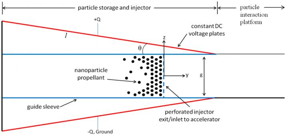 Geometry of tilted plate nanoparticle injector
CREDIT
University of Illinois Department of Aerospace Engineering
Geometry of tilted plate nanoparticle injector
CREDIT
University of Illinois Department of Aerospace Engineering
Abstract: In a new study, researchers at the University of Illinois and the Missouri University of Science and Technology modeled a method to manipulate nanoparticles as an alternative mode of propulsion for tiny spacecraft that require very small levels of thrust.
Urbana, IL | Posted on August 23rd, 2019
The team simulated a system that uses light to generate an electromagnetic field. Neutral nanoparticles made from glass or some other material that insulates rather than conducts electric charges are used. The nanoparticles become polarized. All of the positive charges are displaced in the direction of the field and negative charges shift in the opposite direction. It creates an internal electric field that produces a force to move the particles from a reservoir, funneled through an injector, then shot out of an accelerator to produce thrust.
The study, that has been about eight years in the making, analytically showed that the technique can work, and suggested parameters for success.
"The challenge is in selecting the right permittivity of the medium, the right amount of charge, in which all of this happens," said Joshua Rovey, associate professor in the Department of Aerospace Engineering in The Grainger College of Engineering at the U of I. "You have to choose the right materials for the nanoparticles themselves as well as the material surrounding the nanoparticles as they move through the structure."
The technique is based on a field of physics called plasmonics that studies how optical light or optical electromagnetic waves, interact with nanoscale structures, such as a bar or prism.
Rovey explained when the light hits the nanoscale structure, a resonant interaction occurs. It creates strong electromagnetic fields right next to that structure. And those electromagnetic fields can manipulate particles by applying forces to nanoscale particles that are near those structures. The study focused on how to feed the nanoparticles into the accelerator structure, or injector and how the angles of the plates in the injector affect the forces on these nanoparticles.
"One of the main motivating factors for the concept was the absence of or lack of a power supply in space," Rovey said. "If we can just harness the sun directly, have the sun shine directly on the nanostructures themselves, there's no need for an electrical power supply or solar panel to provide power."
Rovey said this study was a numerical simulation. The next step will be to create nanoscale structures in a lab, load then into the system, apply a light source, and observe how the nanoparticles move.
####
For more information, please click here
Contacts:Joshua Rovey
217-300-7092
Copyright © University of Illinois College of Engineering
If you have a comment, please Contact us.
Issuers of news releases, not 7th Wave, Inc. or Nanotechnology Now, are solely responsible for the accuracy of the content.
Bookmark:


News and information
 Two opposing approaches could give lithium-sulfur batteries a leg up over lithium-ion July 1st, 2022
Efficiently processing high-quality periodic nanostructures with ultrafast laser July 1st, 2022
Photonic synapses with low power consumption and high sensitivity are expected to integrate sensing-memory-preprocessing capabilities July 1st, 2022
Govt.-Legislation/Regulation/Funding/Policy
Solving the solar energy storage problem with rechargeable batteries that can convert and store energy at once June 24th, 2022
Boron nitride nanotube fibers get real: Rice lab creates first heat-tolerant, stable fibers from wet-spinning process June 24th, 2022
UBCO researchers change the game when it comes to activity tracking: Flexible, highly sensitive motion device created by extrusion printing June 17th, 2022
University of Illinois Chicago joins Brookhaven Lab's Quantum Center June 10th, 2022
Possible Futures
Sieving carbons: Ideal anodes for high-energy sodium-ion batteries July 1st, 2022
An artificial intelligence probe help see tumor malignancy July 1st, 2022
Photon-controlled diode: an optoelectronic device with a new signal processing behavior July 1st, 2022
Discoveries
Sieving carbons: Ideal anodes for high-energy sodium-ion batteries July 1st, 2022
Efficiently processing high-quality periodic nanostructures with ultrafast laser July 1st, 2022
Photonic synapses with low power consumption and high sensitivity are expected to integrate sensing-memory-preprocessing capabilities July 1st, 2022
Announcements
Two opposing approaches could give lithium-sulfur batteries a leg up over lithium-ion July 1st, 2022
Efficiently processing high-quality periodic nanostructures with ultrafast laser July 1st, 2022
Photonic synapses with low power consumption and high sensitivity are expected to integrate sensing-memory-preprocessing capabilities July 1st, 2022
Interviews/Book Reviews/Essays/Reports/Podcasts/Journals/White papers/Posters
Sieving carbons: Ideal anodes for high-energy sodium-ion batteries July 1st, 2022
An artificial intelligence probe help see tumor malignancy July 1st, 2022
Photon-controlled diode: an optoelectronic device with a new signal processing behavior July 1st, 2022
Military
Boron nitride nanotube fibers get real: Rice lab creates first heat-tolerant, stable fibers from wet-spinning process June 24th, 2022
Bumps could smooth quantum investigations: Rice University models show unique properties of 2D materials stressed by contoured substrates June 10th, 2022
Nanostructured fibers can impersonate human muscles June 3rd, 2022
Lightening up the nanoscale long-wavelength optoelectronics May 13th, 2022
Energy
Key in increasing efficiency of next-generation solar cell, found in �light absorption capacity�! July 1st, 2022
Solving the solar energy storage problem with rechargeable batteries that can convert and store energy at once June 24th, 2022
Organic water splitters get a boost June 10th, 2022
Aerospace/Space
Boron nitride nanotube fibers get real: Rice lab creates first heat-tolerant, stable fibers from wet-spinning process June 24th, 2022
University of Strathclyde and National University of Singapore to co-ordinate satellite quantum communications May 13th, 2022
Lightening up the nanoscale long-wavelength optoelectronics May 13th, 2022
Grants/Sponsored Research/Awards/Scholarships/Gifts/Contests/Honors/Records
Solving the solar energy storage problem with rechargeable batteries that can convert and store energy at once June 24th, 2022
Boron nitride nanotube fibers get real: Rice lab creates first heat-tolerant, stable fibers from wet-spinning process June 24th, 2022
Research partnerships
New technology helps reveal inner workings of human genome June 24th, 2022
Boron nitride nanotube fibers get real: Rice lab creates first heat-tolerant, stable fibers from wet-spinning process June 24th, 2022
