
| Date | 6th, Sep 2019 |
|---|
Home > Press > Nanotherapy: the controlled delivery of chemotherapeutics to fight cancer stem cells
Abstract: Chemotherapy is one of the most used cancer treatments, however, its side effects place it far from the ideal treatment. IMDEA Nanociencia scientists work to improve the effectiveness of chemotherapy using gold nanoparticles as vehicles to administer drugs only where it is needed. Specifically, they have used the combination of two drugs simultaneously on gold nanoparticles that have given good results in the reduction of breast cancer cells. These materials could be the basis of a "Trojan horse" strategy to effectively release chemotherapy within tumors.
Madrid, Spain | Posted on September 6th, 2019
Chemotherapy is one of the most used treatments against cancer, together with surgery and radiotherapy. In a chemotherapy treatment, one or several drugs are administered to the patient to remove or damage cancer cells. Nevertheless, the treatment has several drawbacks that are hard to overcome, particularly the side effects. In this case, the inherent toxicity of the drugs employed causes a variety of symptoms including, weakness, nausea and hair loss, placing chemotherapy far from the ideal approach.
In this regard, scientists are trying to improve the efficacy and specificity of chemotherapy using carriers to deliver the drugs only where it is needed. Those based on gold nanostructures are excellent candidates for this objective because of their excellent stability, absence of toxicity and ease of modification with several chemical agents. Furthermore, some gold nanostructures, such as nanoclusters, are fluorescent allowing their use simultaneously for biotracking and imaging purposes.
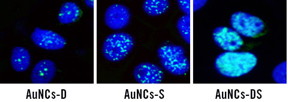
The group of NanoBiotechnology at IMDEA Nanociencia, led by Prof. �lvaro Somoza, has used gold nanoclusters coated with albumin to facilitate the attachment of two active molecules for the treatment of breast cancer. Particularly, they have used doxorubicin (D), a chemotherapeutic agent that intercalates in the DNA causing cell death, and camptothecin analog SN38 (S), a potent topoisomerase I inhibitor. The modified nanostructures were tested in vitro against breast cancer cells, where the release of chemotherapeutics took place in a controlled manner. Remarkably, the nanotherapy was able to reduce the size and number of mammospheres, a cancer stem cell model. This type of cells present higher resistence to chemotherapy and are responsible for relapses and chemoresistance. What is more, the system combining both drugs presented excellent antitumor activity in different cancer models, thus confirming its promising nanotherapeutic potential.
This is the first time than albumin-stabilized gold nanoclusters have been used to deliver more than one drug, with excellent antitumoral activity, in cancer and cancer stem cells. �Our bifunctional nanostructure could be an excellent solution to overcome the solubility and biodistribution problems of different drugs�, Somoza says. These nanomaterials could be the basis of a Trojan-horse strategy to get the chemotherapeutics effectively inside the tumours. The gold nanoclusters act as the vehicles for carrying the drugs where is needed and release them upon internal stimuli. Whereas chemotherapy research is developing new drugs for cancer treatment, emerging nanotherapies are about building smart vehicles for existing drugs, reducing costs and improving the efficiency of the treatments.
This work is a collaboration between research groups at IMDEA Nanociencia, the Autonomous University of Madrid and the Center for Biological Research (CIB-CSIC). It has been partially funded by the Spanish Ministry for Science, Innovation and Universities, the Regional Government of Comunidad de Madrid, the Spanish Association Against Cancer and the Centre of Excellence Severo Ochoa recognition to IMDEA Nanociencia (2017-2021).
####
For more information, please click here
Contacts:IMDEA NanocienciaC/Faraday 928049 Madrid, SpainTel.: +34 91 299 87 12www.nanociencia.imdea.org Twitter: @IMDEA_NanoFacebook: @IMDEANanocienciaYoutube: IMDEA Nanociencia
Copyright © IMDEA Nanociencia
If you have a comment, please Contact us.
Issuers of news releases, not 7th Wave, Inc. or Nanotechnology Now, are solely responsible for the accuracy of the content.
Bookmark:


News and information
 Two opposing approaches could give lithium-sulfur batteries a leg up over lithium-ion July 1st, 2022
Efficiently processing high-quality periodic nanostructures with ultrafast laser July 1st, 2022
Photonic synapses with low power consumption and high sensitivity are expected to integrate sensing-memory-preprocessing capabilities July 1st, 2022
Cancer
New technology helps reveal inner workings of human genome June 24th, 2022
New nano-gel to protect children receiving chemotherapy from hearing loss June 17th, 2022
Electron-phonon coupling assisted universal red luminescence of o-phenylenediamine-based CDs June 10th, 2022
Emerging vaccine nanotechnology June 3rd, 2022
Possible Futures
Sieving carbons: Ideal anodes for high-energy sodium-ion batteries July 1st, 2022
An artificial intelligence probe help see tumor malignancy July 1st, 2022
Photon-controlled diode: an optoelectronic device with a new signal processing behavior July 1st, 2022
Nanomedicine
An artificial intelligence probe help see tumor malignancy July 1st, 2022
New technology helps reveal inner workings of human genome June 24th, 2022
Discoveries
Sieving carbons: Ideal anodes for high-energy sodium-ion batteries July 1st, 2022
Efficiently processing high-quality periodic nanostructures with ultrafast laser July 1st, 2022
Photonic synapses with low power consumption and high sensitivity are expected to integrate sensing-memory-preprocessing capabilities July 1st, 2022
Announcements
Two opposing approaches could give lithium-sulfur batteries a leg up over lithium-ion July 1st, 2022
Efficiently processing high-quality periodic nanostructures with ultrafast laser July 1st, 2022
Photonic synapses with low power consumption and high sensitivity are expected to integrate sensing-memory-preprocessing capabilities July 1st, 2022
Interviews/Book Reviews/Essays/Reports/Podcasts/Journals/White papers/Posters
Sieving carbons: Ideal anodes for high-energy sodium-ion batteries July 1st, 2022
An artificial intelligence probe help see tumor malignancy July 1st, 2022
Photon-controlled diode: an optoelectronic device with a new signal processing behavior July 1st, 2022
Nanobiotechnology
New technology helps reveal inner workings of human genome June 24th, 2022
