
For their experiment, the researchers mixed THz signals using graphene. One signal was a high-intensity wave at a known THz frequency, generated by a local oscillator. The second signal was a faint THz signal that mimicked the THz waves coming from space. After these signals were mixed, the graphene produced an output wave at a much lower frequency, known as the intermediate frequency, that could be analyzed using standard, low-noise GHz electronics.
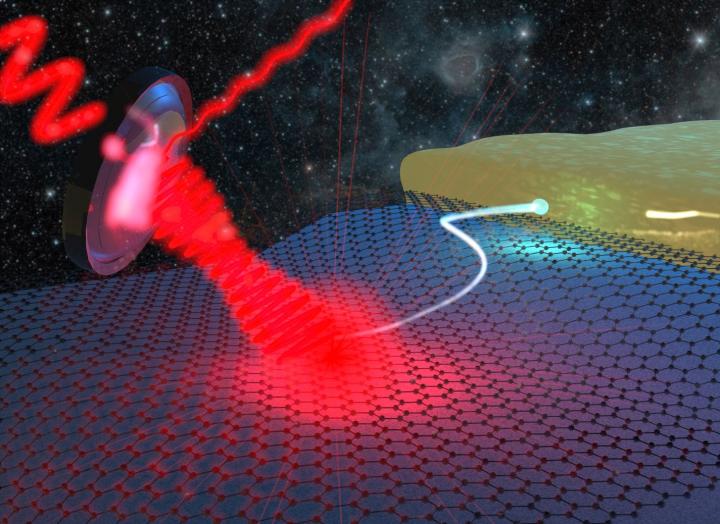 The image depicts a schematic of THz heterodyne detection with graphene. In this, two THz waves (red) are coupled into graphene, where they are combined or mixed. One of the waves is a high-intensity signal generated by a local THz light source (i.e., a local oscillator), at a known THz frequency. The other signal is a faint THz wave that mimics the waves coming from space. Courtesy of Hans He.
The higher the intermediate frequency can be, the higher bandwidth the detector is believed to have, the team said. A high bandwidth is necessary to accurately identify motions inside the celestial objects.
The image depicts a schematic of THz heterodyne detection with graphene. In this, two THz waves (red) are coupled into graphene, where they are combined or mixed. One of the waves is a high-intensity signal generated by a local THz light source (i.e., a local oscillator), at a known THz frequency. The other signal is a faint THz wave that mimics the waves coming from space. Courtesy of Hans He.
The higher the intermediate frequency can be, the higher bandwidth the detector is believed to have, the team said. A high bandwidth is necessary to accurately identify motions inside the celestial objects.
Professor Sergey Cherednichenko said, “According to our theoretical model, this graphene THz detector has a potential to reach quantum-limited operation for the important 1 to 5 THz spectral range. Moreover, the bandwidth can exceed 20 GHz, larger than the 5 GHz that the state-of-the-art technology has to offer.”
For the local oscillator to achieve a trustable detection of faint THz signals, only a small amount of power (
