
| Date | 14th, Sep 2019 |
|---|
Home > Press > Scientists create a nanomaterial that is both twisted and untwisted at the same time: The material developed at University of Bath allows for incredibly sensitive detection of the direction molecules twist
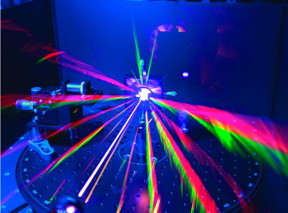 A nanomaterial developed at University of Bath allows for incredibly sensitive detection of the direction molecules twist using laser light.
CREDIT
Ventsislav Valev and Alex Murphy
A nanomaterial developed at University of Bath allows for incredibly sensitive detection of the direction molecules twist using laser light.
CREDIT
Ventsislav Valev and Alex Murphy
Abstract: A new nanomaterial developed by scientists at the University of Bath could solve a conundrum faced by scientists probing some of the most promising types of future pharmaceuticals.
Bath, UK | Posted on September 13th, 2019
Scientists who study the nanoscale - with molecules and materials 10,000 smaller than a pinhead - need to be able to test the way that some molecules twist, known as their chirality, because mirror image molecules with the same structure can have very different properties. For instance one kind of molecule smells of lemons when it twists in one direction, and oranges when twisted the other way.
Detecting these twists is especially important in some high-value industries such as pharmaceuticals, perfumes, food additives and pesticides.
Recently, a new class of nanoscale materials have been developed to help distinguish the chirality of molecules. These so-called 'nanomaterials' usually consist of tiny twisted metal wires, that are chiral themselves.
However, it has become very hard to distinguish the twist of the nanomaterials from the twist of the molecules they are supposed to help study.
To solve this problem the team from the University of Bath's Department of Physics created a nanomaterial that is both twisted and it is not. This nanomaterial has equal number of opposite twists - meaning they cancel each other out. Usually, upon interacting with light, such material appears without any twist; how then could it be optimised to interact with molecules?
Using a mathematical analysis of the material's symmetry properties, the team discovered a few special cases, which can bring the 'hidden' twist to light and allow very sensitive detection of chirality in molecules.
Lead author Professor Ventsislav Valev, from the University of Bath Department of Physics, said: "This work removes an important roadblock for the entire research field and paves the way to ultra-sensitive detection of chirality in molecules, using nanomaterials."
PhD student Alex Murphy, who worked on the study, said: "Molecular chirality is an amazing property to study. You can smell chirality, since the same but oppositely twisted molecules smell of lemons and oranges. You can taste chirality, since one twist of Aspartame is sweet and the other is tasteless. You can feel chirality, since one twist of menthol gives a cool sensation to the skin while the other does not. You touch chirality expressed in the twist of seashells. And it is great to see chirality expressed in its interactions with the colours of laser light."
###
The study is published in the journal Nanoscale Horizons. This study was made available online in May 2019 ahead of final publication in issue this month. The research was funded by the Royal Society, the Engineering and Physical Sciences Research Council, and the Science and Technology Facilities Council.
####
For more information, please click here
Contacts:Chris Melvin
44-012-253-83941
Copyright © University of Bath
If you have a comment, please Contact us.
Issuers of news releases, not 7th Wave, Inc. or Nanotechnology Now, are solely responsible for the accuracy of the content.
Bookmark:


News and information
 Two opposing approaches could give lithium-sulfur batteries a leg up over lithium-ion July 1st, 2022
Efficiently processing high-quality periodic nanostructures with ultrafast laser July 1st, 2022
Photonic synapses with low power consumption and high sensitivity are expected to integrate sensing-memory-preprocessing capabilities July 1st, 2022
Govt.-Legislation/Regulation/Funding/Policy
Solving the solar energy storage problem with rechargeable batteries that can convert and store energy at once June 24th, 2022
Boron nitride nanotube fibers get real: Rice lab creates first heat-tolerant, stable fibers from wet-spinning process June 24th, 2022
UBCO researchers change the game when it comes to activity tracking: Flexible, highly sensitive motion device created by extrusion printing June 17th, 2022
University of Illinois Chicago joins Brookhaven Lab's Quantum Center June 10th, 2022
Possible Futures
Sieving carbons: Ideal anodes for high-energy sodium-ion batteries July 1st, 2022
An artificial intelligence probe help see tumor malignancy July 1st, 2022
Photon-controlled diode: an optoelectronic device with a new signal processing behavior July 1st, 2022
Nanomedicine
An artificial intelligence probe help see tumor malignancy July 1st, 2022
New technology helps reveal inner workings of human genome June 24th, 2022
Discoveries
Sieving carbons: Ideal anodes for high-energy sodium-ion batteries July 1st, 2022
Efficiently processing high-quality periodic nanostructures with ultrafast laser July 1st, 2022
Photonic synapses with low power consumption and high sensitivity are expected to integrate sensing-memory-preprocessing capabilities July 1st, 2022
Materials/Metamaterials
New protocol for assessing the safety of nanomaterials July 1st, 2022
Nanotubes: a promising solution for advanced rubber cables with 60% less conductive filler June 1st, 2022
New route to build materials out of tiny particles May 27th, 2022
A one-stop shop for quantum sensing materials May 27th, 2022
Announcements
Two opposing approaches could give lithium-sulfur batteries a leg up over lithium-ion July 1st, 2022
Efficiently processing high-quality periodic nanostructures with ultrafast laser July 1st, 2022
Photonic synapses with low power consumption and high sensitivity are expected to integrate sensing-memory-preprocessing capabilities July 1st, 2022
Interviews/Book Reviews/Essays/Reports/Podcasts/Journals/White papers/Posters
Sieving carbons: Ideal anodes for high-energy sodium-ion batteries July 1st, 2022
An artificial intelligence probe help see tumor malignancy July 1st, 2022
Photon-controlled diode: an optoelectronic device with a new signal processing behavior July 1st, 2022
Nanobiotechnology
New technology helps reveal inner workings of human genome June 24th, 2022
Photonics/Optics/Lasers
Photon-controlled diode: an optoelectronic device with a new signal processing behavior July 1st, 2022
Efficiently processing high-quality periodic nanostructures with ultrafast laser July 1st, 2022
Photonic synapses with low power consumption and high sensitivity are expected to integrate sensing-memory-preprocessing capabilities July 1st, 2022
