
| Date | 14th, Sep 2019 |
|---|
Home > Press > Inspired by natural signals in living cells, researchers design artificial gas detector: Tiny box puts itself together and glows
 Researchers at the University of Tokyo have built a simple, cheap, highly sensitive and specific detector of liquefied petroleum gas (LPG). The gas is detected by a tiny box called a nanocube, about one-fortieth the size of a human red blood cell. The nanocube glows blue under fluorescent light when it is filled with the gas. Originally published in Communications Chemistry DOI: 10.1038/s42004-019-0212-6
CREDIT
Zhan et al., CC-BY
Researchers at the University of Tokyo have built a simple, cheap, highly sensitive and specific detector of liquefied petroleum gas (LPG). The gas is detected by a tiny box called a nanocube, about one-fortieth the size of a human red blood cell. The nanocube glows blue under fluorescent light when it is filled with the gas. Originally published in Communications Chemistry DOI: 10.1038/s42004-019-0212-6
CREDIT
Zhan et al., CC-BY
Abstract: A cube one-fortieth the size of a human red blood cell can glow when it detects flammable gas. The nanocube, designed by chemists at the University of Tokyo, is part of a research project to develop artificial systems that mimic the complex chain of events inside living cells.
Tokyo, Japan | Posted on September 13th, 2019
The research team has worked on the nanocube project for over a decade. A key feature of the nanocube, just two nanometers on each side, is that it puts itself together, attempting to mimic the way proteins and DNA put themselves together in living cells.
Mimicking life
"People automatically think about devices when we talk about sensors. But there are many examples of natural sensors in the body," said Professor Shuichi Hiraoka, the lead researcher on the project from the University of Tokyo's Department of Basic Science.
The basic chain of events in a cell to detect and report some signal has three steps: 1) A receptor detects the target molecule, 2) the receptor sends a signal to the reporter and 3) the reporter transmits the signal elsewhere in the cell.
The glowing nanocube simplifies the system because it is both the receptor (the inside of the cube) and the reporter (the glow).
"This way, we avoid the problem of transferring information from the receptor to the reporter," explained Hiraoka.
Nanocube sensors fully envelop the molecules they contain, meaning they could be especially useful for distinguishing between molecules that are shaped like simple chains of different lengths (alkanes) without unique functional groups.
Glowing with gas
The latest analysis reveals that the nanocubes glow blue under ultraviolet (UV) light when filled with liquefied petroleum gas (LPG), a type of flammable gas.
The chemical that the cube is made from is a white powder when dry, but when mixed in water, six gear- or snowflake-shaped molecules automatically connect to form the cubes. The natural glow, or fluorescence, of the nanocubes is a balance of two competing physical characteristics of those molecules: The glow is limited when the molecules are stacked like pancakes, but is enhanced when the molecules are locked in place and slightly stretched apart from each other.
Three molecules come together at each corner of the cube, so their edges are "stacked" together, limiting the glow. When the cube fills with gas, the corners bulge slightly and that stretch enhances the glow.
Nanocube gas detectors
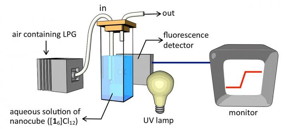
The researchers built a cheap, simple gas detector using only the nanocubes, a common UV light and a fluorescent light detector.
The nanocubes are as sensitive as any current gas detector, meaning they could detect very low amounts of LPG.
However, the nanocubes are incredibly specific to LPG. They do not detect other similar types of flammable gas, such as methane (natural gas) or carbon dioxide (CO2). This specificity likely occurs because exactly three molecules of LPG slot in like blocks in the game Tetris for a perfect fit inside the nanocube.
Common gas detectors do not have this specificity and will sound an alarm for any type of dangerous gas.
"The fact that common sensors cannot distinguish these similar gases is really no problem, because they are all dangerous to us," said Hiraoka.
Rather than to design a new gas detector, the researchers' true goal is to mimic the complex chain of events to detect and report signals in living cells.
Researchers are planning additional projects to alter the building blocks of the nanocubes so that the cubes can detect different molecules and report different signals.
####
About University of TokyoThe University of Tokyo is Japan's leading university and one of the world's top research universities. The vast research output of some 6,000 researchers is published in the world's top journals across the arts and sciences. Our vibrant student body of around 15,000 undergraduate and 15,000 graduate students includes over 4,000 international students. Find out more at http://www.u-tokyo.ac.jp/en/ or follow us on Twitter at @UTokyo_News_en.
For more information, please click here
Contacts:Shuichi Hiraoka
81-035-465-7659
Research contact
Professor Shuichi Hiraoka Department of Basic Science, Graduate School of Arts and Sciences, The University of Tokyo, 3-8-1 Komaba, Meguro-ku, Tokyo 153-8902, Japan Tel: +81-3-5465-7659 Email:
Press Contact
Ms. Caitlin Devor Division for Strategic Public Relations, The University of Tokyo, 7-3-1 Hongo, Bunkyo-ku, Tokyo 113-8654, JAPAN Tel: +81-3-5841-0876 Email:
Public Relations Office
Graduate School of Arts and Sciences, The University of Tokyo, 3-8-1 Komaba, Meguro-ku, Tokyo 153-8902, Japan Tel: +81-3-5454-4920 Email:
Copyright © University of Tokyo
If you have a comment, please Contact us.
Issuers of news releases, not 7th Wave, Inc. or Nanotechnology Now, are solely responsible for the accuracy of the content.
Bookmark:


 Graduate School of Arts and Sciences:
Department of Basic Science (Japanese):
Hiraoka Group laboratory website:
Hiraoka Group Facebook page (Japanese):
News and information
Two opposing approaches could give lithium-sulfur batteries a leg up over lithium-ion July 1st, 2022
Efficiently processing high-quality periodic nanostructures with ultrafast laser July 1st, 2022
Photonic synapses with low power consumption and high sensitivity are expected to integrate sensing-memory-preprocessing capabilities July 1st, 2022
Possible Futures
Sieving carbons: Ideal anodes for high-energy sodium-ion batteries July 1st, 2022
An artificial intelligence probe help see tumor malignancy July 1st, 2022
Photon-controlled diode: an optoelectronic device with a new signal processing behavior July 1st, 2022
Nanomedicine
An artificial intelligence probe help see tumor malignancy July 1st, 2022
New technology helps reveal inner workings of human genome June 24th, 2022
Sensors
Photonic synapses with low power consumption and high sensitivity are expected to integrate sensing-memory-preprocessing capabilities July 1st, 2022
Photonic integrated erbium doped amplifiers reach commercial performance: Boosting light power revolutionizes communications and autopilots June 17th, 2022
A one-stop shop for quantum sensing materials May 27th, 2022
Discoveries
Sieving carbons: Ideal anodes for high-energy sodium-ion batteries July 1st, 2022
Efficiently processing high-quality periodic nanostructures with ultrafast laser July 1st, 2022
Photonic synapses with low power consumption and high sensitivity are expected to integrate sensing-memory-preprocessing capabilities July 1st, 2022
Announcements
Two opposing approaches could give lithium-sulfur batteries a leg up over lithium-ion July 1st, 2022
Efficiently processing high-quality periodic nanostructures with ultrafast laser July 1st, 2022
Photonic synapses with low power consumption and high sensitivity are expected to integrate sensing-memory-preprocessing capabilities July 1st, 2022
Interviews/Book Reviews/Essays/Reports/Podcasts/Journals/White papers/Posters
Sieving carbons: Ideal anodes for high-energy sodium-ion batteries July 1st, 2022
An artificial intelligence probe help see tumor malignancy July 1st, 2022
Photon-controlled diode: an optoelectronic device with a new signal processing behavior July 1st, 2022
Environment
University of Strathclyde and National University of Singapore to co-ordinate satellite quantum communications May 13th, 2022
Lightening up the nanoscale long-wavelength optoelectronics May 13th, 2022
Energy
Key in increasing efficiency of next-generation solar cell, found in �light absorption capacity�! July 1st, 2022
Solving the solar energy storage problem with rechargeable batteries that can convert and store energy at once June 24th, 2022
Organic water splitters get a boost June 10th, 2022
Nanobiotechnology
New technology helps reveal inner workings of human genome June 24th, 2022
