
| Date | 14th, Sep 2019 |
|---|
Home > Press > New health monitors are flexible, transparent and graphene enabled
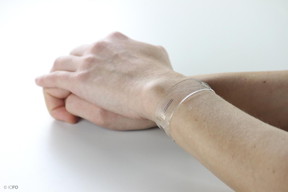 Flexible and transparent bracelet that uses graphene to measure heart rate, respiration rate and blood pulse oxygenation continuously.
CREDIT
ICFO
Flexible and transparent bracelet that uses graphene to measure heart rate, respiration rate and blood pulse oxygenation continuously.
CREDIT
ICFO
Abstract: New technological devices are prioritizing non-invasive tracking of vital signs not only for fitness monitoring, but also for the prevention of common health problems such as heart failure, hypertension, and stress related complications, among others. Wearables based on optical detection mechanisms are proving an invaluable approach for reporting on our bodies inner workings and have experienced a large penetration into the consumer market in recent years. Current wearable technologies, based on non-flexible components, do not deliver the desired accuracy and can only monitor a limited number of vital signs. To tackle this problem, conformable non-invasive optical-based sensors that can measure a broader set of vital signs are at the top of the end-users' wish list.
Barcelona, Spain | Posted on September 13th, 2019
In a recent study published in Science Advances, ICFO researchers have demonstrated a new class of flexible and transparent wearable devices that are conformable to the skin and can provide continuous and accurate measurements of multiple human vital signs. These devices can measure heart rate, respiration rate and blood pulse oxygenation, as well as exposure to UV radiation from the sun. While the device measures the different parameters, the read-out is visualized and stored on a mobile phone interface connected to the wearable via Bluetooth. In addition, the device can operate battery-free since it is charged wirelessly through the phone.
"It was very important for us to demonstrate the wide range of potential applications for our advanced light sensing technology through the creation of various prototypes, including the flexible and transparent bracelet, the health patch integrated on a mobile phone and the UV monitoring patch for sun exposure. They have shown to be versatile and efficient due to these unique features", reports Dr. Emre Ozan Polat, first author of this publication.
The bracelet was fabricated in such a way that it adapts to the skin surface and provides continuous measurement during activity (see Figure 1). The bracelet incorporates a flexible light sensor that can optically record the change in volume of blood vessels, due to the cardiac cycle, and then extract different vital signs such as heart rate, respiration rate and blood pulse oxygenation.
Secondly, the researchers report on the integration of a graphene health patch onto a mobile phone screen, which instantly measures and displays vital signs in real time when a user places one finger on the screen (see Figure 2). A unique feature of this prototype is that the device uses ambient light to operate, promoting low-power-consumption in these integrated wearables and thus, allowing a continuous monitoring of health markers over long periods of time.
ICFO's advanced light sensing technology has implemented two types of nanomaterials: graphene, a highly flexible and transparent material made of one-atom thick layer of carbon atoms, together with a light absorbing layer made of quantum dots. The demonstrated technology brings a new form factor and design freedom to the wearables' field, making graphene-quantum-dots-based devices a strong platform for product developers. Dr. Antonios Oikonomou, business developer at ICFO emphasized this by stating that "The booming wearables industry is eagerly looking to increase fidelity and functionality of its offerings. Our graphene-based technology platform answers this challenge with a unique proposition: a scalable, low-power system capable of measuring multiple parameters while allowing the translation of new form factors into products."
Dr. Stijn Goossens, co-supervisor of the study, also comments that "we have made a breakthrough by showing a flexible, wearable sensing system based on graphene light sensing components. Key was to pick the best of the rigid and flexible worlds. We used the unique benefits of flexible components for vital sign sensing and combined that with the high performance and miniaturization of conventional rigid electronic components."
Finally, the researchers have been able to demonstrate a broad wavelength detection range with the technology, extending the functionality of the prototypes beyond the visible range. By using the same core technology, they have fabricated a flexible UV patch prototype (see Figure 3) capable of wirelessly transferring both power and data, and operating battery-free to sense the environmental UV-index. The patch operates with a low power consumption and has a highly efficient UV detection system that can be attached to clothing or skin, and used for monitoring radiation intake from the sun, alerting the wearer of any possible over-exposure.
"We are excited about the prospects for this technology, pointing to a scalable route for the integration of graphene-quantum-dots into fully flexible wearable circuits to enhance form, feel, durability, and performance", remarks Prof. Frank Koppens, leader of the Quantum Nano-Optoelectronics group at ICFO. "Such results show that this flexible wearable platform is compatible with scalable fabrication processes, proving mass-production of low-cost devices is within reach in the near future."
###
REFERENCE
Flexible graphene photodetectors for wearable fitness monitoring SCIENCE ADVANCES Polat et al., Sci. Adv. 2019; 5 : eaaw7846
FUNDING INFO
This work was funded by the Cellex foundation, by the ERC Proof of Concept grant "GRAPHEALTH", and by the Graphene Flagship.
####
For more information, please click here
Contacts:Alina Hirschmann
34-935-542-246
Copyright © ICFO-The Institute of Photonic Sciences
If you have a comment, please Contact us.
Issuers of news releases, not 7th Wave, Inc. or Nanotechnology Now, are solely responsible for the accuracy of the content.
Bookmark:


News and information
 Two opposing approaches could give lithium-sulfur batteries a leg up over lithium-ion July 1st, 2022
Efficiently processing high-quality periodic nanostructures with ultrafast laser July 1st, 2022
Photonic synapses with low power consumption and high sensitivity are expected to integrate sensing-memory-preprocessing capabilities July 1st, 2022
Flexible Electronics
�Fruitcake� structure observed in organic polymers June 3rd, 2022
Graphene/ Graphite
OCSiAl expands its graphene nanotube production capacities to Europe June 17th, 2022
Bumps could smooth quantum investigations: Rice University models show unique properties of 2D materials stressed by contoured substrates June 10th, 2022
Nanotubes: a promising solution for advanced rubber cables with 60% less conductive filler June 1st, 2022
Dynamic metasurfaces and metadevices empowered by graphene May 6th, 2022
Wearable electronics
�Fruitcake� structure observed in organic polymers June 3rd, 2022
Possible Futures
Sieving carbons: Ideal anodes for high-energy sodium-ion batteries July 1st, 2022
An artificial intelligence probe help see tumor malignancy July 1st, 2022
Photon-controlled diode: an optoelectronic device with a new signal processing behavior July 1st, 2022
Nanomedicine
An artificial intelligence probe help see tumor malignancy July 1st, 2022
New technology helps reveal inner workings of human genome June 24th, 2022
Discoveries
Sieving carbons: Ideal anodes for high-energy sodium-ion batteries July 1st, 2022
Efficiently processing high-quality periodic nanostructures with ultrafast laser July 1st, 2022
Photonic synapses with low power consumption and high sensitivity are expected to integrate sensing-memory-preprocessing capabilities July 1st, 2022
Announcements
Two opposing approaches could give lithium-sulfur batteries a leg up over lithium-ion July 1st, 2022
Efficiently processing high-quality periodic nanostructures with ultrafast laser July 1st, 2022
Photonic synapses with low power consumption and high sensitivity are expected to integrate sensing-memory-preprocessing capabilities July 1st, 2022
Interviews/Book Reviews/Essays/Reports/Podcasts/Journals/White papers/Posters
Sieving carbons: Ideal anodes for high-energy sodium-ion batteries July 1st, 2022
An artificial intelligence probe help see tumor malignancy July 1st, 2022
Photon-controlled diode: an optoelectronic device with a new signal processing behavior July 1st, 2022
