
| Date | 27th, Sep 2022 |
|---|
Home > Press > Uncovering the hidden �noise� that can kill qubits: New detection tool could be used to make quantum computers robust against unwanted environmental disturbances
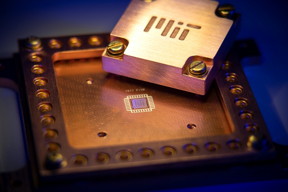 MIT and Dartmouth College researchers developed a tool that detects new characteristics of non-Gaussian �noise� that can destroy the fragile quantum superposition state of qubits, the fundamental components of quantum computers.
Image courtesy of the researchers
MIT and Dartmouth College researchers developed a tool that detects new characteristics of non-Gaussian �noise� that can destroy the fragile quantum superposition state of qubits, the fundamental components of quantum computers.
Image courtesy of the researchers
Abstract: MIT and Dartmouth College researchers have demonstrated, for the first time, a tool that detects new characteristics of environmental �noise� that can destroy the fragile quantum state of qubits, the fundamental components of quantum computers. The advance may provide insights into microscopic noise mechanisms to help engineer new ways of protecting qubits.
Cambridge, MA | Posted on September 17th, 2019
Qubits can represent the two states corresponding to the classic binary bits, a 0 or 1. But, they can also maintain a �quantum superposition� of both states simultaneously, enabling quantum computers to solve complex problems that are practically impossible for classical computers.
But a qubit�s quantum �coherence� � meaning its ability to maintain the superposition state � can fall apart due to noise coming from environment around the qubit. Noise can arise from control electronics, heat, or impurities in the qubit material itself, and can also cause serious computing errors that may be difficult to correct.
Researchers have developed statistics-based models to estimate the impact of unwanted noise sources surrounding qubits to create new ways to protect them, and to gain insights into the noise mechanisms themselves. But, those tools generally capture simplistic �Gaussian noise,� essentially the collection of random disruptions from a large number of sources. In short, it�s like white noise coming from the murmuring of a large crowd, where there�s no specific disruptive pattern that stands out, so the qubit isn�t particularly affected by any one particular source. In this type of model, the probability distribution of the noise would form a standard symmetrical bell curve, regardless of the statistical significance of individual contributors.
In a paper published today in the journal Nature Communications, the researchers describe a new tool that, for the first time, measures �non-Gaussian noise� affecting a qubit. This noise features distinctive patterns that generally stem from a few particularly strong noise sources.
The researchers designed techniques to separate that noise from the background Gaussian noise, and then used signal-processing techniques to reconstruct highly detailed information about those noise signals. Those reconstructions can help researchers build more realistic noise models, which may enable more robust methods to protect qubits from specific noise types. There is now a need for such tools, the researchers say: Qubits are being fabricated with fewer and fewer defects, which could increase the presence of non-Gaussian noise.
�It�s like being in a crowded room. If everyone speaks with the same volume, there is a lot of background noise, but I can still maintain my own conversation. However, if a few people are talking particularly loudly, I can�t help but lock on to their conversation. It can be very distracting,� says William Oliver, an associate professor of electrical engineering and computer science, professor of the practice of physics, MIT Lincoln Laboratory Fellow, and associate director of the Research Laboratory for Electronics (RLE). �For qubits with many defects, there is noise that decoheres, but we generally know how to handle that type of aggregate, usually Gaussian noise. However, as qubits improve and there are fewer defects, the individuals start to stand out, and the noise may no longer be simply of a Gaussian nature. We can find ways to handle that, too, but we first need to know the specific type of non-Gaussian noise and its statistics.�
�It is not common for theoretical physicists to be able to conceive of an idea and also find an experimental platform and experimental colleagues willing to invest in seeing it through,� says co-author Lorenza Viola, a professor of physics at Dartmouth. �It was great to be able to come to such an important result with the MIT team.�
Joining Oliver and Viola on the paper are: first author Youngkyu Sung, Fei Yan, Jack Y. Qiu, Uwe von L�pke, Terry P. Orlando, and Simon Gustavsson, all of RLE; David K. Kim and Jonilyn L. Yoder of the Lincoln Laboratory; and F�lix Beaudoin and Leigh M. Norris of Dartmouth.
Pulse filters
For their work, the researchers leveraged the fact that superconducting qubits are good sensors for detecting their own noise. Specifically, they use a �flux� qubit, which consists of a superconducting loop that is capable of detecting a particular type of disruptive noise, called magnetic flux, from its surrounding environment.
In the experiments, they induced non-Gaussian �dephasing� noise by injecting engineered flux noise that disturbs the qubit and makes it lose coherence, which in turn is then used as a measuring tool. �Usually, we want to avoid decoherence, but in this case, how the qubit decoheres tells us something about the noise in its environment,� Oliver says.
Specifically, they shot 110 �pi-pulses� � which are used to flip the states of qubits � in specific sequences over tens of microseconds. Each pulse sequence effectively created a narrow frequency �filter� which masks out much of the noise, except in a particular band of frequency. By measuring the response of a qubit sensor to the bandpass-filtered noise, they extracted the noise power in that frequency band.
By modifying the pulse sequences, they could move filters up and down to sample the noise at different frequencies. Notably, in doing so, they tracked how the non-Gaussian noise distinctly causes the qubit to decohere, which provided a high-dimensional spectrum of the non-Gaussian noise.
Error suppression and correction
The key innovation behind the work is carefully engineering the pulses to act as specific filters that extract properties of the �bispectrum,� a two-dimension representation that gives information about distinctive time correlations of non-Gaussian noise.
Essentially, by reconstructing the bispectrum, they could find properties of non-Gaussian noise signals impinging on the qubit over time � ones that don�t exist in Gaussian noise signals. The general idea is that, for Gaussian noise, there will be only correlation between two points in time, which is referred to as a �second-order time correlation.� But, for non-Gaussian noise, the properties at one point in time will directly correlate to properties at multiple future points. Such �higher-order� correlations are the hallmark of non-Gaussian noise. In this work, the authors were able to extract noise with correlations between three points in time.
This information can help programmers validate and tailor dynamical error suppression and error-correcting codes for qubits, which fixes noise-induced errors and ensures accurate computation.
Such protocols use information from the noise model to make implementations that are more efficient for practical quantum computers. But, because the details of noise aren�t yet well-understood, today�s error-correcting codes are designed with that standard bell curve in mind. With the researchers� tool, programmers can either gauge how their code will work effectively in realistic scenarios or start to zero in on non-Gaussian noise.
Keeping with the crowded-room analogy, Oliver says: �If you know there�s only one loud person in the room, then you�ll design a code that effectively muffles that one person, rather than trying to address every possible scenario.�
###
Written by Rob Matheson, MIT News Office
####
For more information, please click here
Contacts:Abby Abazorius, MIT News Office 617.253.2709
Copyright © Massachusetts Institute of Technology
If you have a comment, please Contact us.
Issuers of news releases, not 7th Wave, Inc. or Nanotechnology Now, are solely responsible for the accuracy of the content.
Bookmark:


News and information
 �Kagome� metallic crystal adds new spin to electronics October 28th, 2022
Improving the efficiency of nanogenerators that harvest static electricity October 28th, 2022
New era of two-dimensional ferroelectrics: Reviewing layered van-der-Waals ferroelectrics for future nanoelectronics October 28th, 2022
Advanced Materials and NanoSystems: Theory and Experiment-Part 1 & 2 October 28th, 2022
Quantum Physics
Key element for a scalable quantum computer: Physicists from Forschungszentrum J�lich and RWTH Aachen University demonstrate electron transport on a quantum chip September 23rd, 2022
Lattice distortion of perovskite quantum dots induces coherent quantum beating September 9th, 2022
Physics
Layer Hall effect and hidden Berry curvature in antiferromagnetic insulators September 30th, 2022
Possible Futures
New era of two-dimensional ferroelectrics: Reviewing layered van-der-Waals ferroelectrics for future nanoelectronics October 28th, 2022
Advanced Materials and NanoSystems: Theory and Experiment-Part 1 & 2 October 28th, 2022
Chip Technology
�Kagome� metallic crystal adds new spin to electronics October 28th, 2022
New era of two-dimensional ferroelectrics: Reviewing layered van-der-Waals ferroelectrics for future nanoelectronics October 28th, 2022
Quantum Computing
New measurements quantifying qudits provide glimpse of quantum future October 14th, 2022
Discoveries
Scientists have proposed a new material for perovskite solar cells: It is cheaper its analogues, easier to manufacture and to modify October 28th, 2022
�Kagome� metallic crystal adds new spin to electronics October 28th, 2022
Improving the efficiency of nanogenerators that harvest static electricity October 28th, 2022
Announcements
Scientists have proposed a new material for perovskite solar cells: It is cheaper its analogues, easier to manufacture and to modify October 28th, 2022
�Kagome� metallic crystal adds new spin to electronics October 28th, 2022
Improving the efficiency of nanogenerators that harvest static electricity October 28th, 2022
New era of two-dimensional ferroelectrics: Reviewing layered van-der-Waals ferroelectrics for future nanoelectronics October 28th, 2022
Interviews/Book Reviews/Essays/Reports/Podcasts/Journals/White papers/Posters
Scientists have proposed a new material for perovskite solar cells: It is cheaper its analogues, easier to manufacture and to modify October 28th, 2022
Improving the efficiency of nanogenerators that harvest static electricity October 28th, 2022
New era of two-dimensional ferroelectrics: Reviewing layered van-der-Waals ferroelectrics for future nanoelectronics October 28th, 2022
Advanced Materials and NanoSystems: Theory and Experiment-Part 1 & 2 October 28th, 2022
Research partnerships
�Kagome� metallic crystal adds new spin to electronics October 28th, 2022
New measurements quantifying qudits provide glimpse of quantum future October 14th, 2022
Quantum nanoscience
Upgrading your computer to quantum September 23rd, 2022
Key element for a scalable quantum computer: Physicists from Forschungszentrum J�lich and RWTH Aachen University demonstrate electron transport on a quantum chip September 23rd, 2022
Lattice distortion of perovskite quantum dots induces coherent quantum beating September 9th, 2022
Master equation to boost quantum technologies: FQXi-funded analysis will help physicists exert exquisitely precise real-time feedback control over quantum systems August 26th, 2022
