
| Date | 19th, Sep 2019 |
|---|
Home > Press > Tiny bubbles in our body could fight cancer better than chemo
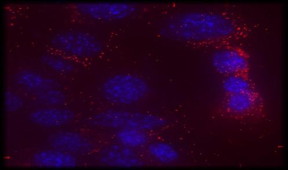 Bubbly extracellular vesicles (in red), carrying a combination of therapeutic drugs and genes, target breast cancer cells (in blue) in mice. Courtesy photo.
Abstract: Healthy cells in our body release nano-sized bubbles that transfer genetic material such as DNA and RNA to other cells. It's your DNA that stores the important information necessary for RNA to produce proteins and make sure they act accordingly.
East Lansing, MI | Posted on September 18th, 2019
These bubbly extracellular vesicles could become mini treatment transporters, carrying a combination of therapeutic drugs and genes that target cancer cells and kill them, according to new research from Michigan State University and Stanford University.
The study, which focused on breast cancer cells in mice, is published in Molecular Cancer Therapeutics.
"What we've done is improve a therapeutic approach to delivering enzyme-producing genes that can convert certain drugs into toxic agents and target tumors," said Masamitsu Kanada, lead author and an assistant professor of pharmacology and toxicology in MSU's Institute for Quantitative Health Science and Engineering.
These drugs, or prodrugs, start out as inactive compounds. But once they metabolize in the body, they're immediately activated and can get to work on fighting everything from cancer to headaches. Aspirin is an example of a common prodrug.
In this case, researchers used extracellular vesicles, or EVs, to deliver the enzyme-producing genes that could activate a prodrug combination therapy of ganciclovir and CB1954 in breast cancer cells. Minicircle DNA and regular plasmid - two different gene vectors that act as additional delivery mechanisms for DNA - were loaded into the vesicles to see which was better at helping transport treatment. This is known as a gene-directed enzyme, prodrug therapy.
They found that the minicircle DNA was 14 times more effective at delivery and even more successful at killing cancerous tumors.
"Interestingly, the plasmid delivery method didn't show any tumor cell killing," Kanada said. "Yet the minicircle DNA-based therapy killed more than half of the breast cancer cells in the mice."
According to Kanada, this new approach could effectively become a better cancer treatment option than chemotherapy down the road.
"Conventional chemotherapy isn't able to differentiate between tumors and normal tissue, so it attacks it all," Kanada said. "This non-specificity can cause severe side effects and insufficient drug concentration in tumors."
With EVs, treatment can be targeted and because of their compatibility with the human body, this type of delivery could minimize the risk of unwanted immune responses that can come with other gene therapies.
"If EVs prove to be effective in humans, it would be an ideal platform for gene delivery and it could be used in humans sooner than we expect," Kanada said.
A phase-one clinical trial, separate from Kanada's work, is set to start soon in the U.S. and will use EVs and a type of therapeutic RNA molecule for the treatment of metastatic pancreatic cancer.
While that trial moves forward, Kanada and his team will continue to further engineer and test EVs, improving their effectiveness and safety so using them as a cancer-fighting gene therapy in humans becomes reality.
###
The study was funded in part by the National Institutes of Health.
####
About Michigan State UniversityMichigan State University has been working to advance the common good in uncommon ways for more than 160 years. One of the top research universities in the world, MSU focuses its vast resources on creating solutions to some of the world's most pressing challenges, while providing life-changing opportunities to a diverse and inclusive academic community through more than 200 programs of study in 17 degree-granting colleges.
For more information, please click here
Contacts:Sarina Gleason
517-355-9742
Copyright © Michigan State University
If you have a comment, please Contact us.
Issuers of news releases, not 7th Wave, Inc. or Nanotechnology Now, are solely responsible for the accuracy of the content.
Bookmark:


News and information
 Two opposing approaches could give lithium-sulfur batteries a leg up over lithium-ion July 1st, 2022
Efficiently processing high-quality periodic nanostructures with ultrafast laser July 1st, 2022
Photonic synapses with low power consumption and high sensitivity are expected to integrate sensing-memory-preprocessing capabilities July 1st, 2022
Cancer
New technology helps reveal inner workings of human genome June 24th, 2022
New nano-gel to protect children receiving chemotherapy from hearing loss June 17th, 2022
Electron-phonon coupling assisted universal red luminescence of o-phenylenediamine-based CDs June 10th, 2022
Emerging vaccine nanotechnology June 3rd, 2022
Govt.-Legislation/Regulation/Funding/Policy
Solving the solar energy storage problem with rechargeable batteries that can convert and store energy at once June 24th, 2022
Boron nitride nanotube fibers get real: Rice lab creates first heat-tolerant, stable fibers from wet-spinning process June 24th, 2022
UBCO researchers change the game when it comes to activity tracking: Flexible, highly sensitive motion device created by extrusion printing June 17th, 2022
University of Illinois Chicago joins Brookhaven Lab's Quantum Center June 10th, 2022
Possible Futures
Sieving carbons: Ideal anodes for high-energy sodium-ion batteries July 1st, 2022
An artificial intelligence probe help see tumor malignancy July 1st, 2022
Photon-controlled diode: an optoelectronic device with a new signal processing behavior July 1st, 2022
Nanomedicine
An artificial intelligence probe help see tumor malignancy July 1st, 2022
New technology helps reveal inner workings of human genome June 24th, 2022
Discoveries
Sieving carbons: Ideal anodes for high-energy sodium-ion batteries July 1st, 2022
Efficiently processing high-quality periodic nanostructures with ultrafast laser July 1st, 2022
Photonic synapses with low power consumption and high sensitivity are expected to integrate sensing-memory-preprocessing capabilities July 1st, 2022
Announcements
Two opposing approaches could give lithium-sulfur batteries a leg up over lithium-ion July 1st, 2022
Efficiently processing high-quality periodic nanostructures with ultrafast laser July 1st, 2022
Photonic synapses with low power consumption and high sensitivity are expected to integrate sensing-memory-preprocessing capabilities July 1st, 2022
Interviews/Book Reviews/Essays/Reports/Podcasts/Journals/White papers/Posters
Sieving carbons: Ideal anodes for high-energy sodium-ion batteries July 1st, 2022
An artificial intelligence probe help see tumor malignancy July 1st, 2022
Photon-controlled diode: an optoelectronic device with a new signal processing behavior July 1st, 2022
Nanobiotechnology
New technology helps reveal inner workings of human genome June 24th, 2022
