
| Date | 21st, Sep 2019 |
|---|
Home > Press > SMART announces a revolutionary tech to study cell nanomechanics: New research discovery enables scientists to study membrane mechanics of cell's nucleus, revolutionising the understanding of metastatic cancers as well as opening the doors for identification of stem cells for the
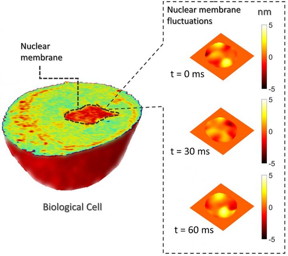 Measuring sub-nanometer membrane fluctuations for nuclear mechanics.
CREDIT
Singapore-MIT Alliance for Research and Technology
Measuring sub-nanometer membrane fluctuations for nuclear mechanics.
CREDIT
Singapore-MIT Alliance for Research and Technology
Abstract: �New confocal reflectance interferometric microscope enables scientists to probe nuclear membrane mechanics within intact cells in a label-free fashion�Nuclear mechanics is known to play a key role in many diseases including cancer metastasis and genetic illnesses such as progeria and muscular dystrophy�The label-free technology does not affect cells, allowing cell screening for therapeutic applications in which cells are injected or implanted into the human body�Existing label-free techs allow studying 'thin' cultured cells only; in contrast, the newly developed tech can enable scientists to study cells in biological tissues
Singapore and Cambridge, MA | Posted on September 20th, 2019
Researchers at Singapore-MIT Alliance for Research and Technology (SMART) and MIT's Laser Biomedical Research Center (LBRC) have developed a new way to study cells, paving the way for a better understanding of how cancers spread and become killers.
The new technology was explained in a paper titled "Studying nucleic envelope and plasma membrane mechanics of eukaryotic cells using confocal reflectance interferometric microscopy", which was published in the prestigious academic journal, Nature Communications. The new confocal reflectance interferometric microscope provides 1.5 microns depth resolution and better than 200 picometers height measurement sensitivity for high-speed characterization of nanometer scale nucleic envelope and plasma membrane fluctuations in biological cells. It enables researchers to use these fluctuations to understand key biological questions such as the role of nuclear stiffness in cancer metastasis and genetic diseases.
"Current methods for nuclear mechanics are invasive as they either require mechanical manipulation such as stretching or require injecting fluorescent probes that 'light up' the nucleus to observe its shape. Both these approaches would undesirably change cell's intrinsic properties, limiting study of cellular mechanisms, disease diagnosis, and cell-based therapies," said Dr. Vijay Raj Singh, SMART Research Scientist and Dr. Zahid Yaqoob, MIT LBRC Principal Investigator. "With the confocal reflectance interferometric microscope, we can study nuclear mechanics of biological cells without affecting their native properties."
While the scientists can study about a hundred cells in a few minutes, they believe that the system can be upgraded in the future to improve the throughput to tens of thousands of cells.
"Today, many disease mechanisms are not fully understood because we lack a way to look at how cells' nucleus changes when it undergoes stress," said Dr. Peter So, SMART BioSyM Principal Investigator, , MIT Professor, and LBRC MIT Director. "For example, people often do not die from the primary cancer, but from the secondary cancers that form after the cancer cells metastasize from the primary site - and doctors do not know why cancer becomes aggressive and when it happens. Nuclear mechanics plays a vital role in cancer metastasis as the cancer cells must 'squeeze' through the blood vessel walls into the blood stream and again when they enter a new location. This is why the ability to study nuclear mechanics is so important to our understanding of cancer formation, diagnostics, and treatment."
With the new interferometric microscope, scientists at LBRC are studying cancer cells when they undergo mechanical stress, especially during extravasation process, paving the way for new cancer treatments. Further, the scientists are also able to use the same technology to study the effect of 'lamin mutations' on nuclear mechanics, which result in rare genetic diseases such as Progeria that leads to fast aging in young children.
The confocal reflectance interferometric microscope also has applications in other sectors as well. For example, this technology has the potential for studying cellular mechanics within intact living tissues. With the new technology, the scientists could shed new light on biological processes within the body's major organs such as liver, allowing safer and more accurate cell therapies. Cell therapy is a major focus area for Singapore, with the government recently announcing a S$80m boost to the manufacturing of living cells as medicine.
###
About BioSyM
BioSystems and Micromechanics (BioSyM) Inter-Disciplinary Research Group brings together a multidisciplinary team of faculties and researchers from MIT and the universities and research institutes of Singapore. BioSyM's research deals with the development of new technologies to address critical medical and biological questions applicable to a variety of diseases with an aim to provide novel solutions to the healthcare industry and to the broader research infrastructure in Singapore. The guiding tenet of BioSyM is that accelerated progress in biology and medicine will critically depend upon the development of modern analytical methods and tools that provide a deep understanding of the interactions between mechanics and biology at multiple length scales - from molecules to cells to tissues - that impact maintenance or disruption of human health.
For more information, please visit: http://web.mit.edu/smart/research/biosym/BioSyM%20-%20Home1.html
About BioSyM
BioSystems and Micromechanics (BioSyM) Inter-Disciplinary Research Group brings together a multidisciplinary team of faculties and researchers from MIT and the universities and research institutes of Singapore. BioSyM's research deals with the development of new technologies to address critical medical and biological questions applicable to a variety of diseases with an aim to provide novel solutions to the healthcare industry and to the broader research infrastructure in Singapore. The guiding tenet of BioSyM is that accelerated progress in biology and medicine will critically depend upon the development of modern analytical methods and tools that provide a deep understanding of the interactions between mechanics and biology at multiple length scales - from molecules to cells to tissues - that impact maintenance or disruption of human health.
For more information, please visit: http://web.mit.edu/smart/research/biosym/BioSyM%20-%20Home1.html
####
About Singapore-MIT Alliance for Research and TechnologySingapore-MIT Alliance for Research and Technology (SMART) is MIT's Research Enterprise in Singapore, established by the Massachusetts Institute of Technology (MIT) in partnership with the National Research Foundation of Singapore (NRF) since 2007. SMART is the first entity in the Campus for Research Excellence and Technological Enterprise (CREATE) developed by NRF. SMART serves as an intellectual and innovation hub for research interactions between MIT and Singapore. Cutting-edge research projects in areas of interest to both Singapore and MIT are undertaken at SMART. SMART currently comprises an Innovation Centre and six Interdisciplinary Research Groups (IRGs): Antimicrobial Resistance (AMR), BioSystems and Micromechanics (BioSyM), Critical Analytics for Manufacturing Personalized-Medicine (CAMP), Disruptive & Sustainable Technologies for Agricultural Precision (DiSTAP), Future Urban Mobility (FM) and Low Energy Electronic Systems (LEES).
SMART research is funded by the National Research Foundation Singapore under the CREATE programme. For more information, please visit - http://smart.mit.edu
Laser Biomedical Research Center (LBRC)
Established in 1985, the Laser Biomedical Research Center is a National Research Resource Center supported by the National Institute of Biomedical Imaging and Bioengineering (NIBIB), a Biomedical Technology Resource Center of the National Institutes of Health. The LBRC's mission is to develop the basic scientific understanding and new techniques required for advancing the clinical applications of lasers and spectroscopy. Researchers at the LBRC develop laser-based microscopy and spectroscopy techniques for medical applications such as the spectral diagnosis of various diseases and investigation of biophysical and biochemical properties of cells and tissues. A unique feature of the LBRC is its ability to form strong clinical collaborations with outside investigators in areas of common interest that further the Center's mandated research objectives. For more information, visit https://lbrc.mit.edu/ .
For more information, please click here
Contacts:Tazkira Shafat Sattar
658-280-3055
Copyright © Singapore-MIT Alliance for Research and Technology
If you have a comment, please Contact us.
Issuers of news releases, not 7th Wave, Inc. or Nanotechnology Now, are solely responsible for the accuracy of the content.
Bookmark:


Imaging
 An artificial intelligence probe help see tumor malignancy July 1st, 2022
News and information
Two opposing approaches could give lithium-sulfur batteries a leg up over lithium-ion July 1st, 2022
Efficiently processing high-quality periodic nanostructures with ultrafast laser July 1st, 2022
Photonic synapses with low power consumption and high sensitivity are expected to integrate sensing-memory-preprocessing capabilities July 1st, 2022
Cancer
New technology helps reveal inner workings of human genome June 24th, 2022
New nano-gel to protect children receiving chemotherapy from hearing loss June 17th, 2022
Electron-phonon coupling assisted universal red luminescence of o-phenylenediamine-based CDs June 10th, 2022
Emerging vaccine nanotechnology June 3rd, 2022
Possible Futures
Sieving carbons: Ideal anodes for high-energy sodium-ion batteries July 1st, 2022
An artificial intelligence probe help see tumor malignancy July 1st, 2022
Photon-controlled diode: an optoelectronic device with a new signal processing behavior July 1st, 2022
Nanomedicine
An artificial intelligence probe help see tumor malignancy July 1st, 2022
New technology helps reveal inner workings of human genome June 24th, 2022
Announcements
Two opposing approaches could give lithium-sulfur batteries a leg up over lithium-ion July 1st, 2022
Efficiently processing high-quality periodic nanostructures with ultrafast laser July 1st, 2022
Photonic synapses with low power consumption and high sensitivity are expected to integrate sensing-memory-preprocessing capabilities July 1st, 2022
Interviews/Book Reviews/Essays/Reports/Podcasts/Journals/White papers/Posters
Sieving carbons: Ideal anodes for high-energy sodium-ion batteries July 1st, 2022
An artificial intelligence probe help see tumor malignancy July 1st, 2022
Photon-controlled diode: an optoelectronic device with a new signal processing behavior July 1st, 2022
Research partnerships
New technology helps reveal inner workings of human genome June 24th, 2022
Boron nitride nanotube fibers get real: Rice lab creates first heat-tolerant, stable fibers from wet-spinning process June 24th, 2022
