
| Date | 21st, Sep 2019 |
|---|
Home > Press > Nano bulb lights novel path: Rice University engineers create tunable, nanoscale, incandescent light source
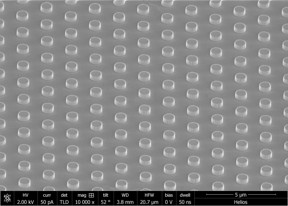 An electron microscope image shows an array of thermal light emitters created by Rice University engineers. The emitters are able to deliver highly configurable thermal light. (Credit: The Naik Lab/Rice University)
CREDIT
The Naik Lab/Rice University
An electron microscope image shows an array of thermal light emitters created by Rice University engineers. The emitters are able to deliver highly configurable thermal light. (Credit: The Naik Lab/Rice University)
CREDIT
The Naik Lab/Rice University
Abstract: What may be viewed as the world's smallest incandescent lightbulb is shining in a Rice University engineering laboratory with the promise of advances in sensing, photonics and perhaps computing platforms beyond the limitations of silicon.
Houston, TX | Posted on September 20th, 2019
Gururaj Naik of Rice's Brown School of Engineering and graduate student Chloe Doiron have assembled unconventional "selective thermal emitters" -- collections of near-nanoscale materials that absorb heat and emit light.
Their research, reported in Advanced Materials, one-ups a recent technique developed by the lab that uses carbon nanotubes to channel heat from mid-infrared radiation to improve the efficiency of solar energy systems.
The new strategy combines several known phenomena into a unique configuration that also turns heat into light -- but in this case, the system is highly configurable.
Basically, Naik said, the researchers made an incandescent light source by breaking down a one-element system -- the glowing filament in a bulb -- into two or more subunits. Mixing and matching the subunits could give the system a variety of capabilities.
"The previous paper was all about making solar cells more efficient," said Naik, an assistant professor of electrical and computer engineering. "This time, the breakthrough is more in the science than the application. Basically, our goal was to build a nanoscale thermal light source with specific properties, like emitting at a certain wavelength, or emitting extremely bright or new thermal light states.
"Previously, people thought of a light source as just one element and tried to get the best out of it," he said. "But we break the source into many tiny elements. We put sub-elements together in such a fashion that they interact with each other. One element may give brightness; the next element could be tuned to provide wavelength specificity. We share the burden among many small parts.
"The idea is to rely upon collective behavior, not just a single element," Naik said. "Breaking the filament into many pieces gives us more degrees of freedom to design the functionality."
The system relies on non-Hermitian physics, a quantum mechanical way to describe "open" systems that dissipate energy -- in this case, heat -- rather than retain it. In their experiments, Naik and Doiron combined two kinds of near-nanoscale passive oscillators that are electromagnetically coupled when heated to about 700 degrees Celsius. When the metallic oscillator emitted thermal light, it triggered the coupled silicon disk to store the light and release in the desired manner, Naik said.
The light-emitting resonator's output, Doiron said, can be controlled by damping the lossy resonator or by controlling the level of coupling through a third element between the resonators. "Brightness and the selectivity trade off," she said. "Semiconductors give you a high selectivity but low brightness, while metals give you very bright emission but low selectivity. Just by coupling these elements, we can get the best of both worlds."
"The potential scientific impact is that we can do this not just with two elements, but many more," Naik said. "The physics would not change."
He noted that though commercial incandescent bulbs have given way to LEDs for their energy efficiency, incandescent lamps are still the only practical means to produce infrared light. "Infrared detection and sensing both rely on these sources," Naik said. "What we've created is a new way to build light sources that are bright, directional and emit light in specific states and wavelengths, including infrared."
The opportunities for sensing lie at the system's "exceptional point," he said.
"There's an optical phase transition because of how we've coupled these two resonators," Naik said. "Where this happens is called the exceptional point, because it's exceptionally sensitive to any perturbation around it. That makes these devices suitable for sensors. There are sensors with microscale optics, but nothing has been shown in devices that employ nanophotonics."
The opportunities may also be great for next-level classical computing. "The International Roadmap for Semiconductor Technology (ITRS) understands that semiconductor technology is reaching saturation and they're thinking about what next-generation switches will replace silicon transistors," Naik said. "ITRS has predicted that will be an optical switch, and that it will use the concept of parity-time symmetry, as we do here, because the switch has to be unidirectional. It sends light in the direction we want, and none comes back, like a diode for light instead of electricity."
###
The National Science Foundation supported the research.
####
About Rice UniversityLocated on a 300-acre forested campus in Houston, Rice University is consistently ranked among the nation's top 20 universities by U.S. News & World Report. Rice has highly respected schools of Architecture, Business, Continuing Studies, Engineering, Humanities, Music, Natural Sciences and Social Sciences and is home to the Baker Institute for Public Policy. With 3,962 undergraduates and 3,027 graduate students, Rice's undergraduate student-to-faculty ratio is just under 6-to-1. Its residential college system builds close-knit communities and lifelong friendships, just one reason why Rice is ranked No. 1 for lots of race/class interaction and No. 4 for quality of life by the Princeton Review. Rice is also rated as a best value among private universities by Kiplinger's Personal Finance.
Follow Rice News and Media Relations via Twitter @RiceUNews.
For more information, please click here
Contacts:Jade Boyd
713-348-6778
Copyright © Rice University
If you have a comment, please Contact us.
Issuers of news releases, not 7th Wave, Inc. or Nanotechnology Now, are solely responsible for the accuracy of the content.
Bookmark:


 Rice device channels heat into light:
Department of Electrical and Computer Engineering:
George R. Brown School of Engineering:
News and information
Two opposing approaches could give lithium-sulfur batteries a leg up over lithium-ion July 1st, 2022
Efficiently processing high-quality periodic nanostructures with ultrafast laser July 1st, 2022
Photonic synapses with low power consumption and high sensitivity are expected to integrate sensing-memory-preprocessing capabilities July 1st, 2022
Govt.-Legislation/Regulation/Funding/Policy
Solving the solar energy storage problem with rechargeable batteries that can convert and store energy at once June 24th, 2022
Boron nitride nanotube fibers get real: Rice lab creates first heat-tolerant, stable fibers from wet-spinning process June 24th, 2022
UBCO researchers change the game when it comes to activity tracking: Flexible, highly sensitive motion device created by extrusion printing June 17th, 2022
University of Illinois Chicago joins Brookhaven Lab's Quantum Center June 10th, 2022
Possible Futures
Sieving carbons: Ideal anodes for high-energy sodium-ion batteries July 1st, 2022
An artificial intelligence probe help see tumor malignancy July 1st, 2022
Photon-controlled diode: an optoelectronic device with a new signal processing behavior July 1st, 2022
Chip Technology
Photon-controlled diode: an optoelectronic device with a new signal processing behavior July 1st, 2022
Photonic synapses with low power consumption and high sensitivity are expected to integrate sensing-memory-preprocessing capabilities July 1st, 2022
Nanotubes/Buckyballs/Fullerenes/Nanorods
Boron nitride nanotube fibers get real: Rice lab creates first heat-tolerant, stable fibers from wet-spinning process June 24th, 2022
Nanotubes: a promising solution for advanced rubber cables with 60% less conductive filler June 1st, 2022
Protective equipment with graphene nanotubes meets the strictest ESD safety standards March 25th, 2022
CEA and Startup C12 Join Forces to Develop Next-Generation Quantum Computers with Multi-Qubit Chips at Wafer Scale March 25th, 2022
Optical computing/Photonic computing
Photon-controlled diode: an optoelectronic device with a new signal processing behavior July 1st, 2022
Efficiently processing high-quality periodic nanostructures with ultrafast laser July 1st, 2022
Photonic synapses with low power consumption and high sensitivity are expected to integrate sensing-memory-preprocessing capabilities July 1st, 2022
Sensors
Photonic synapses with low power consumption and high sensitivity are expected to integrate sensing-memory-preprocessing capabilities July 1st, 2022
Photonic integrated erbium doped amplifiers reach commercial performance: Boosting light power revolutionizes communications and autopilots June 17th, 2022
A one-stop shop for quantum sensing materials May 27th, 2022
Nanoelectronics
Controlled synthesis of crystal flakes paves path for advanced future electronics June 17th, 2022
Eyebrow-raising: Researchers reveal why nanowires stick to each other February 11th, 2022
Visualizing temperature transport: An unexpected technique for nanoscale characterization November 19th, 2021
Discoveries
Sieving carbons: Ideal anodes for high-energy sodium-ion batteries July 1st, 2022
Efficiently processing high-quality periodic nanostructures with ultrafast laser July 1st, 2022
Photonic synapses with low power consumption and high sensitivity are expected to integrate sensing-memory-preprocessing capabilities July 1st, 2022
Announcements
Two opposing approaches could give lithium-sulfur batteries a leg up over lithium-ion July 1st, 2022
Efficiently processing high-quality periodic nanostructures with ultrafast laser July 1st, 2022
Photonic synapses with low power consumption and high sensitivity are expected to integrate sensing-memory-preprocessing capabilities July 1st, 2022
Interviews/Book Reviews/Essays/Reports/Podcasts/Journals/White papers/Posters
Sieving carbons: Ideal anodes for high-energy sodium-ion batteries July 1st, 2022
An artificial intelligence probe help see tumor malignancy July 1st, 2022
Photon-controlled diode: an optoelectronic device with a new signal processing behavior July 1st, 2022
Energy
Key in increasing efficiency of next-generation solar cell, found in �light absorption capacity�! July 1st, 2022
Solving the solar energy storage problem with rechargeable batteries that can convert and store energy at once June 24th, 2022
Organic water splitters get a boost June 10th, 2022
Photonics/Optics/Lasers
Photon-controlled diode: an optoelectronic device with a new signal processing behavior July 1st, 2022
Efficiently processing high-quality periodic nanostructures with ultrafast laser July 1st, 2022
Photonic synapses with low power consumption and high sensitivity are expected to integrate sensing-memory-preprocessing capabilities July 1st, 2022
Solar/Photovoltaic
Key in increasing efficiency of next-generation solar cell, found in �light absorption capacity�! July 1st, 2022
Solving the solar energy storage problem with rechargeable batteries that can convert and store energy at once June 24th, 2022
USTC found a pathway to high-quality ZnSe quantum wires April 8th, 2022
Graphene crystals grow better under copper cover April 1st, 2022
