
| Date | 27th, Sep 2019 |
|---|
Home > Press > Physicists found weak spots in ceramic/graphene composites: Physicists found out the structures in nanomaterials made of ceramic and graphene plates, in which cracks appear most frequently
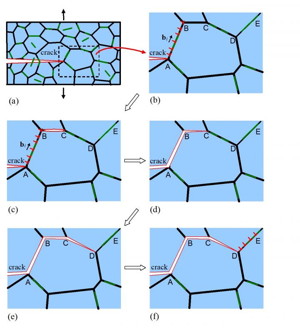 Crack propagation over grain boundaries in the composite. Graphene plates are marked by green lines.
CREDIT
Peter the Great St.Petersburg Polytechnic University
Crack propagation over grain boundaries in the composite. Graphene plates are marked by green lines.
CREDIT
Peter the Great St.Petersburg Polytechnic University
Abstract: Physicists and materials scientists from Peter the Great St.Petersburg Polytechnic University (SPbPU) found out the structures in nanomaterials made of ceramic and graphene plates, in which cracks appear most frequently. The results of the first trial of the model, that describes the found regularity, were published in the Mechanics of Materials Journal. This model will help in creation of crack-resistant materials. The research was supported by the Russian Science Foundation grant.
Saint Petersburg, Russia | Posted on September 27th, 2019
Graphene is the lightest and strongest carbon modification. Moreover, it has a very high electrical conductivity. Because of these characteristics graphene is often included in the composition of new ceramic-based materials. Ceramics are resistant to high temperatures, and, if carbon modifications are added, the composites become multifunctional. In the future they can be used in production of flexible electronic devices, sensors, in construction and aviation.
It is known from many experimental studies of such composites that their mechanic characteristics are set by the graphene proportion in the composition and by the size of graphene plates allocated in the ceramic matrix. For example, in case of low graphene concentration high crack resistance was achieved with the help of long plates. However, in one of the recent experiments of synthesis of materials from alumina ceramics and graphene the opposite effect was shown: as the plates were bigger, the crack resistance was weaker. The researches from Saint Petersburg have developed a theoretical model that explains this paradox.
The SPbPU physicists of the of the Advanced Manufacturing Technologies Center of the National Technology Initiative (NTI) of Peter the Great St. Petersburg Polytechnic University supposed that the formation of cracks in the composites is connected with the boundaries of so-called ceramic grains - microscopic crystals that form the material. Graphene plates in the composites can be located both at the boundaries of ceramic grains and inside grains. In the course of the tensile deformation of nanocrystalline materials, the grains slide relative to each other, and the cracks spread over their boundaries. But why do graphene additions stop this process in some cases and not stop it in others? To find the answer, the scientists developed a mathematical model that takes into account the tensile load, the force of friction, elastic moduli of the composite, and the correlation between the dimensions of ceramic grains and graphene plates. With the help of the model the scientists computed the critical values of the stress intensity factor for three different composites. When these values were exceeded, cracks spread all over in the material. The composites varied in the size of ceramic grains (from 1.23 to 1.58 micrometers) and the length and width of graphene plates (from 193 to 1070 and from 109 to 545 nanometers).
It was found that the closer the length of graphene plates to the length of grain boundary lines, the lower the critical value of the stress intensity factor. The value difference for different materials comes up to 20%. It is congruent to experimental data published earlier: just at close values of grain boundary length and the length of graphene plates the crack resistance of the material dropped. This implies that to make the material stronger, graphene plates must be substantially smaller in length that ceramic grains.
"The found regularity is valid for fine-grained ceramics, and, after all, by reducing the grain size, the creators of new composite materials add more functionality to them," explains Alexander Sheinerman, Doctor of Physical and Mathematical Sciences, the head of research laboratory "The Mechanics of New Nanomaterials" of the Advanced Manufacturing Technologies Center of the National Technology Initiative NTI SPbPU. "Therewith, the effects of grain refinement can be contradictory, for example, the hardness rises, but the material becomes more fragile. Our model helps to pick the correlation of the graphene plate size and the size of grains, which provide better mechanic and functional characteristics.
####
For more information, please click here
Contacts:Raisa Bestugina
7-812-591-6675
Copyright © Peter the Great Saint-Petersburg Polytechnic University
If you have a comment, please Contact us.
Issuers of news releases, not 7th Wave, Inc. or Nanotechnology Now, are solely responsible for the accuracy of the content.
Bookmark:


News and information
 Two opposing approaches could give lithium-sulfur batteries a leg up over lithium-ion July 1st, 2022
Efficiently processing high-quality periodic nanostructures with ultrafast laser July 1st, 2022
Photonic synapses with low power consumption and high sensitivity are expected to integrate sensing-memory-preprocessing capabilities July 1st, 2022
Graphene/ Graphite
OCSiAl expands its graphene nanotube production capacities to Europe June 17th, 2022
Bumps could smooth quantum investigations: Rice University models show unique properties of 2D materials stressed by contoured substrates June 10th, 2022
Nanotubes: a promising solution for advanced rubber cables with 60% less conductive filler June 1st, 2022
Dynamic metasurfaces and metadevices empowered by graphene May 6th, 2022
Govt.-Legislation/Regulation/Funding/Policy
Solving the solar energy storage problem with rechargeable batteries that can convert and store energy at once June 24th, 2022
Boron nitride nanotube fibers get real: Rice lab creates first heat-tolerant, stable fibers from wet-spinning process June 24th, 2022
UBCO researchers change the game when it comes to activity tracking: Flexible, highly sensitive motion device created by extrusion printing June 17th, 2022
University of Illinois Chicago joins Brookhaven Lab's Quantum Center June 10th, 2022
Possible Futures
Sieving carbons: Ideal anodes for high-energy sodium-ion batteries July 1st, 2022
An artificial intelligence probe help see tumor malignancy July 1st, 2022
Photon-controlled diode: an optoelectronic device with a new signal processing behavior July 1st, 2022
Discoveries
Sieving carbons: Ideal anodes for high-energy sodium-ion batteries July 1st, 2022
Efficiently processing high-quality periodic nanostructures with ultrafast laser July 1st, 2022
Photonic synapses with low power consumption and high sensitivity are expected to integrate sensing-memory-preprocessing capabilities July 1st, 2022
Materials/Metamaterials
New protocol for assessing the safety of nanomaterials July 1st, 2022
Nanotubes: a promising solution for advanced rubber cables with 60% less conductive filler June 1st, 2022
New route to build materials out of tiny particles May 27th, 2022
A one-stop shop for quantum sensing materials May 27th, 2022
Announcements
Two opposing approaches could give lithium-sulfur batteries a leg up over lithium-ion July 1st, 2022
Efficiently processing high-quality periodic nanostructures with ultrafast laser July 1st, 2022
Photonic synapses with low power consumption and high sensitivity are expected to integrate sensing-memory-preprocessing capabilities July 1st, 2022
Interviews/Book Reviews/Essays/Reports/Podcasts/Journals/White papers/Posters
Sieving carbons: Ideal anodes for high-energy sodium-ion batteries July 1st, 2022
An artificial intelligence probe help see tumor malignancy July 1st, 2022
Photon-controlled diode: an optoelectronic device with a new signal processing behavior July 1st, 2022
