
| Date | 27th, Sep 2019 |
|---|
Home > Press > Turning heat into electricity: A new thermoelectric material developed at FEFU: Young scientists from FEFU manufactured new thermoelectric material based on strontium titanate and titanium oxide
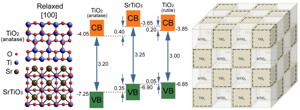 Graphical abstract
CREDIT
FEFU press-office
Graphical abstract
CREDIT
FEFU press-office
Abstract: Young scientists from Far Eastern Federal University (FEFU) developed the concept and manufactured samples of a new thermoelectric material -- biphase nanoceramics based on strontium titanate SrTiO3 and titanium oxide TiO2. It can help to transform exhaust heat (heat losses amounting to about 60% of heat exchange) into electrical energy and to protect devices operating at temperatures above 1,000�? from overheating. The article was published in the special Advanced Thermoelectric Materials issue of the Materials journal.
Vladivostok, Russia | Posted on September 27th, 2019
The team from FEFU worked together with scientists from the Institute of Chemistry of the Far Eastern Department of the Russian Academy of Sciences and has already obtained the first experimental samples of biphase nanoceramics. The material has high mechanical performance, thermal, and chemical resistance. The team is currently testing its thermoelectric properties.
'Many technological properties cause the emission of exhaust heat at high temperatures. For example, the temperature on the outer side of an exhaust pipe can reach about 700�C. In these conditions popular thermoelectric materials based on bismuth telluride Bi2Te3 and lead telluride PbTe face increased risks of thermal breakdown which may lead to environmental pollution with heavy metals. Our task was to develop a high-quality thermoelectric material that would be chemically stable and resistant to high temperatures,' said Alexey Zavjalov, a researcher at the School of Natural Sciences, FEFU, who developed the composition of the new material.
The team from FEFU suggested a biphase ceramic system based on metal oxides: strontium titanate SrTiO3 and titanium oxide TiO2. The oxides have high thermal and chemical resistance at temperatures above 1,000� but do not show excellent thermoelectric properties on their own. The biphase structure and nanosized grains considerably increase the material's thermoelectric efficacy.
Increased density and mechanical performance of the material along with the nanosize of its grains and high concentration of intergranular boundaries are important properties for extreme temperature conditions. In the new material they were obtained by means of high-speed consolidation of SrCO3 and anatase TiO2 nanopowders under pressure. This process is called reactive spark plasma sintering.
'The new material may be used not only for secondary exhaust heat processing, but also as a part of high-tech applications as an active heat buffer. TiO2-SrTiO3 based nanoceramics can increase the service life and characteristics of devices that operate at temperatures above 1,000�,' said Denis Kosyanov, a senior researcher at the Center for National Technological Initiatives, FEFU, and the head of the group.
The team of young researchers from FEFU won a grant of the Russian Foundation for Basic Research for the development of new materials for laser technologies based on 'optical ceramics - thermoelectrics' heterostructures in 2018. The concept of the new thermoelectric ceramics is a result of grant work.
###
FEFU runs a Materials priority project, and a Center for National Technological Initiatives in Neurotechnologies, VR/AR Technologies (grant No. 1/1251/2018 dated October 16, 2018). The researchers working in these areas develop scientific and technical bases for multifunctional ceramic materials to be used in microelectronics, lighting technologies, and radiochemistry.
The research was carried out within the framework of grant No. 18-29-11044 provided by the Russian Foundation for Basic Research.
####
For more information, please click here
Contacts:Alexander Zverev
Copyright © Far Eastern Federal University
If you have a comment, please Contact us.
Issuers of news releases, not 7th Wave, Inc. or Nanotechnology Now, are solely responsible for the accuracy of the content.
Bookmark:


News and information
 Two opposing approaches could give lithium-sulfur batteries a leg up over lithium-ion July 1st, 2022
Efficiently processing high-quality periodic nanostructures with ultrafast laser July 1st, 2022
Photonic synapses with low power consumption and high sensitivity are expected to integrate sensing-memory-preprocessing capabilities July 1st, 2022
Govt.-Legislation/Regulation/Funding/Policy
Solving the solar energy storage problem with rechargeable batteries that can convert and store energy at once June 24th, 2022
Boron nitride nanotube fibers get real: Rice lab creates first heat-tolerant, stable fibers from wet-spinning process June 24th, 2022
UBCO researchers change the game when it comes to activity tracking: Flexible, highly sensitive motion device created by extrusion printing June 17th, 2022
University of Illinois Chicago joins Brookhaven Lab's Quantum Center June 10th, 2022
Possible Futures
Sieving carbons: Ideal anodes for high-energy sodium-ion batteries July 1st, 2022
An artificial intelligence probe help see tumor malignancy July 1st, 2022
Photon-controlled diode: an optoelectronic device with a new signal processing behavior July 1st, 2022
Discoveries
Sieving carbons: Ideal anodes for high-energy sodium-ion batteries July 1st, 2022
Efficiently processing high-quality periodic nanostructures with ultrafast laser July 1st, 2022
Photonic synapses with low power consumption and high sensitivity are expected to integrate sensing-memory-preprocessing capabilities July 1st, 2022
Materials/Metamaterials
New protocol for assessing the safety of nanomaterials July 1st, 2022
Nanotubes: a promising solution for advanced rubber cables with 60% less conductive filler June 1st, 2022
New route to build materials out of tiny particles May 27th, 2022
A one-stop shop for quantum sensing materials May 27th, 2022
Announcements
Two opposing approaches could give lithium-sulfur batteries a leg up over lithium-ion July 1st, 2022
Efficiently processing high-quality periodic nanostructures with ultrafast laser July 1st, 2022
Photonic synapses with low power consumption and high sensitivity are expected to integrate sensing-memory-preprocessing capabilities July 1st, 2022
Interviews/Book Reviews/Essays/Reports/Podcasts/Journals/White papers/Posters
Sieving carbons: Ideal anodes for high-energy sodium-ion batteries July 1st, 2022
An artificial intelligence probe help see tumor malignancy July 1st, 2022
Photon-controlled diode: an optoelectronic device with a new signal processing behavior July 1st, 2022
Battery Technology/Capacitors/Generators/Piezoelectrics/Thermoelectrics/Energy storage
Sieving carbons: Ideal anodes for high-energy sodium-ion batteries July 1st, 2022
Two opposing approaches could give lithium-sulfur batteries a leg up over lithium-ion July 1st, 2022
Solving the solar energy storage problem with rechargeable batteries that can convert and store energy at once June 24th, 2022
OCSiAl expands its graphene nanotube production capacities to Europe June 17th, 2022
