
| Date | 27th, Sep 2019 |
|---|
Home > Press > Machine learning at the quantum lab
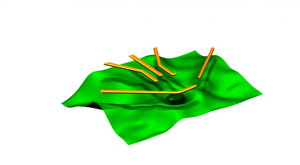 Artistic illustration of the potential landscape defined by voltages applied to nanostructures in order to trap single electrons in a quantum dot.
CREDIT
Department of Physics, University of Basel
Artistic illustration of the potential landscape defined by voltages applied to nanostructures in order to trap single electrons in a quantum dot.
CREDIT
Department of Physics, University of Basel
Abstract: For several years, the electron spin of individual electrons in a quantum dot has been identified as an ideal candidate for the smallest information unit in a quantum computer, otherwise known as a qubit.
Machine learning at the quantum lab
Basel, Switzerland | Posted on September 27th, 2019
Controlled via applied voltages
In quantum dots made of layered semiconductor materials, individual electrons are caught in a trap, so to speak. Their spins can be determined reliably and switched quickly, with researchers keeping the electrons under control by applying voltages to the various nanostructures within the trap. Among other things, this allows them to control how many electrons enter the quantum dot from a reservoir via tunneling effects. Here, even small changes in voltage have a considerable influence on the electrons.
For each quantum dot, the applied voltages must therefore be tuned carefully in order to achieve the optimum conditions. When several quantum dots are combined to scale the device up to a large number of qubits, this tuning process becomes enormously time-consuming because the semiconductor quantum dots are not completely identical and must each be characterized individually.
Automation thanks to machine learning
Now, scientists from the Universities of Oxford, Basel, and Lancaster have developed an algorithm that can help to automate this process. Their machine-learning approach reduces the measuring time and the number of measurements by a factor of approximately four in comparison with conventional data acquisition.
First, the scientists train the machine with data on the current flowing through the quantum dot at different voltages. Like facial recognition technology, the software gradually learns where further measurements are needed with a view to achieving the maximum information gain. The system then performs these measurements and repeats the process until effective characterization is achieved according to predefined criteria and the quantum dot can be used as a qubit.
"For the first time, we've applied machine learning to perform efficient measurements in gallium arsenide quantum dots, thereby allowing for the characterization of large arrays of quantum devices," says Dr. Natalia Ares from the University of Oxford. "The next step at our laboratory is now to apply the software to semiconductor quantum dots made of other materials that are better suited to the development of a quantum computer," adds Professor Dr. Dominik Zumb�hl from the Department of Physics and the Swiss Nanoscience Institute at the University of Basel. "With this work, we've made a key contribution that will pave the way for large-scale qubit architectures."
####
For more information, please click here
Contacts:Dr. Natalia Ares Materials Department, Oxford University 16 Parks Road Oxford, OX1 3PH, UK Tel: +44 (0)1865 273719
Prof. Dr. Dominik M. Zumb�hl Department of Physics, University of Basel Klingelbergstrasse 82 4056 Basel, Switzerland T +41 (0)61 207 36 93
Dr. Edward Laird Department of Physics, Lancaster University Office: A051, A - Floor, Physics Building Lancaster LA1 4YB, UK Tel: +44 (0)1524 510831
Copyright © Swiss Nanoscience Institute at the University of Basel
If you have a comment, please Contact us.
Issuers of news releases, not 7th Wave, Inc. or Nanotechnology Now, are solely responsible for the accuracy of the content.
Bookmark:


News and information
 Two opposing approaches could give lithium-sulfur batteries a leg up over lithium-ion July 1st, 2022
Efficiently processing high-quality periodic nanostructures with ultrafast laser July 1st, 2022
Photonic synapses with low power consumption and high sensitivity are expected to integrate sensing-memory-preprocessing capabilities July 1st, 2022
Govt.-Legislation/Regulation/Funding/Policy
Solving the solar energy storage problem with rechargeable batteries that can convert and store energy at once June 24th, 2022
Boron nitride nanotube fibers get real: Rice lab creates first heat-tolerant, stable fibers from wet-spinning process June 24th, 2022
UBCO researchers change the game when it comes to activity tracking: Flexible, highly sensitive motion device created by extrusion printing June 17th, 2022
University of Illinois Chicago joins Brookhaven Lab's Quantum Center June 10th, 2022
Possible Futures
Sieving carbons: Ideal anodes for high-energy sodium-ion batteries July 1st, 2022
An artificial intelligence probe help see tumor malignancy July 1st, 2022
Photon-controlled diode: an optoelectronic device with a new signal processing behavior July 1st, 2022
Chip Technology
Photon-controlled diode: an optoelectronic device with a new signal processing behavior July 1st, 2022
Photonic synapses with low power consumption and high sensitivity are expected to integrate sensing-memory-preprocessing capabilities July 1st, 2022
Quantum Computing
University of Illinois Chicago joins Brookhaven Lab's Quantum Center June 10th, 2022
Bumps could smooth quantum investigations: Rice University models show unique properties of 2D materials stressed by contoured substrates June 10th, 2022
Discoveries
Sieving carbons: Ideal anodes for high-energy sodium-ion batteries July 1st, 2022
Efficiently processing high-quality periodic nanostructures with ultrafast laser July 1st, 2022
Photonic synapses with low power consumption and high sensitivity are expected to integrate sensing-memory-preprocessing capabilities July 1st, 2022
Announcements
Two opposing approaches could give lithium-sulfur batteries a leg up over lithium-ion July 1st, 2022
Efficiently processing high-quality periodic nanostructures with ultrafast laser July 1st, 2022
Photonic synapses with low power consumption and high sensitivity are expected to integrate sensing-memory-preprocessing capabilities July 1st, 2022
Interviews/Book Reviews/Essays/Reports/Podcasts/Journals/White papers/Posters
Sieving carbons: Ideal anodes for high-energy sodium-ion batteries July 1st, 2022
An artificial intelligence probe help see tumor malignancy July 1st, 2022
Photon-controlled diode: an optoelectronic device with a new signal processing behavior July 1st, 2022
Grants/Sponsored Research/Awards/Scholarships/Gifts/Contests/Honors/Records
Solving the solar energy storage problem with rechargeable batteries that can convert and store energy at once June 24th, 2022
Boron nitride nanotube fibers get real: Rice lab creates first heat-tolerant, stable fibers from wet-spinning process June 24th, 2022
Quantum Dots/Rods
New substance classes for nanomaterials: Nano spheres and diamond slivers made of silicon and germanium: Potential applications as nano semiconductor materials September 10th, 2021
�Missing jigsaw piece�: engineers make critical advance in quantum computer design August 20th, 2021
Research partnerships
New technology helps reveal inner workings of human genome June 24th, 2022
Boron nitride nanotube fibers get real: Rice lab creates first heat-tolerant, stable fibers from wet-spinning process June 24th, 2022
